Riverside in Cook County, Illinois — The American Midwest (Great Lakes)
Bourbon Spring
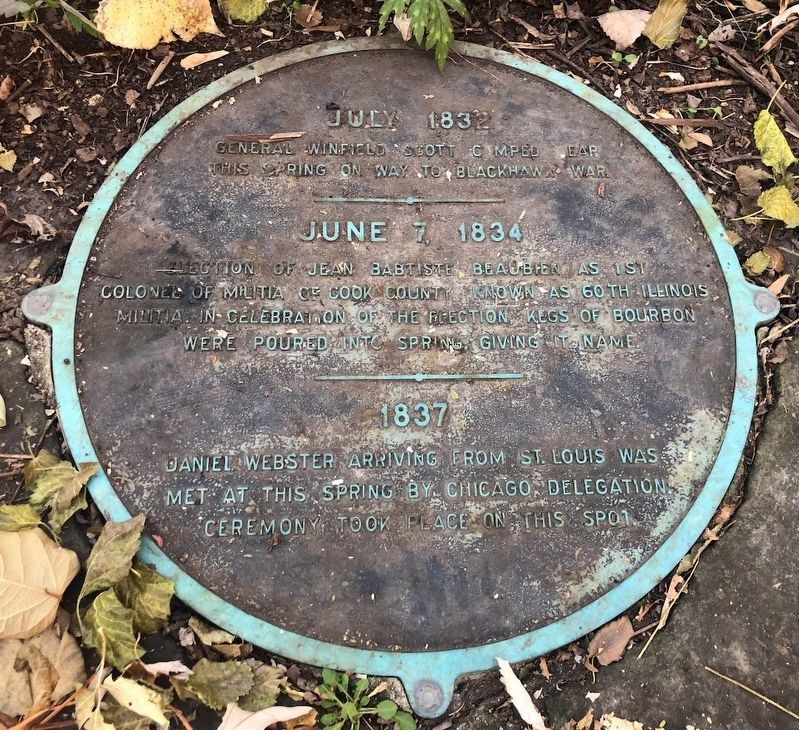
Photographed by Sean Flynn, November 13
1. Bourbon Spring Marker
General Winfield Scott camped near this spring on way to Blackhawk War.
June 7, 1834
Election of Jean Babtiste Beaubien as 1st Colonel of Militia of Cook County, known as 60th Illinois Militia. In celebration of the election, kegs of bourbon were poured into spring, giving it name.
1837
Daniel Webster arriving from St. Louis was met at this spring by Chicago delegation. Ceremony took place on this spot.
Erected 1935 by Riverside Garden Club.
Topics and series. This historical marker is listed in these topic lists: Government & Politics • Settlements & Settlers • Wars, US Indian • Waterways & Vessels. In addition, it is included in the Black Hawk War, and the Works Progress Administration (WPA) projects series lists. A significant historical month for this entry is July 1832.
Location. 41° 49.555′ N, 87° 49.318′ W. Marker is in Riverside, Illinois, in Cook County. It can be reached from the intersection of Barrypoint Road and Bloomingbank Road. The plaque is in the northeast corner of the Swan Pond park in downtown Riverside, perhaps 20 feet below street level near the Barrypoint-Bloomingbank
this page online

Regionally, this marker is in Greater Chicago. It is also in the American Midwest. Globally, it is in North America, on the Great Lakes, in the Western Hemisphere, in the Western World, and in the Anglosphere. Historically, it finds itself in what was once the Viceroyalty of New France, the territory of the Mississippian Culture, and the Northwest Territory.
Other nearby markers. At least 8 other markers are within walking distance of this marker: Stephen Van Rensselaer Forbes Home Site (about 300 feet away, measured in a direct line); Sergeant James P. Quinn (about 700 feet away); World War Memorial (about 700 feet away); Reverend Hedley Heber Cooper (about 700 feet away); Veterans Memorial (about 700 feet away); War Dead of World Wars I and II (about 700 feet away); Private Albert Edward Moore (about 700 feet away); Riverside (approx. 0.2 miles away). Touch for a list and map
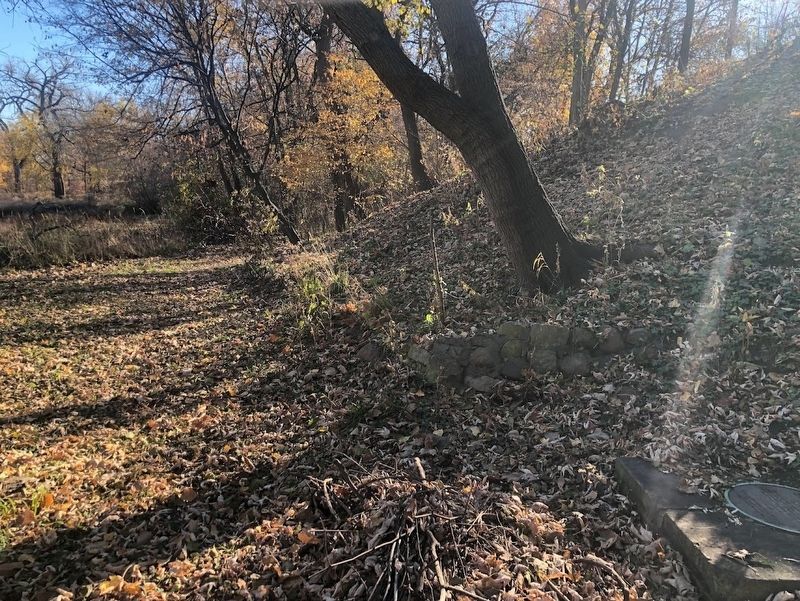
Photographed by Sean Flynn, November 13, 2023
2. Bourbon Spring Marker
A view of the marker to the south. The WPA-constructed steps to the marker can be found by following the visible short limestone wall a short distance.
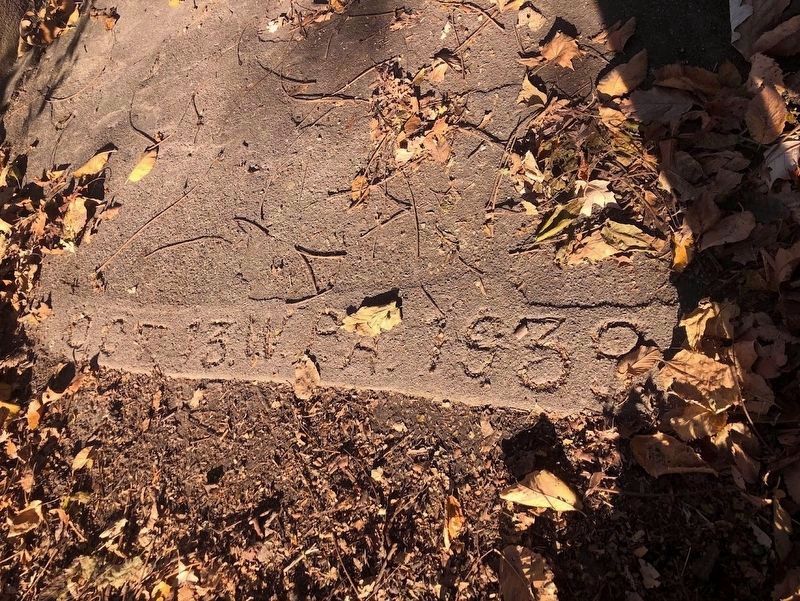
More about this marker. A set of WPA-constructed steps off Barrypoint Road, across from Scottswood Commons park, offer the most direct way to reach this marker. At the top of the steps is etched: "OCT 13 W.P.A. 1939." Once you reach the bottom, the marker can be found by following a short limestone wall for about 20 yards. The marker can also be accessed a bit more indirectly by going down the paved pathway on the east side of the park (closer to the library) and then taking a right (west) and walking about 120 yards through a field and then some trees to reach the marker. During a mid-November visit, when most leaves had fallen, the marker was also visible from the sidewalk above the Barrypoint-Bloomingbank intersection, maybe 20 feet above the marker.
The marker itself is mostly readable, although some of the letters show signs of damage or wear. Additionally, the second part of the fur trader's name appears to be spelled "Babtiste"; other references elsewhere (including at the nearby Stephen Van Rensselaer Forbes Home Site historical marker) spell his name Baptiste.
According to a 2007 article
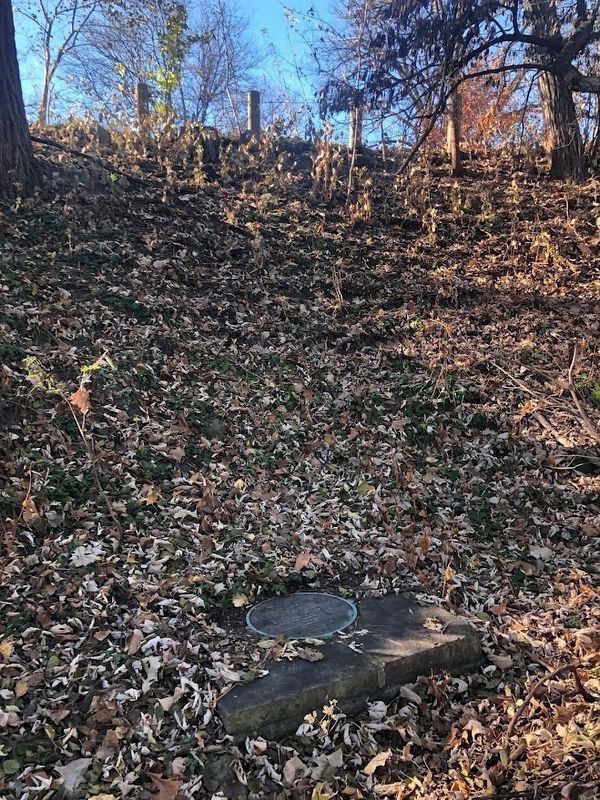
Photographed by Sean Flynn, November 13, 2023
3. Bourbon Spring Marker
The view from the marker, looking up (about 20 feet higher) towards street level. The intersection of Barrypoint and Bloomingbank is just above this location, and beyond that is Scottswood Common, named after Winfield Scott and the purported location of his 1832 encampment.
Regarding Bourbon Spring. The events described on the plaque are long-standing elements of local lore, although the veracity of some elements (including Scott's encampment and Webster's visit) may not be certain—perhaps in no small part because Riverside for much of its early history was a dry community where alcohol was not permitted.
Winfield Scott's troops arrived in Chicago in July 1832 to fight in the Blackhawk War, but they were ravaged by a cholera epidemic, which would soon affect the citizens of Chicago. Scott's troops traveled west to recover, spending 10 days along the Des Plaines River (then known as the Aux Plaines) before continuing their march towards the fighting in Wisconsin. According to researchers, all that is known is that he camped somewhere around here, on high ground near the riverbank; the area above Bourbon Spring would qualify, although whether that was the exact spot is not known. Whatever the case, Frederick Law Olmsted, when laying out Riverside in 1868, named

Photographed by Sean Flynn, November 13, 2023
4. Street-level view of the Bourbon Spring Marker
Upon close inspection, the marker can be found just above the concrete pylon in the foreground. The photo is taken from near the intersection of Barrypoint and Bloomingbank.
A historical marker to the Stephen Van Rensselaer Forbes home site, about 100 years north of Bourbon Spring, says that Jean Baptiste Beaubien's election as county colonel happened in that house. However, other sources indicate the election may have happened at Lawton's Tavern, a popular stopping point for travelers that sat about a third of a mile south of here, on the Riverside side of the Des Plaines River, at a spot that was then a well-used ford of the river and is now the location of a bridge crossing.
As for Daniel Webster, legend has it that Stephen Forbes's brother was a lifelong friend of Webster, which would have precipitated the visit to Riverside in 1837. However, there is no contemporary evidence of this visit nor of his friendship with Forbes's brother.
Related markers. Click here for a list of markers that are related to this marker. Jean Baptiste Beaubien
Also see . . .
1. The Legend of Bourbon Spring.
Riverside-Brookfield Landmark: "Is the Bourbon Spring monument the preservation of fable or of fact? That a spring was here,(Submitted on November 13, 2023, by Sean P. Flynn of Oak Park, Illinois.)in that area, tends toward the factual. Was it ever 'bourbonized'? Did General Scott rest his men here? Did the great orator, Daniel Webster, meet anyone here? No conclusive evidence seems to exist, other than that of memory and opinion, and that makes up the legend of Bourbon Spring."Photographed by Sean Flynn, November 13, 20235. WPA-built stepsEtched into the top step: "OCT 13 W.P.A. 1939"
2. Bourbon Spring whiskey. A history of Bourbon Spring from nearby Quincy Street Distillery.
Excerpt: "Handmade just a short walk away from its namesake spring where the Cook County Militia was founded in 1834, Bourbon Spring® is a bold, young Illinois bourbon whiskey, as wonderful sipped neat or with ice as it is mixed in a cocktail."(Submitted on November 13, 2023, by Sean P. Flynn of Oak Park, Illinois.)

Courtesy of the Village of Riverside, Illinois, circa 1880
6. Historic map of Riverside
Bourbon Spring is identified on this historic map of the Riverside area near "Picnic Island," which today is the site of Swan Pond. Lawton's Tavern and the site of Scott's encampment, among many other historic spots in the Riverside area, are noted on the map.
Credits. This page was last revised on June 25, 2026. It was originally submitted on November 13, 2023, by Sean P. Flynn of Oak Park, Illinois. This page has been viewed 735 times since then and 81 times this year. Photos: 1, 2, 3, 4, 5, 6. submitted on November 13, 2023, by Sean P. Flynn of Oak Park, Illinois. • Andrew Ruppenstein was the editor who published this page.
