Decorah in Winneshiek County, Iowa — The American Midwest (Upper Plains)
Valders House
Heritage Park, Vesterheim Norwegian-American Museum

Photographed by Cosmos Mariner, September 9, 2023
1. Valders House Marker
Overview
Norway's population nearly tripled during the 19th century. This increase, combined with restrictive inheritance laws and lack of farmable land, made it extremely difficult to escape rural poverty. Most Norwegian immigrants were from the lowest social and economic classes in Norway. Five of the six children who lived in this house during the mid-19th century left Norway for the United States and Canada.
• Originally in Valdres, Norway
• Built in 1795 and enlarged in 1860
• Moved to Vesterheim in 1975
• 1994.096.001 — Gift of Valdres Folkemuseum
The Valdres House was moved to Vesterheim from central Norway in 1975. It is a modest size for the home of a landowner, the top of rural Norway's socioeconomic class. The oldest part of the house was built in 1795 and was enlarged in 1860. Torstein and Ingebjǿrg Rudi Moen purchased this house and the surrounding farm in 1866. The couple had six children — all but one left Norway for the United States and Canada.
Norway's population nearly tripled over the course of the 19th century. This increase was due to improved nutrition, the smallpox vaccine, and reduced infant mortality.
this page online
The oldest son of a landowner inherited the farm. If there were no sons, the oldest daughter and her husband could inherit. In Norway, the farm could be inherited prior to the death of one or both parents. If this happened, the son entered into a contract that provided the parents guaranteed housing (even if the farm was sold) and an annual food and fuel allowance. The contract also provided for younger siblings. Because of the population explosion, however, there were often too many siblings for the brother to support. The grown-up brothers and sisters became farmers, laborers, or found other work. In reality, most of these siblings ended up living in rural poverty.
Farming in 19th-century Norway was extremely primitive compared with other countries at the time. Even the largest farms were engaged in subsistence farming, rather than in raising crops for

Vesterheim Archives
2. Marker detail: Torstein and Ingebjǿrg Rudi Moen
Instead of the more common horse drawn plows and harrows used in Europe and England at the time, farmers in the coastal districts of western Norway used hand tools like spades and hoes to prepare the soil for planting.
People had few ways of escaping rural poverty, which is one of the reasons that most of the emigrants from Norway were from the lower classes. They didn't have money to buy or rent land in Norway. With more opportunities to find paying jobs in America, they could save up money, work hard, and buy cheap land that the U.S. government made available by forcibly removing Native Americans.
Only about 3% of Norway's land is suitable for agriculture and all of it was held by a minority of landowners. As late as 1900, around 72% of Norway's population lived in rural areas. Many farms in Norway were divided into units with separate households. The bǿnder or gårdmenn owned their farms. Within the control of landowners were tenant farmers and cotters who either leased land or were granted

Photo by Knud Knudsen. Courtesy of Photo Collection, University of Bergen Library
3. Marker detail: Clearing rocks from fields in Hardanger.
Erected by Vesterheim Norwegian-American Museum.
Topics and series. This historical marker is listed in these topic lists: Agriculture • Architecture • Immigration • Settlements & Settlers. In addition, it is included in the Norwegian-Americans series list. A significant historical year for this entry is 1795.
Location. 43° 18.289′ N, 91° 47.508′ W. Marker is in Decorah, Iowa, in Winneshiek County. It can be reached from North Mill Street just north of West Water Street, on the right when traveling north. The marker is located in Vesterheim Norwegian-American Museum Heritage Park. Touch for map. Marker is at or near this postal address: 520 West Water Street, Decorah IA 52101, United States of America. Touch for directions.

Regionally, this marker is in Northeast Iowa — the Driftless Area and in Eastern Iowa. It is also in the American Midwest, in the Corn Belt, and in the Driftless Area — Bluff Country. Globally, it is in North America,
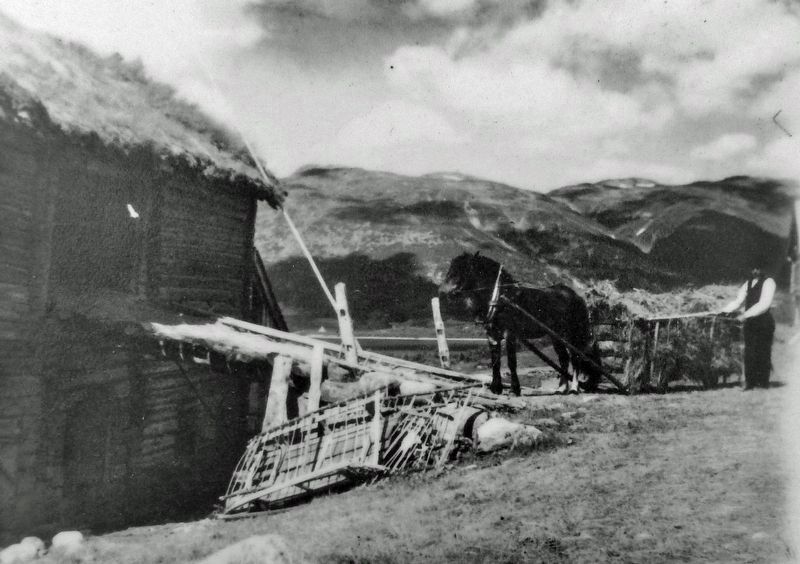
Photo by Herbjǿrn Gausta. Vesterheim Archives
4. Marker detail: Farmer in Rauland, Norway
Other nearby markers. At least 8 other markers are within walking distance of this marker: Egge-Koren House (a few steps from this marker); Norsvin Mill (a few steps from this marker); Stabbur (a few steps from this marker); Rovang Schoolhouse (within shouting distance of this marker); Haugan House (within shouting distance of this marker); Vesterheim (within shouting distance of this marker); Wickney House (within shouting distance of this marker); Bethania Church (within shouting distance of this marker). Touch for a list and map of all markers in Decorah.
Related markers. Click here for a list of markers that are related to this marker. Vesterheim Norwegian-American Museum Heritage Park
Also see . . . Valdres House. (Includes link to a virtual tour of the interior.) Excerpt:
Øystre Slidre, Valdres, Norway (1795). A modest landowner’s home built with traditional labor-intensive log construction methods. Five of six children(Submitted on November 18, 2023, by Cosmos Mariner of Cape Canaveral, Florida.)raised in this house left for frontiers in the United States and Canada at the height of emigration in the late 1800s.Photographed by Cosmos Mariner, September 9, 20235. Valders House MarkerLooking north. The marker is on the left. Valders House is in the background.


Photographed by Cosmos Mariner, September 9, 2023
6. Valders House (east & northwest elevations)
Credits. This page was last revised on November 24, 2023. It was originally submitted on November 16, 2023, by Cosmos Mariner of Cape Canaveral, Florida. This page has been viewed 276 times since then and 27 times this year. Photos: 1, 2, 3, 4, 5, 6. submitted on November 18, 2023, by Cosmos Mariner of Cape Canaveral, Florida.
