Central Vancouver in Metro Vancouver, British Columbia — Canada’s West Coast (North America)
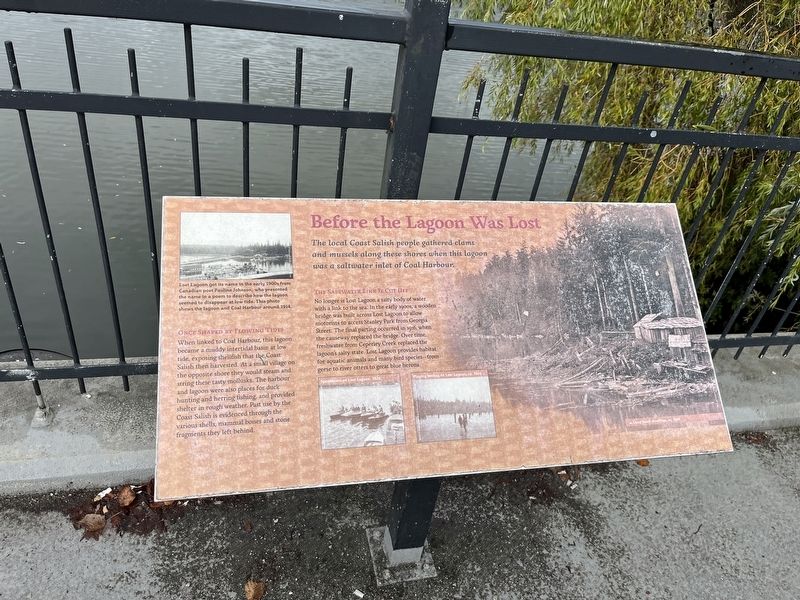
Before the Lagoon Was Lost
Photographed by Adam Margolis, October 10, 2023
1. Before the Lagoon Was Lost Marker
[caption] Lost Lagoon got its name in the earl 1900s from Canadian poet Pauline Johnson, who presented the name in a poem to describe how the lagoon seemed to disappear at low tide. This photo shows the lagoon and Coal Harbour around 1914.
ONCE SHAPED BY FLOWING TIDES
When linked to Coal Harbour, this lagoon became a muddy intertidal basin at low tide, exposing shellfish that the Coast Salish then harvested. At a small village on the opposite shore they would steam and string these tasty mollusks. The harbour and lagoon were also places for duck hunting and herring fishing, and provided shelter in rough weather. Past use by the Coast Salish is evidenced through the various shells, mammal bones and stone fragments they left behind.
THE SALTWATER LINK IS CUT OFF
No longer is Lost Lagoon a salty body of water with a link to the sea. In the early 1900s, a wooden bridge was built across Lost Lagoon to allow motorists to access Stanley Park from Georgia Street. The final parting occurred
this page online
Topics. This historical marker is listed in these topic lists: Animals • Bridges & Viaducts • Parks & Recreational Areas • Waterways & Vessels. A significant historical year for this entry is 1914.
Location. 49° 17.665′ N, 123° 8.265′ W. Marker is in Vancouver, British Columbia, in Metro Vancouver. It is in Central Vancouver. It is on Lost Lagoon Path. Touch for map. Marker is at or near this postal address: 712 Lost Lagoon Path, Vancouver BC V6G 2S1, Canada. Touch for directions.

Regionally, this marker is on the Lower Mainland and in Coast & Mountains. Globally, it is in North America, in the Cascade Range, in the Inside Passage, on the Ring of Fire, on the Pacific Rim, in the Western Hemisphere, in the Western World, and in the Anglosphere. Historically, it finds itself in what was once a British colony.
Other nearby markers. At least 8 other markers are within
Photographed by Adam Margolis, October 10, 2023
2. Before the Lagoon Was Lost Marker
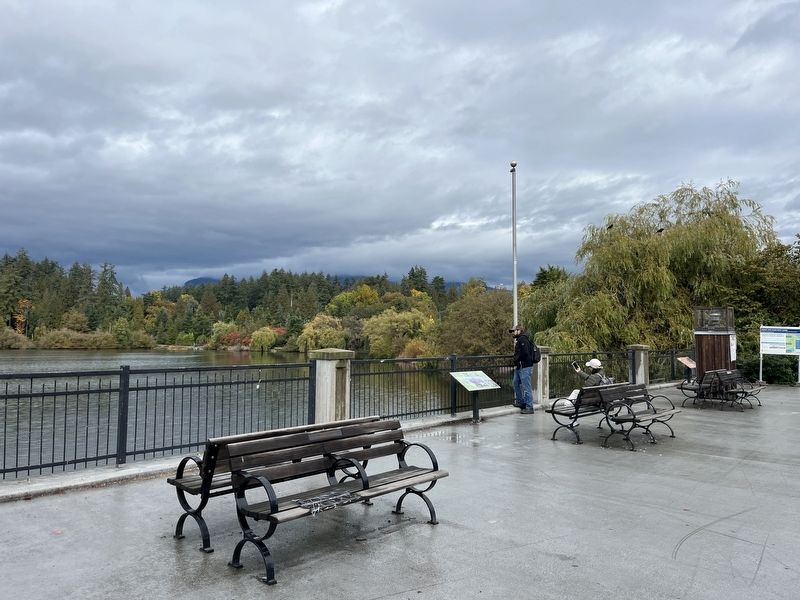
Marker is seen towards the right.
Credits. This page was last revised on November 22, 2023. It was originally submitted on November 18, 2023, by Adam Margolis of Mission Viejo, California. This page has been viewed 361 times since then and 36 times this year. Photos: 1, 2. submitted on November 18, 2023, by Adam Margolis of Mission Viejo, California. • Andrew Ruppenstein was the editor who published this page.
