Decorah in Winneshiek County, Iowa — The American Midwest (Upper Plains)
Painter-Bernatz Mill
Heritage Park, Vesterheim Norwegian-American Museum

Photographed by Cosmos Mariner, September 9, 2023
1. Painter-Bernatz Mill Marker
Overview
Northeast Iowa was home to many different Native American groups that utilized the natural resources of this area for thousands of years. After Native Americans were forced out of the region by the U.S. government, European settlers like William Painter moved into the area. Painter built this mill around 1850 and used it to grind grain. It operated with water power until 1947, and by diesel power until 1964.
• A mill race brought water from the Upper Iowa River to the mill.
• 1994.100.001 — Gift of the Carlson Family
The United States government was actively removing Native Americans from this region when European settlers first arrived here. Members of the Ho-Chunk tribe (called the Winnebago by the U.S. government) were forced to live in this valley for 20 years after being driven off their ancestral lands in Wisconsin in the 1830s. In 1848, the Ho-Chunk were relocated to a reservation in Minnesota and later forced into the Dakota Territory where many starved and froze.
Many Native Americans found the concept of owning land absurd, which the U.S. government used to its advantage when entering into treaties with
this page online
Even after the removals, the Ho-Chunk people faced the possibility of having their children forcibly taken to boarding schools in an attempt to have their culture erased by the U.S. government — a practice that continued into the 1970s. In 1887, the federal government passed the Dawes Act, breaking up communal lands on reservations into individual allotments for tribe members and sold “excess land” to white settlers. Many reservations still bear the scars of the Dawes Act on their maps. Tribal sovereignty and the rights of tribal members are still living issues for the Ho-Chunk people and many other tribes. Today, the Ho-Chunk people live all over the world, but their official reservations are divided

Courtesy Smithsonian American Art Museum
2. Marker detail: 1835 Depiction of Chief Waukon Haga
Lithograph by James Otto Lewis.
The William Painter and William Day families were the first settlers of European descent to arrive in the area in 1849 by way of Wisconsin and Virginia, respectively. Painter claimed the western portion of what would become Decorah, and Day took the eastern portion. Settlers from Norway began arriving in large numbers by 1850.
When William Painter arrived in 1849, he was the first of many business people who used the Upper Iowa River to power their mills and factories. As many as 40 mills were established throughout the county by the early settlers. Most of these would have been smaller mills for grinding grain, like the Norsvin Mill here in Heritage Park. Painter's mill is a classic example of a mill — not just a grist mill, but a mill that is a factory. The building is designed to use the mill's power to produce goods as quickly and efficiently as possible.
The Upper Iowa River is now diverted and contained by a levee system to the north. This plat map of Decorah from 1886 shows that the Upper Iowa River originally made a hairpin bend around this site. Water to power the mill's turbine was diverted from the river west of the mill and into a mill race, which took the water directly to the mill and then back out into the river to the east of the building. Later owners of the mill expanded the building several times and ground flour and animal feed by water power until 1947, and by diesel power until 1964. Today, the Upper Iowa River is enjoyed for its beauty and recreational uses.
Erected by Vesterheim Norwegian-American Museum.
Topics and series. This historical marker is listed in these topic lists: Immigration • Indigenous Peoples and Communities • Industry & Commerce • Settlements & Settlers. In addition, it is included in the National Register of Historic Places (NRHP),

Vesterheim Archives
3. Marker detail: 1886 plat map of Decorah
The original mill race is shown in dark green and the mill is shown in light green. In the 1940s, the Army Corps of Engineers rerouted the river north and built a system of levees to prevent flooding downtown.
Location. 43° 18.338′ N, 91° 47.531′ W. Marker is in Decorah, Iowa, in Winneshiek County. It can be reached from North Mill Street just south of Heivly Street, on the right when traveling north. The marker is located in Vesterheim Norwegian-American Museum Heritage Park, on the south side of the Painter-Bernatz Mill. Touch for map. Marker is at or near this postal address: 520 West Water Street, Decorah IA 52101, United States of America. Touch for directions.

Regionally, this marker is in Northeast Iowa — the Driftless Area and in Eastern Iowa. It is also in the American Midwest, in the Corn Belt, and in the Driftless Area — Bluff Country. Globally, it is in North America, the Western Hemisphere, the Western World, and the Anglosphere. Historically, it finds itself in what was once the territory of the Mississippian Culture and also the Louisiana Purchase.
Other nearby markers. At least 8 other markers are within walking distance of this marker: Conservation (a few steps from this marker); Timber Framing (a few steps from this marker);
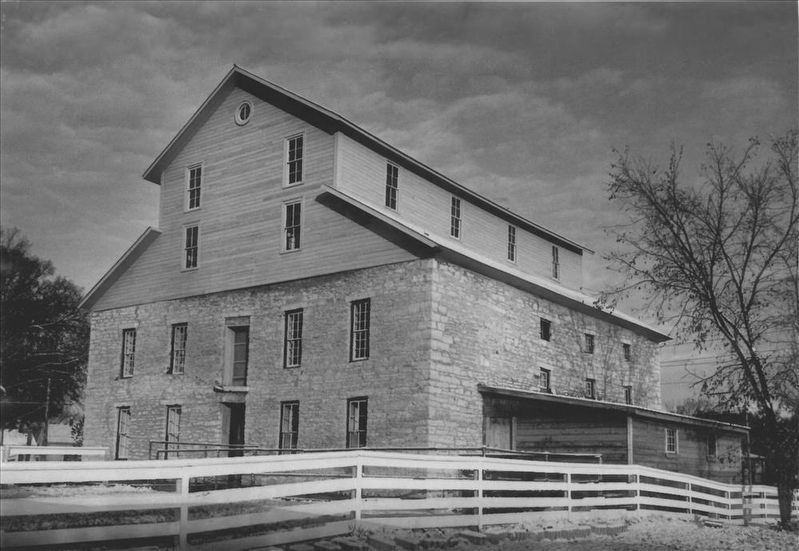
via NPS, unknown
4. Old Stone Mill aka Painter-Bernatz Mill
National Register of Historic Places Nomination Form
NPGallery Digital Asset Management System
Click for more information.
NPGallery Digital Asset Management System
Click for more information.
Regarding Painter-Bernatz Mill. National Register of Historic Places #74000816.
From the National Register Nomination:
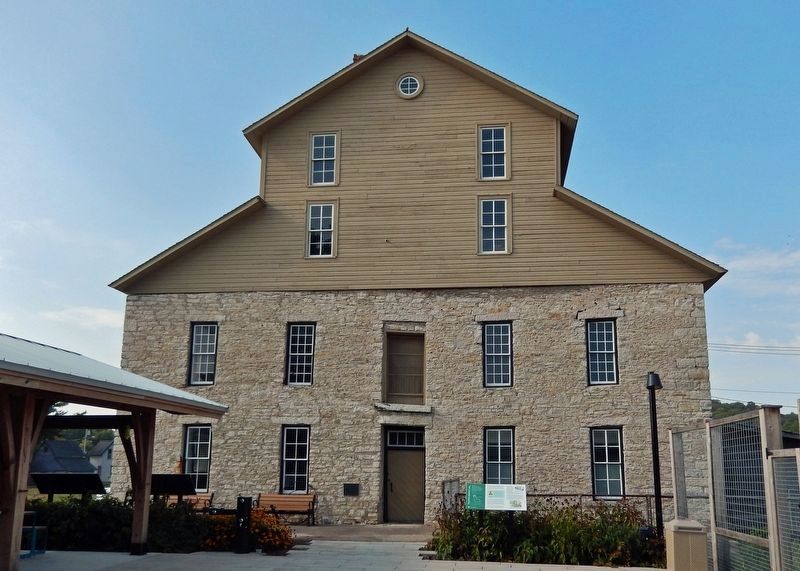
The original exterior appearance of the Stone Mill was similar in plan to the present appearance. The building was constructed of native limestone, is 59 feet by 52 feet in plan, and two stories (22') high. The walls vary in thickness from 6 feet at the base (basement) to about 18 inches at the top. There were two floors plus a loft and a basement in the original structure. There are two large arches in the south foundation wall indicating that originally the water was routed beneath the building in order to power the machinery. In 1914 a concrete retaining wall was constructed which blocked the above mentioned arches and the water was routed to the eastside of the building where it turned two water turbines.Photographed by Cosmos Mariner, September 9, 20235. Painter-Bernatz Mill MarkerLooking north through Heritage Park. Painter-Bernatz Mill in the background. Marker is on right side of the entrance.
Related markers. Click here for a list of markers that are related to this marker. Vesterheim Norwegian-American Museum Heritage Park
Also see . . .
1. Painter-Bernatz Mill. Vesterheim website entry:
(Includes link to a virtual tour of the interior.) Excerpt:
Decorah, Iowa (1851). William Painter built the original mill on this site in 1851 as a commercial flour mill. Shortly thereafter he enlarged it to its present size. The upper story was added in 1890. A millrace from a dam upstream on the Upper Iowa River brought water to power the turbine. The waterpower was replaced by diesel power in 1947, when the Army Corps of Engineers built the levee system. The mill continued to operate until 1964. It was dedicated on July 4, 1971, as part of Vesterheim’s Heritage Park and now houses Vesterheim’s exhibits on agriculture and industry. The mill is listed on the National Register of Historic Places and is a designated site in the Silos & Smokestacks National Heritage Area.(Submitted on November 22, 2023, by Cosmos Mariner of Cape Canaveral, Florida.)
2. Painter-Bernatz Mill (Wikipedia).

Photographed by Cosmos Mariner, September 9, 2023
6. Painter-Bernatz Mill Race
The mill race brought water from the Upper Iowa River into the inlet on the southeast corner of the mill. The water flowed over the mill’s turbine, powering the machinery inside.
Excerpt:
Also known as the Old Stone Mill, it was the first of at least 15 mills that used this river as its source of power. The lower two floors are composed of native limestone. The original hip roof was removed sometime between 1874 and 1890 and the present gable roof was built giving the mill a large loft. Diesel power replaced waterpower in 1947. The building continued to operate as a mill until 1964. It became a part of the Vesterheim Norwegian-American Museum in 1971, and houses exhibits on agriculture and industry. The former mill is the oldest building in Decorah.(Submitted on November 22, 2023, by Cosmos Mariner of Cape Canaveral, Florida.)

Photographed by Cosmos Mariner, September 9, 2023
7. Mill Dedication Plaque
Norwegian-American Museum
The Stone Mill
Division of Pioneer Industries
Made possible through a gift from the Dahl-Vinje
family of La Crosse, Wisconsin, given in memory of
their father Harry J. Dahl (1883-1962), automobile
industry pioneer.
Building presented by
Roy Carlson, Decorah, Iowa.
National Register of Historic Places

Photographed by Cosmos Mariner, September 9, 2023
8. Painter-Bernatz Mill (north elevation)

Photographed by Cosmos Mariner, September 9, 2023
9. Painter-Bernatz Mill (west elevation)
Credits. This page was last revised on November 24, 2023. It was originally submitted on November 18, 2023, by Cosmos Mariner of Cape Canaveral, Florida. This page has been viewed 266 times since then and 16 times this year. Photos: 1, 2, 3. submitted on November 22, 2023, by Cosmos Mariner of Cape Canaveral, Florida. 4. submitted on November 23, 2023, by Larry Gertner of New York, New York. 5, 6, 7, 8, 9. submitted on November 22, 2023, by Cosmos Mariner of Cape Canaveral, Florida.
