Cape Girardeau in Cape Girardeau County, Missouri — The American Midwest (Upper Plains)
Down the Colorado
Fort D
Photographed by Cosmos Mariner, August 21, 2021
1. Down the Colorado Marker
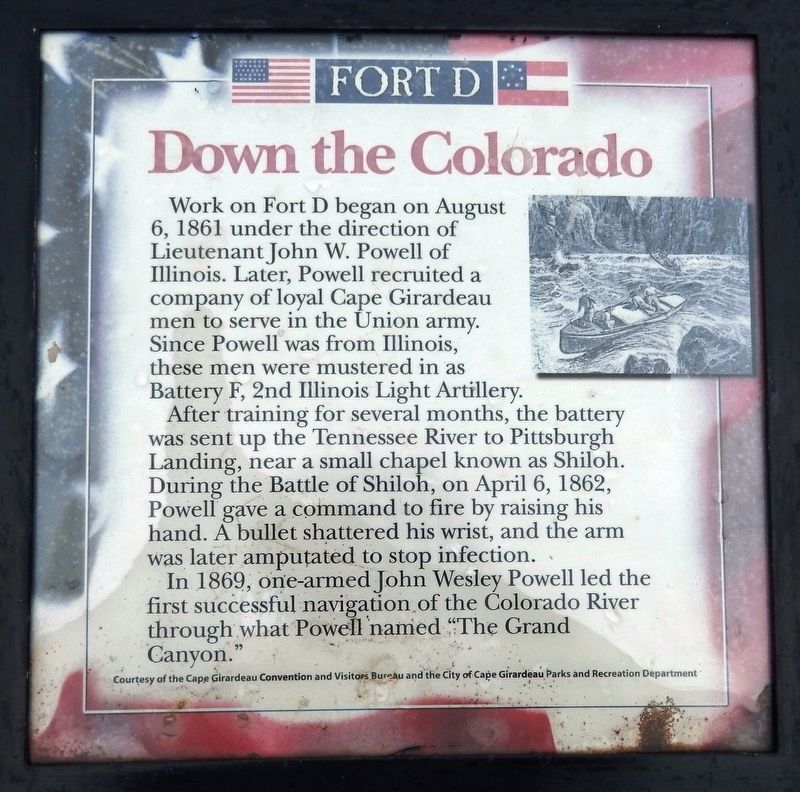
Work on Fort D began on August 6, 1861 under the direction of Lieutenant John W. Powell of Illinois. Later, Powell recruited a company of loyal Cape Girardeau men to serve in the Union army. Since Powell was from Illinois, these men were mustered in as Battery F, 2nd Illinois Light Artillery.
After training for several months, the battery was sent up the Tennessee River to Pittsburgh Landing, near a small chapel known as Shiloh. During the Battle of Shiloh, on April 6, 1862, Powell gave a command to fire by raising his hand. A bullet shattered his wrist, and the arm was later amputated to stop infection.
In 1869, one-armed John Wesley Powell led the first successful navigation of the Colorado River through what Powell named “The Grand Canyon.”
Erected 2005 by Cape Girardeau Convention and Visitors Bureau; and the City of Cape Girardeau Parks and Recreation Department.
Topics. This historical marker is listed in these topic lists: Exploration • Forts and Castles • War, US Civil • Waterways & Vessels. A significant historical year for this entry is 1869.
Location. 37° 17.447′ N, 89° 31.592′ W. Marker is
this page online

Regionally, this marker is in Southeast Missouri. It is also in the American Ozarks, in the Lewis & Clark Corridor, in the Corn Belt, and in the Great River Road Region. Globally, it is in North America, the Western Hemisphere, the Western World, and the Anglosphere. Historically, it finds itself in what was once the territory of the Mississippian Culture, the Louisiana Purchase, and the Antebellum South.
Other nearby markers. At least 8 other markers are within walking distance of this marker: The 20th Illinois Regiment (here, next to this marker); Unwanted, Untrained & Indispensable (here, next to this marker); Marching with the 1st Nebraska (here, next to this marker); Grant Takes Command (here, next to this marker);
Photographed by Cosmos Mariner, August 21, 2021
2. Down the Colorado Marker
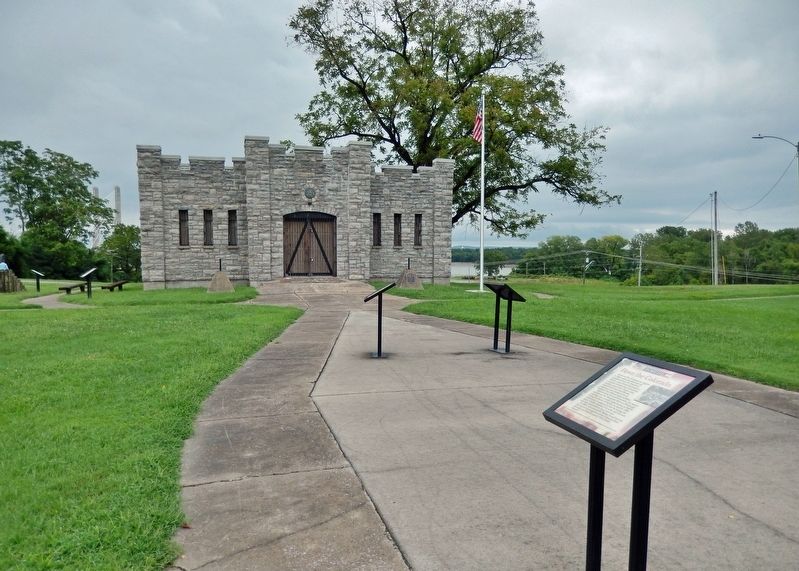
Looking northeast. Fort D Historic Site Museum in background.
Related markers. Click here for a list of markers that are related to this marker. Fort D Historic Site
Also see . . .
1. John Wesley Powell (Wikipedia). Excerpt:
Despite the loss of an arm, Powell returned to the Army and was present at the battles of Champion Hill, Big Black River Bridge, and in the siege of Vicksburg. He was made a major and commanded an artillery brigade with the 17th Army Corps during the Atlanta campaign. After the fall of Atlanta, he participated in the battle of Nashville. At the end of the war he was made a brevet lieutenant colonel but preferred to use the title of "major". After leaving the Army, Powell took the post of professor of geology at Illinois Wesleyan University. He also lectured at Illinois State Normal University for most of his career. He declined a permanent appointment in favor of exploration of the American West.(Submitted on November 27, 2023, by Cosmos Mariner of Cape Canaveral, Florida.)
2. John Wesley Powell Expedition (USGS). Excerpt:
John Wesley Powell — teacher, Civil War major, statesman, and above all, scientist — was a geology professor when he planned the first scientific expedition of the Green and Colorado rivers. His plan was to enter the Great unknown, take scientific measurements, chart the region, and complete our nation’s maps. Powell’s crew for his initial expedition in 1869 included four guides, the brother of one of these guides, the major’s youngest brother, a former U.S. Army lieutenant, an 18-year-old mule driver and Indian scout, and an Englishman interested in the adventure. Of the ten men, only Powell and five others made it all the way from the Green River in Wyoming to present-day Lake Mead...(Submitted on November 27, 2023, by Cosmos Mariner of Cape Canaveral, Florida.)
Credits. This page was last revised on November 27, 2023. It was originally submitted on November 26, 2023, by Cosmos Mariner of Cape Canaveral, Florida. This page has been viewed 177 times since then and 17 times this year. Photos: 1, 2. submitted on November 27, 2023, by Cosmos Mariner of Cape Canaveral, Florida.
