Original Old Town in Elmina in Komenda-Edina-Eguafo-Abirem District, Central Region, Ghana — West Africa
St. George's Castle, Elmina
Photographed by J. Makali Bruton, September 24, 2023
1. St. George's Castle, Elmina Marker

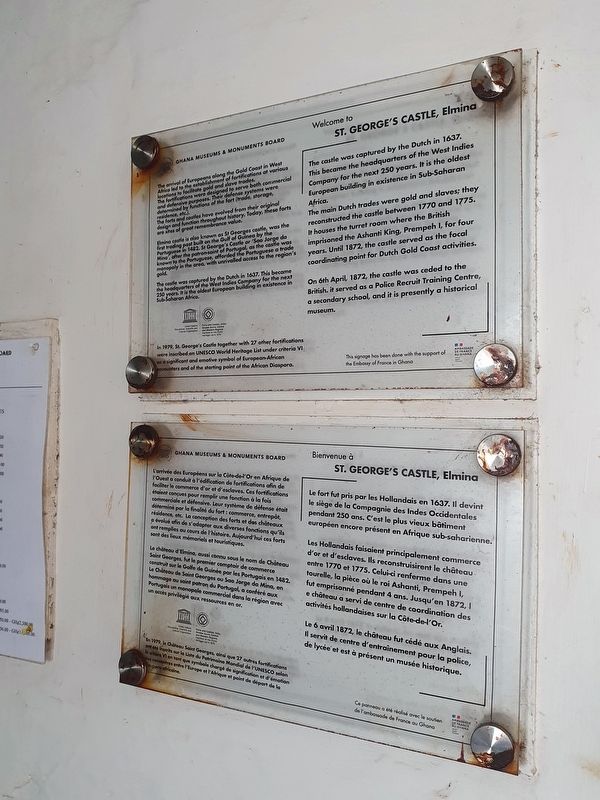
The arrival of Europeans along the Gold Coast in West Africa led to the establishment of fortifications at various locations to facilitate gold and slave trades. The fortifications were designed to serve both commercial and defensive purposes. Their defense systems were determined by functions of the fort (trade, storage, residences, etc.)
The forts and castles have evolved from their original design and function throughout history. Today, these forts are sites of great remembrance value.
Elmina castle is also known as St. Georges castle, was the fat trading post built on the Gulf of Guinea by the Portuguese in 1482. St. George's Castle or ‘Sao Jorge do Mina’, after the patron-saint of Portugal, as the case was known to the Portuguese, afforded the Portuguese a trade monopoly in the area, with unrivalled access to the region's gold.
The castle was captured by the Dutch in 1637. This became the headquarters of the West Indies Company for the next 230 years. It is the oldest European building in existence in Sub-Saharan Africa.
In 1979. St. George's Castle together
this page online
Welcome to St. George’s Castle, Elmina
The castle was captured by the Dutch in 1637. This became the headquarters of the West Indies Company for the next 250 years. It is the oldest European building in existence in Sub-Saharan Africa.
The main Dutch trades were gold and slaves; they reconstructed the castle between 1770 and 1775. It houses the turret room where the British imprisoned the Ashanti King, Prempeh I, for four years. Until 1872, the castle served as the focal coordinating point for Dutch Gold Coast activities.
On 6th April, 1872, the castle was ceded to the British, it served as a Police Recruit Training Centre, a secondary school, and it is presently a historical museum.
This signage has been done with the support of the Embassy of France in Ghana
L arrivée des Européens sur la Côte-de-l'Or en Afrique de l'Ouest conduit à l'édification de fortifications afin de faciter le commerce d'or
Photographed by J. Makali Bruton, September 24, 2023
2. St. George's Castle, Elmina Marker
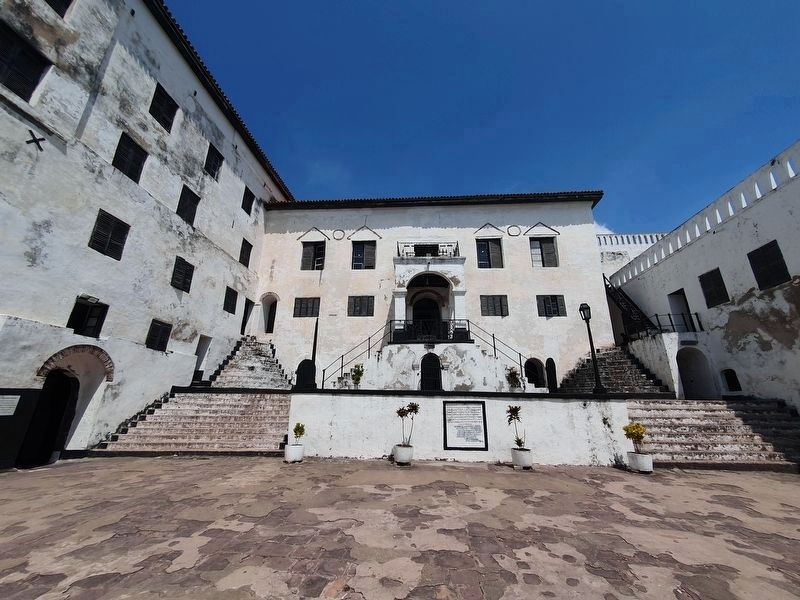
The marker is in the reception area towards the left in this view. The tablet towards the right of center is a dedication to the memory of Lambert Jacob van Tets, one of the Director Generals of the Dutch West Indies Company, who died in 1758.
Le chateau d'Elmina, aussi connu sous le nom de Château Saint Georges, fut le premier comptoir de commerce construit sur le Golfe de Guinée par les Portugais en 1482. Le Château de Saint Georges ou Sao Jorge de Mina, en hommage au saint patron du Portugal, a conféré aux Portugais un monopole commercial dans la région avec unes privilégié aux ressources en or.
En 1979 le Château Saint Georges, ainsi que 27 autres fortifications on tete inscrits sur la Liste du Patrimonie Mondial de l’UNESCO selon le ritere VI en tant que symbole chargé de signification et d'émotion des rencontres entre l’Europe et l’Afrique et point de de départ de le diaspora africaine.
Bienvenue à St. Georges Castle, Elmina
Le fort fut pris par les Hollandais en
Photographed by J. Makali Bruton, September 24, 2023
3. St. George's Castle, Elmina and its Catholic Church
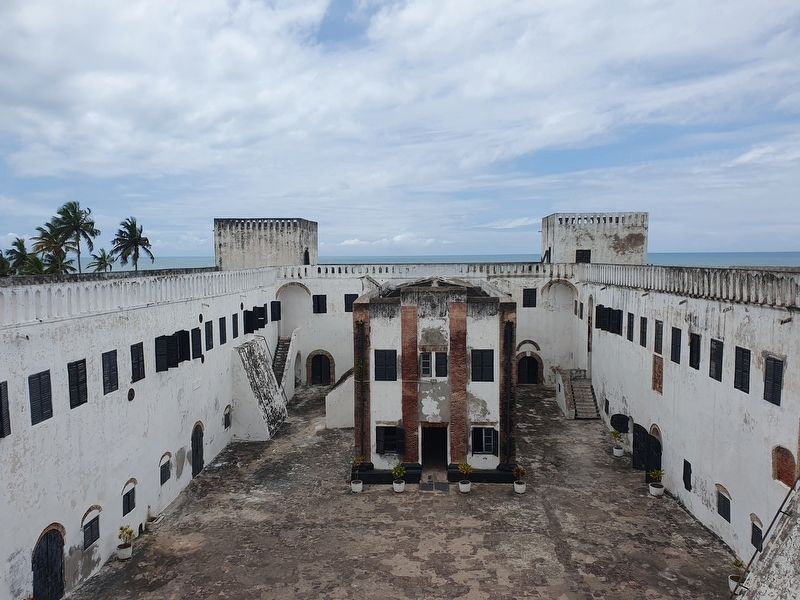
The church is one of the oldest in Western Africa.
Les Hollandais faisaient principalement commerce d'or et d'esclaves. Ils reconstruisirent le château entre 1770 et 1775. Celui-ci renferm dans une tourelle, la pièce où le roi Ashanti, Prempeh I, fut emprisonné pendant 4 ans. Jusqu'en 1872, 1 e château a servi de centre de coordination des activités hollandaises sur la Côte-de-l'Or.
Le 6 avril 1872, le château fut cédé aux Anglais. Il servit de centre d'entraînement pour la police, de lycée et est à présent un musée historique.
Clou Ce panneau a ete realise avec le soutien de l’ambassade de France au Ghana
Erected by Embassy of France in Ghana.
Topics. This historical marker is listed in these topic lists: Colonial Era • Industry & Commerce • Wars, Non-US. A significant historical date for this entry is April 6, 1872.
Location. 5° 4.956′ N, 1° 20.888′ W. Marker is in Elmina, Central Region, in Komenda-Edina-Eguafo-Abirem District. It is in Original Old Town. It can be reached from Liver Pool Road south of Benya
Photographed by J. Makali Bruton, September 24, 2023
4. A view of Cape Coast from St. George's Castle, Elmina
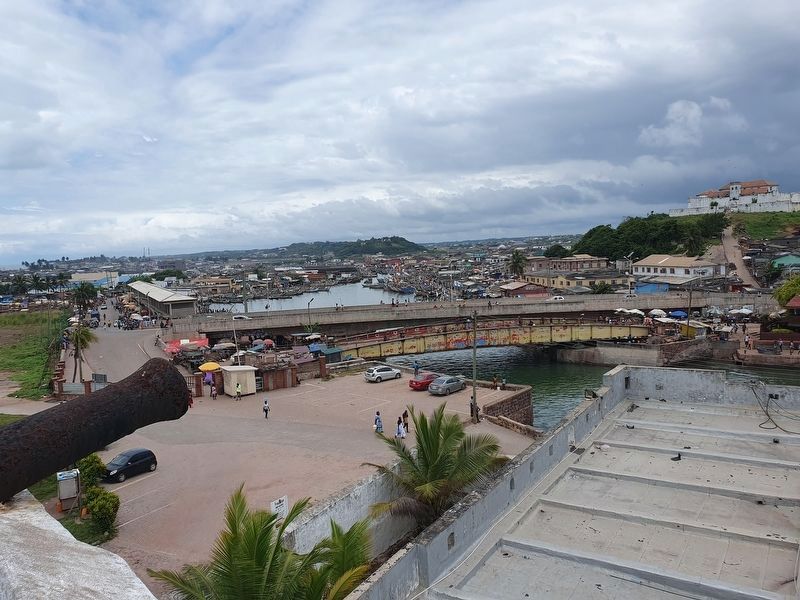
Fort Coenraadsburg can be seen to the far left in this view.

Regionally, it is in Africa, Sub-Saharan Africa, West Africa, and the Anglosphere. Historically, it finds itself in what was once a British colony.
Other nearby markers. At least 8 other markers are within 13 kilometers of this marker, measured as the crow flies: Old Dutch Cemetery (approx. 0.6 kilometers away); Sir James Marshall (approx. 11.8 kilometers away); Captain James Potter (approx. 12 kilometers away); William Degraft (approx. 12 kilometers away); Rev. Thomas Birch Freeman (approx. 12 kilometers away); The Methodist Church in Ghana / Rev. Joseph Rhodes Dunwell (approx. 12 kilometers away); Royal West African Frontier Force Memorial (approx. 12 kilometers away); Cape Coast Castle (approx. 12.1 kilometers away).
Also see . . . St. Georges or Elmina Castle at Wikipedia. (Submitted on December 8, 2023.)
Credits. This page was last revised on December 8, 2023. It was originally submitted on December 8, 2023, by J. Makali Bruton of Washington, District of Columbia. This page has been viewed 633 times since then and 262 times this year. Photos: 1, 2, 3, 4. submitted on December 8, 2023, by J. Makali Bruton of Washington, District of Columbia.
