Washington in Franklin County, Missouri — The American Midwest (Upper Plains)
The Civil War Comes to Washington
Photographed by Devry Becker Jones (CC0), October 6, 2018
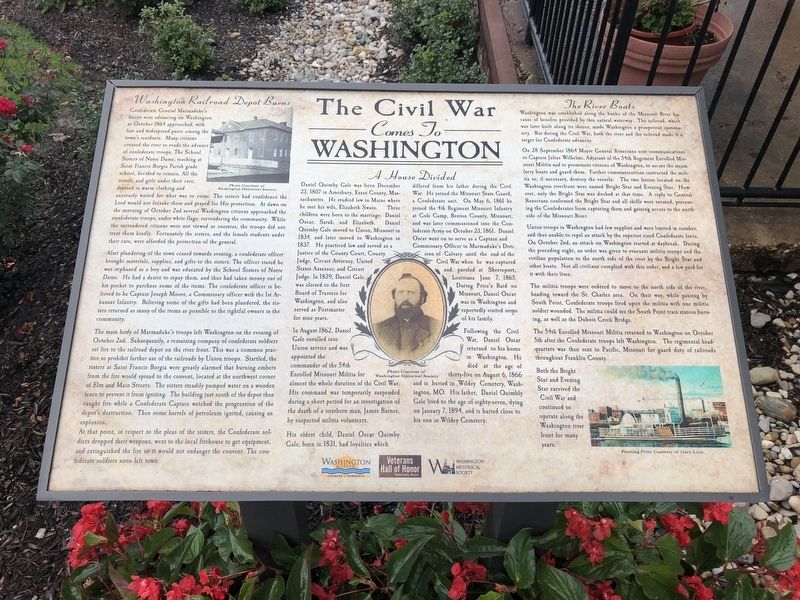
1. The Civil War Comes to Washington Marker
After plundering of the town ceased towards evening, a confederate officer brought materials, supplies, and gifts to the sisters. The officer stated he was orphaned as a boy and was educated by the School
this page online
The main body of Marmaduke's troops left Washington on the evening of October 2nd. Subsequently, a remaining company of confederate soldiers set fire to the railroad depot on the river front. This was a common practice to prohibit further use of the railroads by Union troops. Startled, the sisters at Saint Francis Borgia were greatly alarmed that burning embers from the fire would spread to the convent, located at the northwest corner of Elm and Main Streets. The sisters steadily pumped water on a wooden fence to prevent it from igniting. The building just south of the depot then caught fire while a Confederate Captain watched the progression of the depot's destruction. Then some barrels of petroleum ignited causing an explosion.
At that point, in
Photographed by Devry Becker Jones (CC0), October 6, 2018
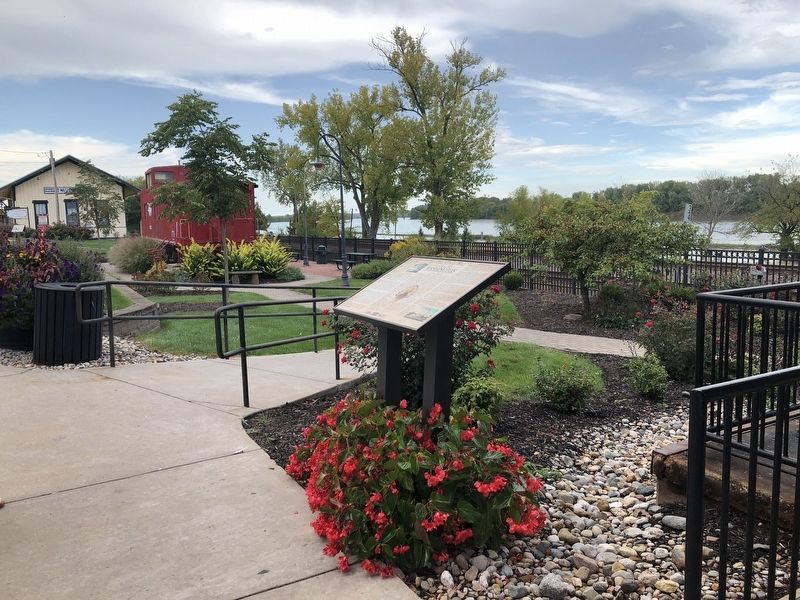
2. The Civil War Comes to Washington Marker
In August 1862, Daniel Gale enrolled into Union service and was appointed the commander of the 54th Enrolled Missouri Militia for almost the whole duration of the Civil War. His command was temporarily suspended during a short period for an investigation of the death of a southern man, James Barnes, by
Library of Congress
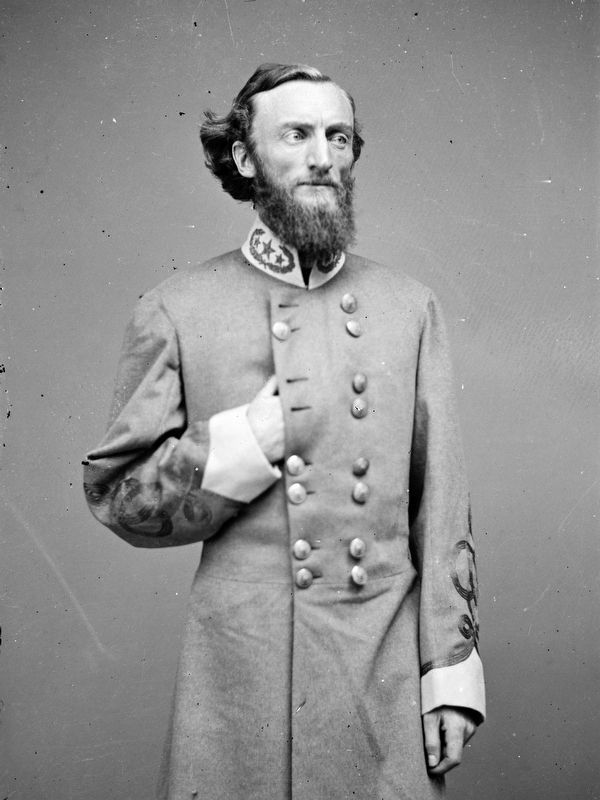
3. Brig. Gen. John S. Marmaduke, C.S.A.
Civil war photographs, 1861-1865, Library of Congress, Prints and Photographs Division.
His eldest child, Daniel Oscar Quimby Gale, born in 1831, had loyalties which differed from his father during the Civil War. He joined the Missouri State Guard, a Confederate unit. On May 6, 1861 he joined the 4th Regiment Missouri Infantry at Cole Camp, Benton County, Missouri, and was later commissioned into the Confederate Army on October 23, 1861. Daniel Oscar went on to serve as a Captain and Commissary Officer in Marmaduke's Division of Cavalry until the end of the Civil War when he was captured and paroled at Shreveport, Louisiana June 7, 1865. During Price's Raid on Missouri, Daniel Oscar was in Washington and reportedly visited some of his family.
Following the Civil War, Daniel Oscar returned to his home in Washington. He died at the age of thirty-five on August 6, 1866 and is buried in Wildey Cemetery, Washington, MO. His father, Daniel Quimbly Gale lived to the age of eighty-seven, dying on January 7, 1894, and is buried close to his son in Wildey Cemetery.
On 28 September 1864 Major General Rosecrans sent communications to Captain Julius Wilhelmi, Adjutant of the 54th Regiment Enrolled Missouri Militia and to prominent citizens of Washington, to secure the steam ferry boats and guard them. Further communications instructed the militia to, if necessary, destroy the vessels. The two ferries located on the Washington riverfront were named Bright Star and Evening Star. However, only the Bright Star was docked at that time. A reply to General Rosecrans confirmed the Bright Star and all skiffs were secured, preventing the Confederates from capturing them and gaining access to the north side of the Missouri River.
Union troops in Washington had few supplies and were limited in number, and thus unable to repel an attack by the superior sized Confederate force. On October 2nd, an attack on Washington started at daybreak. During the preceding night, an order was given to evacuate militia troops and the civilian population to the north side of the river by the Bright Star and other boats. Not all civilians complied with this order, and a few paid for it with their lives.
The militia troops were ordered to move to the north side of the river, heading toward the St. Charles area. On their way, while passing by South Point, Confederate troops fired upon the militia with one militia soldier wounded. The militia could see the South Point train station burning, as well as the Dubois Creek Bridge.
The 54th Enrolled Missouri Militia returned to Washington on October 5th after the Confederate troops left Washington. The regimental headquarters was then sent to Pacific, Missouri for guard duty of railroads throughout Franklin County.
Both the Bright Star and the Evening Star survived the Civil War and continued to operate along the Washington riverfront for many years.
Erected by Washington, Missouri Chamber of Commerce; Veterans Hall of Honor, Franklin County, Missouri; Washington Historical Society.
Topics and series. This historical marker is listed in these topic lists: Religion & Religious Structures • War, US Civil • Waterways & Vessels. In addition, it is included in the Missouri’s Civil War series list. A significant historical date for this entry is January 7, 1894.
Location. 38° 33.709′ N, 91° 0.774′ W. Marker is in Washington, Missouri, in Franklin County. It is on West Front Street west of Elm Street, on the right when traveling west. Touch for map. Marker is at or near this postal address: 301 West Front Street, Washington MO 63090, United States of America. Touch for directions.

Regionally, this marker is in the Missouri River Corridor and in Greater St. Louis. It is also in the American Midwest, in the Lewis & Clark Corridor, in the Corn Belt, and on the Santa Fe Trail Corridor. Globally, it is in North America, the Western Hemisphere, the Western World, and the Anglosphere. Historically, it finds itself in what was once the territory of the Mississippian Culture, the Louisiana Purchase, and the Antebellum South.
Other nearby markers. At least 8 other markers are within walking distance of this marker: Missouri Pacific Railway Station (a few steps from this marker); 1865 Missouri Pacific Railroad Depot (a few steps from this marker); Henry A. Hartbauer (a few steps from this marker); Pacific House (within shouting distance of this marker); Washington's Railroad History (within shouting distance of this marker); Missouri Pacific Passenger Depot (within shouting distance of this marker); Wolf Hotel (within shouting distance of this marker); Pacific Railroad Depot (within shouting distance of this marker). Touch for a list and map of all markers in Washington.
Credits. This page was last revised on April 5, 2026. It was originally submitted on October 8, 2018, by Devry Becker Jones of Washington, District of Columbia. This page has been viewed 1,265 times since then and 111 times this year. Last updated on January 10, 2024, by Carl Gordon Moore Jr. of North East, Maryland. Photos: 1, 2. submitted on October 8, 2018, by Devry Becker Jones of Washington, District of Columbia. 3. submitted on January 3, 2021, by Allen C. Browne of Silver Spring, Maryland. • J. Makali Bruton was the editor who published this page.
