San Miguel de Cozumel in Cozumel, Quintana Roo, Mexico — The Yucatan Peninsula (The Southeast)
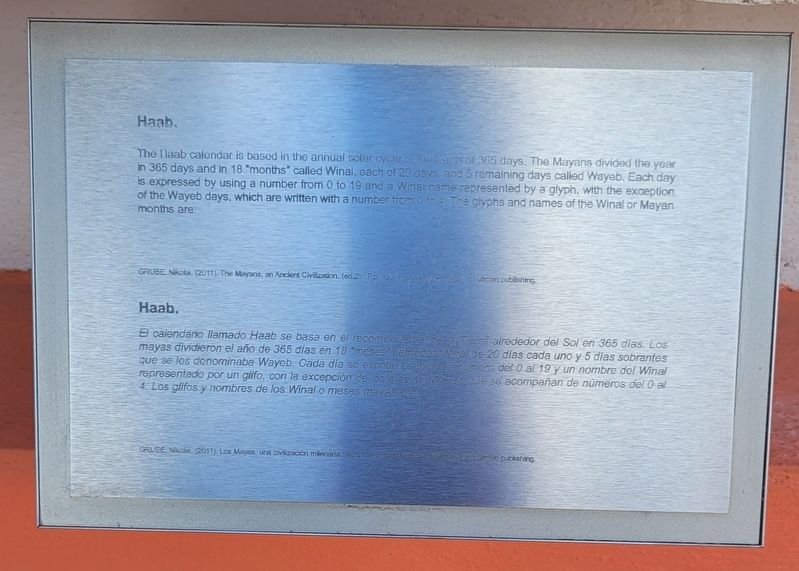
Haab
Photographed by James Hulse, February 7, 2023
1. Haab Marker
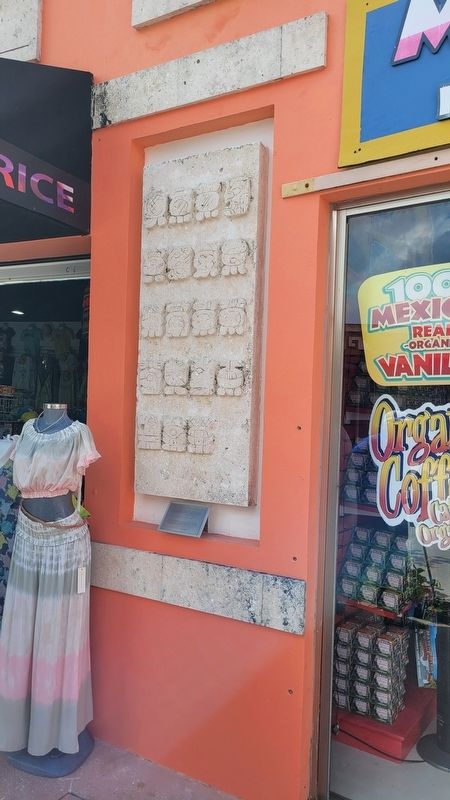
 The Haab calendar is based in the annual solar cycle of the earth of 365 days. The Mayans divided the year in 365 days and in 18 "months" called Winal, each of 20 days, and 5 remaining days called Wayeb. Each day is expressed by using a number from 0 to 19 and a Winal name represented by a glyph, with the exception of the Wayeb days, which are written with a number from 0 to 4. The glyphs and names of the Winal or Mayan months are:
GRUBE, Nikola (2011), The Mayans, an Ancient Civilization. (2nd issue). P.p. 433. Potsdam, Germany: h.f. ullman publishing.
Spanish:
GRUBE, Nikola (2011). Los Mayas, una civilización milionaria (ed 2). P.p. 433. Potsdam, Alemania: h.f. ullman publishing.
Topics.
this page online
Location. 20° 28.712′ N, 86° 58.454′ W. Marker is in San Miguel de Cozumel, Quintana Roo, in Cozumel. It is at the intersection of Carretera Costera Sur and Av Claudio Canto on Carretera Costera Sur. The marker is located in central section of the International Cruise Terminal Cozumel. Touch for map. Marker is at or near this postal address: Carr Costera Sur 6, San Miguel de Cozumel QR 77675, Mexico. Touch for directions.

Regionally, this marker is in the Mexican Maya Heartland and on the Yucatán Peninsula. Globally, it is on the Caribbean Sea, in North America, in Mesoamerica, in a Gulf of Mexico state, and in the Western Hemisphere. Historically, it finds itself in what was once New Spain and also a Spanish colony.
Other nearby markers. At least 8 other markers are within walking distance of this marker: Tzolkin (here, next to this marker); Temple of Kukulkán, Chichén Itzá, Yucatan (a few steps from this marker);
Photographed by James Hulse, February 7, 2023
2. The Haab and Marker
Also see . . . Haabʼ. Wikipedia
The five nameless days at the end of the calendar, called Wayebʼ, was thought to be a dangerous time. Foster (2002) writes "During Wayeb, portals between the mortal realm and the Underworld dissolved. No boundaries prevented the ill-intending deities from causing disasters." To ward off these evil spirits, the Mayans had customs and rituals they practised during Wayebʼ. For example, the Mayans would not leave their homes and wash their hair.(Submitted on January 13, 2024, by James Hulse of Medina, Texas.)
Credits. This page was last revised on January 13, 2024. It was originally submitted on January 13, 2024, by James Hulse of Medina, Texas. This page has been viewed 233 times since then and 21 times this year. Photos: 1, 2. submitted on January 13, 2024, by James Hulse of Medina, Texas.
