Near Pioneer in West Carroll Parish, Louisiana — The American South (West South Central)
Mound A
Photographed by James Hulse, January 15, 2023
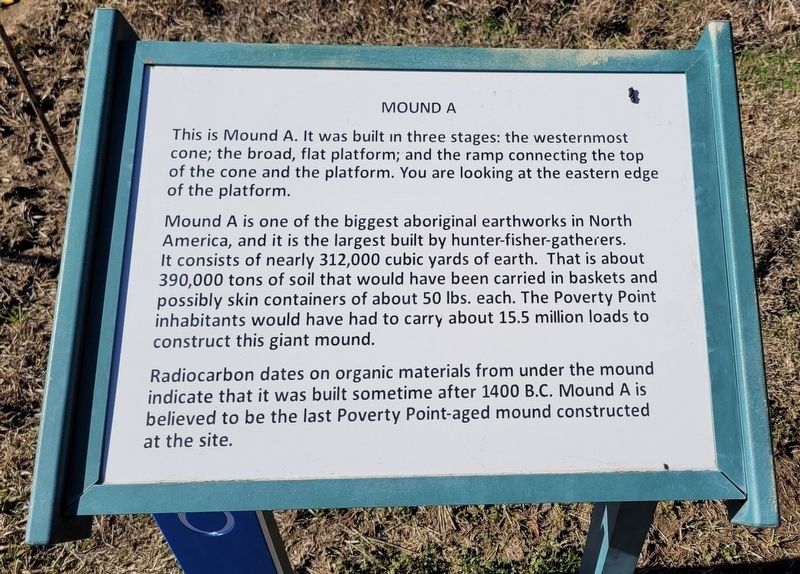
1. Mound A Marker
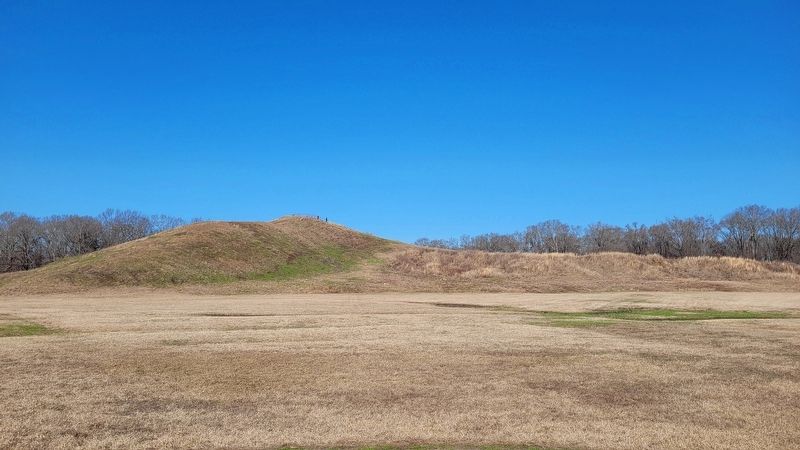
Mound A is one of the biggest aboriginal earthworks in North America, and it is the largest built by hunter-fisher-gatherers. It consists of nearly 312,000 cubic yards of earth. That is about 390,000 tons of soil that would have been carried in baskets and possibly skin containers of about 50 lbs. each. The Poverty Point inhabitants would have had to carry about 15.5 million loads to construct this giant mound.
Radiocarbon dates on organic materials from under the mound indicate that it was built sometime after 1400 B.C. Mound A is believed to be the last Poverty Point-aged mound constructed at the site.
Topics. This historical marker is listed in these topic lists: Anthropology & Archaeology • Indigenous Peoples and Communities • Parks & Recreational Areas. A significant historical year for this entry is 1400 BCE.
Location. 32° 38.13′ N, 91° 24.576′ W. Marker is near Pioneer, Louisiana, in West Carroll Parish.
this page online

Regionally, this marker is in North Louisiana. It is also in the American South, specifically in the Deep South, and in the Mississippi Delta. Globally, it is in North America, a Gulf of Mexico state, the Western Hemisphere, the Western World, and the Anglosphere. Historically, it finds itself in what was once the territory of the Mississippian Culture, the Louisiana Purchase, one of the Confederate States of America, and the Antebellum South.
Other nearby markers. At least 8 other markers are within walking distance of this marker: Mound A Apex (about 500 feet away, measured in a direct line); Mound E (approx. 0.2 miles away); Southwest Ridges (approx. 0.2 miles away); Poverty Point Earthworks (approx. ¼ mile away); Mound C (approx. 0.3 miles away); a different marker also named Poverty Point Earthworks (approx.
Photographed by James Hulse, January 15, 2023
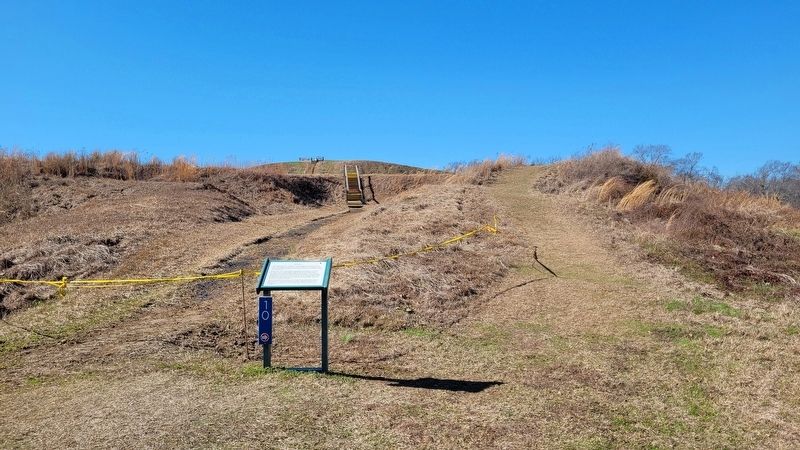
2. The view of the Mound A and the Marker
Also see . . . History & Artifacts of Poverty Point. Poverty Point World Heritage Site
Those who lived at Poverty Point more than 3,000 years ago left no written records of their day-to-day lives. We know that the site was a ceremonial center that was once home to hundreds or perhaps thousands of people, as well as a trading hub unmatched by any in North America at that time.(Submitted on January 20, 2024, by James Hulse of Medina, Texas.)
Photographed by James Hulse, January 15, 2023
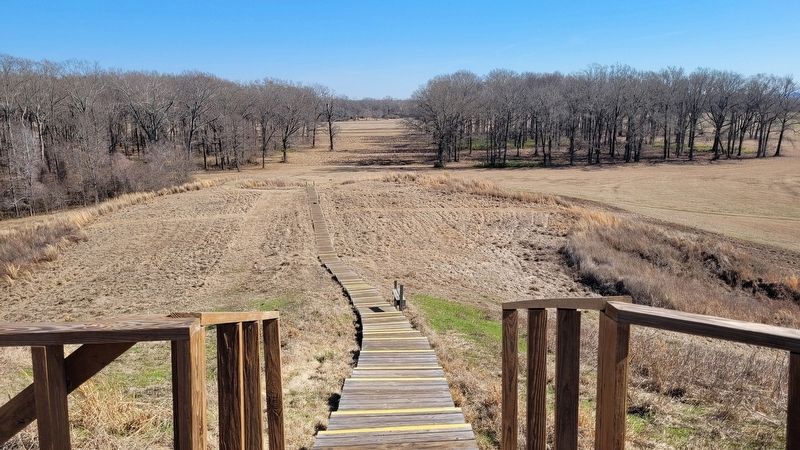
3. The view from the top of Mound A looking down
Photographed by James Hulse, January 15, 2023
4. The view of Mound A
Credits. This page was last revised on January 20, 2024. It was originally submitted on January 19, 2024, by James Hulse of Medina, Texas. This page has been viewed 188 times since then and 21 times this year. Photos: 1, 2, 3, 4. submitted on January 19, 2024, by James Hulse of Medina, Texas.
