Downtown in Fargo in Cass County, North Dakota — The American Midwest (Upper Plains)
Red River Valley Crops

Photographed by Cosmos Mariner, September 4, 2023
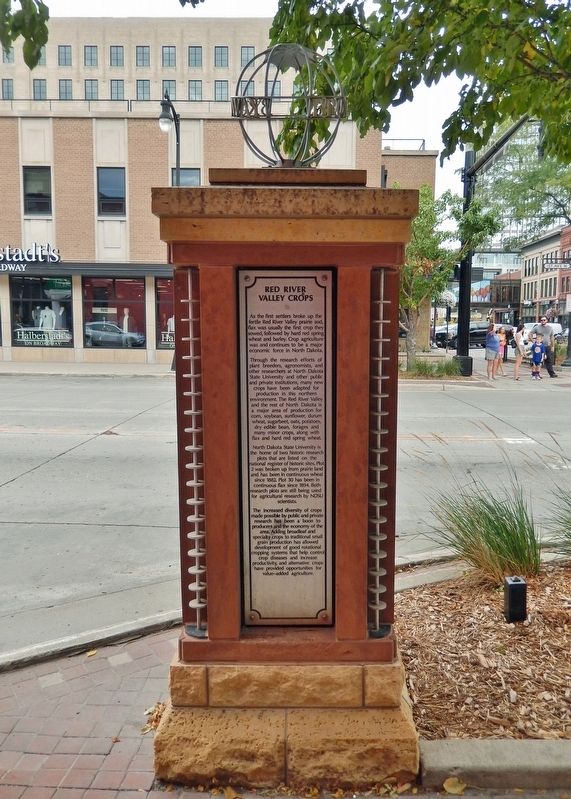
1. Red River Valley Crops Marker
As the first settlers broke up the fertile Red River Valley prairie sod, flax was usually the first crop they sowed, followed by hard red spring wheat and barley. Crop agriculture was and continues to be a major economic force in North Dakota.
Through the research efforts of plant breeders, agronomists, and other researchers at North Dakota State University and other public and private institutions, many new crops have been adapted for production in this northern environment. The Red River Valley and the rest of North Dakota is a major area of production for corn, soybean, sunflower, durum wheat, sugarbeet, oats, potatoes, dry edible bean, forages and many minor crops, along with flax and hard red spring wheat.
North Dakota State University is the home of two historic research plots that are listed on the national register of historic sites. Plot 2 was broken up from prairie land and has been in continuous wheat since 1882. Plot 30 has been in continuous flax since 1894. Both research plots are still being used for agricultural research by NDSU scientists.
The increased diversity of crops made possible by public and private
this page online
Topics and series. This historical marker is listed in these topic lists: Agriculture • Education • Science & Medicine • Settlements & Settlers. In addition, it is included in the National Register of Historic Places (NRHP) series list. A significant historical year for this entry is 1882.
Location. 46° 52.613′ N, 96° 47.275′ W. Marker is in Fargo, North Dakota, in Cass County. It is in Downtown. It is at the intersection of 1st Avenue North and Broadway North, on the right when traveling east on 1st Avenue North. The marker is located along the sidewalk near the southwest corner of the intersection. Touch for map. Marker is at or near this postal address: 74 Broadway North, Fargo ND 58102, United States of America. Touch for directions.

Regionally, this marker is in the Red River Valley.
Photographed by Cosmos Mariner, September 4, 2023
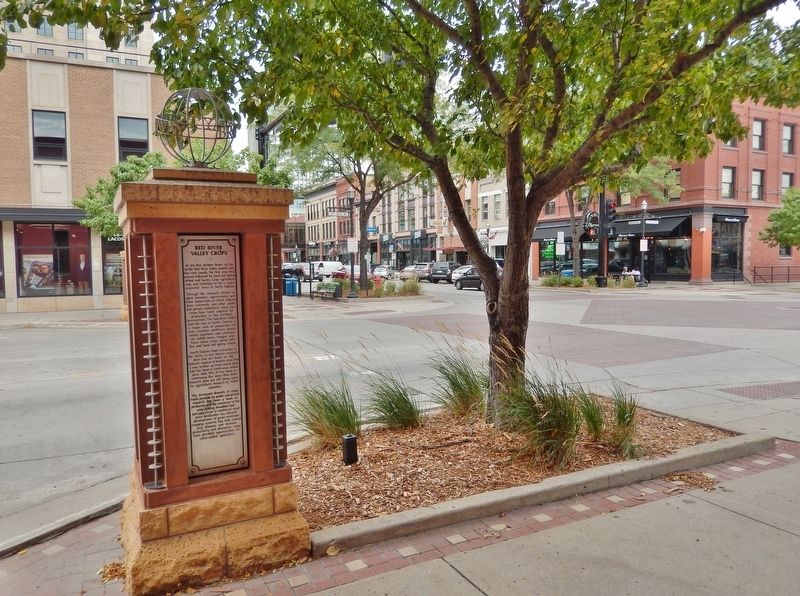
2. Red River Valley Crops Marker
Looking north across 1st Avenue North.
Other nearby markers. At least 8 other markers are within walking distance of this marker: Bonanza Farms (a few steps from this marker); Plains Art Museum (within shouting distance of this marker); City Hall & Library (within shouting distance of this marker); Machinery Row (within shouting distance of this marker); NDSU Agriculture (within shouting distance of this marker); Northern Pacific Railroad (about 300 feet away, measured in a direct line); Fargo & Southern Railroad (about 300 feet away); Osco Drug (about 400 feet away). Touch for a list and map of all markers in Fargo.
Also see . . .
1. Research Plot 2 (Wikipedia). Excerpt:
National Register of Historic Places #91001474.(Submitted on January 31, 2024, by Cosmos Mariner of Cape Canaveral, Florida.)
Research Plot 2 is located on the North Dakota State University campus in Fargo, North Dakota. The plot was established in 1882 on land that was brokenfrom native prairie sod. It has been sown to spring wheat continuously since that date. The plot was listed on the National Register of Historic Places in 1991. The plot is known as the oldest continuously cultivated wheat field site used in research.Photographed by Cosmos Mariner, September 4, 20233. Red River Valley Crops MarkerLooking northeast; Broadway and 1st Avenue North intersection is in the background.
2. Research Plot 30 (Wikipedia). Excerpt:
National Register of Historic Places #91001475.(Submitted on January 31, 2024, by Cosmos Mariner of Cape Canaveral, Florida.)
Research Plot 30 is a historic agriculture site on the North Dakota State University campus in Fargo, North Dakota. Flax was first planted at the site in 1894 by Professor Henry L. Bolley, a noted researcher in flax botany. By 1900, the flax plants were dead or dying. Bolley identified flax pathogens introduced by the plants themselves as the cause, and further identified resistant plants. Flax breeding programs from all over the world have sent material to NDSU to be tested for resistance to flax wilt in Plot 30. The site was listed on the National Register of Historic Places in 1991. At the time of the nomination, the site had been cultivated in flax for nearly a century.
Credits. This page was last revised on January 31, 2024. It was originally submitted on January 31, 2024, by Cosmos Mariner of Cape Canaveral, Florida. This page has been viewed 978 times since then and 139 times this year. Photos: 1, 2, 3. submitted on January 31, 2024, by Cosmos Mariner of Cape Canaveral, Florida.
