Wildwood in St. Louis County, Missouri — The American Midwest (Upper Plains)
Meramec Greenway - Rock Hollow Trail
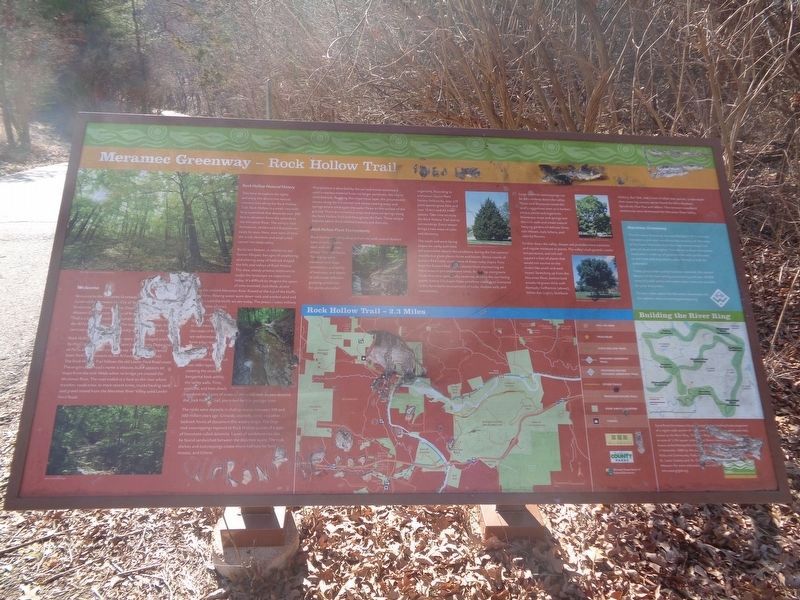
Photographed by Jason Voigt, January 31, 2024
1. Meramec Greenway - Rock Hollow Trail Marker
Marker has been subject of vandalism
Welcome
Welcome to the Meramec Greenway-Rock Hollow Trail, a partnership between the City of Wildwood, Great Rivers Greenway, Saint Louis County Department of Parks, and the Missouri Department of Natural Resources. The Rock Hollow Trail is a 2.3-mile, multi-use asphalt trail that connects with the Al Foster Memorial Trail. The topography is steep, so be cautious as the trail descends quickly and sharply into the valley.
Rock Hollow is a 252-acre open space park managed and leased by the City of Wildwood from Saint Louis County Department of Parks and Great Rivers Greenway. It adjoins Castlewood State Park and connects to the Al Foster Memorial Trail. The Rock Hollow Trail follows the old Lawler Ford Road route. The origin of the road's name is obscure, but it appears on maps from the mid-1860s when no bridge yet crossed the Meramec River. The road ended at a ford on the river where travelers could cross. In more recent times, trucks hauling sand and gravel mined from the Meramec River Valley used Lawler Ford Road.
Rock Hollow Natural History
Take time to explore the sights and enjoy the distinctive natural
this page online
Rocks last forever, in relation to our human lifespan, but ages of weathering and wearing away of bedrock shaped the hills and valleys of Rock Hollow. The slow, steady process continues to sculpt the landscape we experience today. It's difficult to imagine the spans of time involved. Just think, at one time the ancient Meramec River flowed at the top of the bluffs. Over time, flowing water wore down rock and eroded sand and soil to create the bluffs we see today. The process takes millions and millions of years.
Rocks are classified as igneous, metamorphic or sedimentary. All of the rocks of Rock Hollow are sedimentary, which form when minerals and material deposits accumulate. Layers of newer materials deposit over older layers, creating the strata of horizontal beds within the valley walls. Time, pressure,
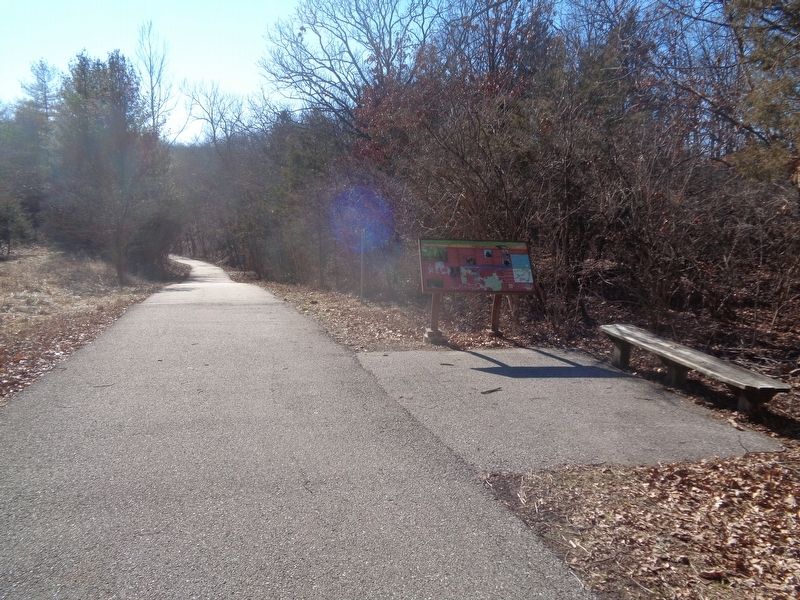
Photographed by Jason Voigt, January 31, 2024
2. Meramec Greenway - Rock Hollow Trail Marker
Marker is located off the Rock Hollow Trail, within a short distance from the trailhead
The rocks were deposits in shallow oceans between 300 and 500 million years ago. Crinoids, seashells, coral, and other bedrock fossils all document this watery origin. The large rock outcroppings exposed at Rock Hollow consist of a type of limestone called dolomite. Layers of sandstone can also be found sandwiched between the dolomite layers. The rock shelves and outcroppings create micro-habitats for ferns, mosses, and lichens.
Precipitation is absorbed by the soil and moves downward until it reaches material it can no longer penetrate, like clay or solid bedrock. Reaching the impervious layer, the groundwater moves along the horizontal rock strata creating seeps and springs where once again the water flows on the surface of the ground. There are numerous seeps and seasonal springs along the Rock Hollow Trail and throughout the Park. These unique features add to Rock Hollow's beauty and diversity.
Rock Hollow Plant Environments
Rock Hollow is a richly diverse Park site with several
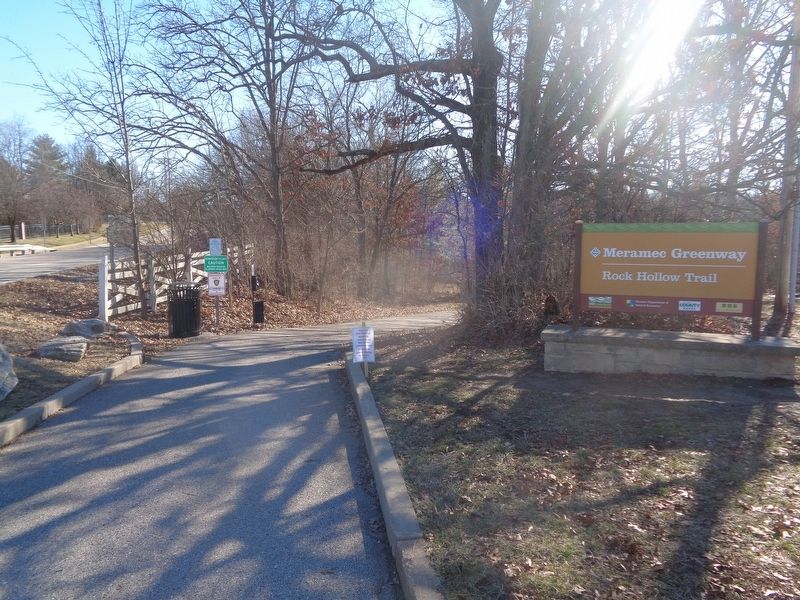
Photographed by Jason Voigt, January 31, 2024
3. Meramec Greenway - Rock Hollow Trail Marker
This is the trailhead located off Ridge Road and outside Ridge Meadows Elementary School
The south and west-facing slopes are rocky with little soil and exhibit desert-like conditions during the hot summer months but glade plants thrive and bloom. Dense stands of Eastern Red Cedar cover some of these rocky slopes. Fires kept the Eastern Red (unreadable) from encroaching on these areas in pre-settlement times. But today, evergreens choke the once open, rocky savannas, shading the sun-loving plants. Knarly Chinkapin Oaks somehow manage an existence in this formidable environment of rocks, shallow soils, and competition.
Large dolomite outcroppings can be seen midway down the valley. These rock exposures reveal the land's ruggedness even as it
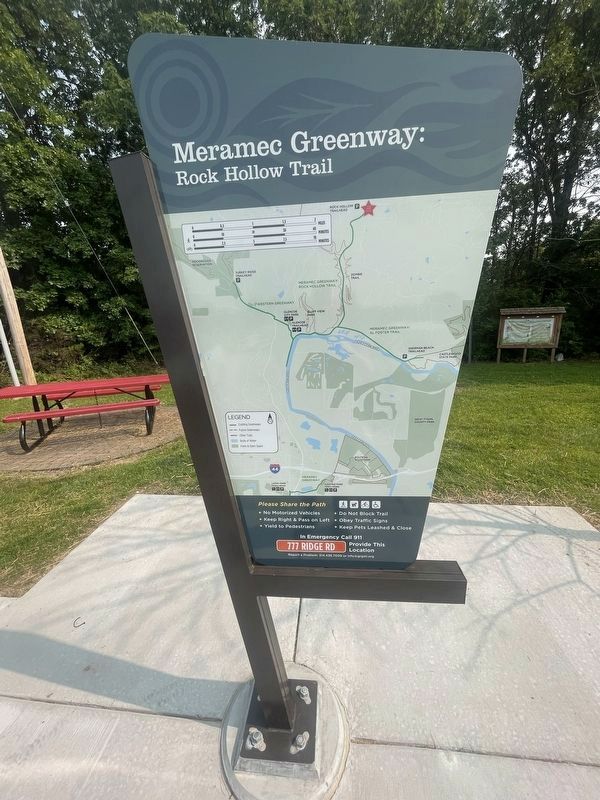
Photographed by Garrett Koch, June 2, 2025
4. Meramec Greenway - Rock Hollow Trail Marker
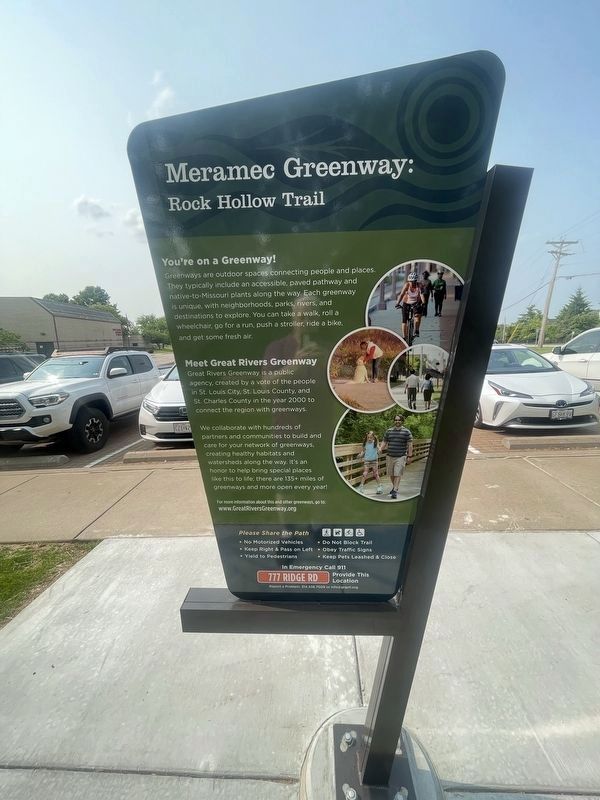
Marker is reported damaged (photo proof) and although I didn't have the chance to hike down the trail to look for it but I did find this sign where the trail meets the Ridge Meadows Elementary School parking lot. As a HMDB marker hound for the last couple years, I've found a lot of the standard, maroon-colored marker signboards replaced with these vertical signs, especially for Greenway locations which we have a lot of in the STL area due to the development of the "River Ring" project. This is SIDE 1.
Further down the valley, deeper soil provides more nutrients and regular moisture to plants. The valley's lush growth, cooler temperatures, and rich soil support a host of plants that would not survive on the desert-like south and west slopes. Stretching up from the Meramec River, bottomland woodland grows thick with Kentucky Coffeetree, White Ash, Shellbark Hickory, Bur Oak, and a host of other tree species. Underneath their towering canopy can be found the Ohio Buckeye, Spicebush, Paw Paw and others. This remnant woodland community once dominated the Meramec River Valley.
(aside:)
Meramec Greenway
The Meramec Greenway was established in 1975 with the mandate to plan and coordinate the recovery of 108 miles of the lower Meramec River that had deteriorated from years of abuse and neglect. The Meramec River Recreation Association, made up of governments with jurisdictions on the river and area citizens, was formed to lead the restoration.
Photographed by Garrett Koch, June 2, 2025
5. Meramec Greenway - Rock Hollow Trail Marker
This is side 2 of the recently added Meramec Greenway sign also uploaded into this marker page. The unfortunate thing about this trend is the loss of historical information provided to the visiting public. You can see the amount of information on the old Maroon-colored marker that is replaced with expanded details of the Great Rivers Greenway agency on this sign. It's unsure if this is truly a replacement for the older, damaged marker signboard.
Today good water quality has been restored, the natural beauty of the river setting is recovering and over 28,000 acres of public parks and conservation areas are available for your enjoyment.
To learn more about the Meramec Greenway visit the website: www.meramecgreenway.org
Erected by City of Wildwood, Great Rivers Greenway, Missouri Department of Natural Resources and Saint Louis County Parks.
Topics. This historical marker is listed in these topic lists: Environment • Horticulture & Forestry • Parks & Recreational Areas. A significant historical year for this entry is 1975.
Location. 38° 34.289′ N, 90° 36.032′ W. Marker has been damaged. Marker is in Wildwood, Missouri, in St. Louis County. It can be reached from Ridge Road south of Autumn Bluff Drive. Marker is located on the Rock Hollow Trail, close to the trailhead near Ridge Meadows Elementary School. Touch for map. Marker is at or near this postal address: 777 Ridge Rd, Ballwin MO 63021, United States of America. Touch for directions.

Regionally, this marker is in Greater St. Louis. It is also in the American Midwest, in the Lewis & Clark Corridor,

Photographed by Garrett Koch, September 8, 2026
6. Meramec Greenway - Rock Hollow Trail Marker - CONFIRMED MISSING!
Other nearby markers. At least 8 other markers are within 4 miles of this location, measured as the crow flies: Historic Grover (approx. 2 miles away); Historic Glencoe (approx. 2.3 miles away); Dedicated to World Peace (approx. 2.4 miles away); Historic Pond (approx. 2½ miles away); 20th Century History of Castlewood (approx. 3.2 miles away); Historic Route 66 (approx. 3.3 miles away); Site of John Ball Homestead (approx. 3½ miles away); Early Stewards of the Land: The Osage (approx. 3.6 miles away). Touch for a list and map of all markers in Wildwood.

Photographed by Garrett Koch, September 8, 2026
7. Meramec Greenway - Rock Hollow Trail Marker
Meramec Greenway - Rock Hollow Trail Marker - SIGNS OF MISSING MARKER - concrete footings where posts of marker signboard used to rest. As can be seen from the text of the inscription on this marker page, a lot of geological history of the Rock Hollow formation and evolutionary development will not longer be available to those visiting the site of this trail.
Credits. This page was last revised on September 15, 2026. It was originally submitted on February 1, 2024, by Jason Voigt of Glen Carbon, Illinois. This page has been viewed 424 times since then and 95 times this year. Photos: 1. submitted on February 1, 2024, by Jason Voigt of Glen Carbon, Illinois. 2, 3. submitted on February 2, 2024, by Jason Voigt of Glen Carbon, Illinois. 4, 5. submitted on March 24, 2026, by Garrett Koch of Saint Louis, Missouri. 6, 7. submitted on September 9, 2026, by Garrett Koch of Saint Louis, Missouri.
