Victoria in Victoria County, Texas — The American South (West South Central)
Victoria County

Photographed by Dave W, March 12, 2022
1. Victoria County Marker
1528 · 1685
Cabeza de Vaca · Cavelier de la Salle
Victoria County
Under the Mexican Government Victoria was a district in 1832, a Municipality in 1835. Under the Republic of Texas Victoria County was created March 17, 1836 with Victoria as the county seat. Its territory has since been materially reduced through the creation of other counties.
The principal industry of the people of the region during the 19th century was cattle raising. Here that industry had its origin in Texas, and Victoria County continues to the present day to be the leading cattle county of the state.
1836 1936
Erected jointly by the government of the United States and the State of Texas
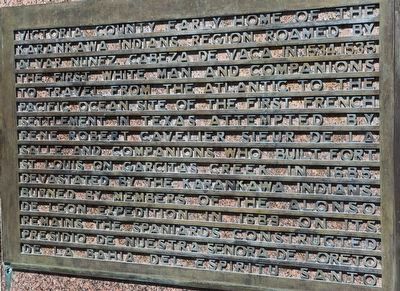
Victoria County early home of the Karankawa Indians. Region roamed by Alvar Nunez Cabeza de Vaca in 1534-1535, the first white man and companions to travel from the Atlantic to the Pacific Ocean. Site of the first French settlement in Texas attempted by Rene Robert Cavelier Sieur de La Salle and companions who built Fort St. Louis on Garcitas Creek in 1685. Devastated by the Karankawa Indians burned by members of the Alonso De Leon expedition in 1689. On its remains the Spaniards constructed Presidio de Nuestra Senora de Loreto de la Bahia Del Espiritu Santo.
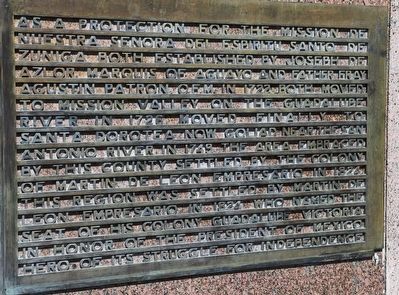
As a protection for the Mission de Nuestra Senora del Espiritu Santo de Zuniga both established by Joseph De Azlor, Marquis of Aguayo and Father Fray Agustin Patron, O.F.M. in 1722. Both moved to Mission Valley on the Guadalupe River in 1726. Moved finally to Santa Dorotea now Goliad near the San Antonio River in 1749. The area embraced by this county settled by the colony of Martin De Leon, Empresario, in 1824 who named the seat of his colony Guadalupe Victoria in honor of the president of Mexico hero of its struggle for Independence
Erected 1936 by Government of the United states and
this page online
Topics and series. This historical marker is listed in these topic lists: Agriculture • Exploration • Indigenous Peoples and Communities • Settlements & Settlers. In addition, it is included in the Texas 1936 Centennial Markers and Monuments series list. A significant historical year for this entry is 1528.
Location. 28° 48.078′ N, 97° 0.079′ W. Marker is in Victoria, Texas, in Victoria County. It is on East Power Avenue. Touch for map. Marker is at or near this postal address: 402 E Power Ave, Victoria TX 77901, United States of America. Touch for directions.

Regionally, this marker is in the American South and on the Gulf Coast. Globally, it is in North America, a Gulf of Mexico state, the Western Hemisphere, the Western World, and the Anglosphere. Historically, it finds itself in what was once New Spain, the Republic of Texas, and one of the Confederate States of America.
Other nearby markers. At least 8 other markers are within walking distance of this marker: Memorial Square (within shouting distance of this marker); Peter Underhay Pridham (within shouting distance
Photographed by Dave W, March 12, 2022
2. Victoria County Marker
Front Left Panel
Photographed by Dave W, March 12, 2022
3. Victoria County Marker
Front Right Panel
Photographed by Dave W, February 14, 2026
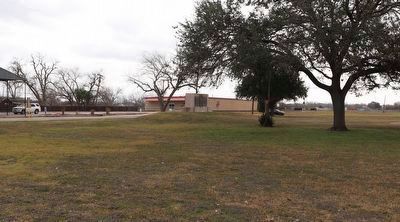
4. Victoria County Marker
Marker is the three panels on concrete in the center of the frame.
Photographed by Jeff Leichsenring, April 10, 2026
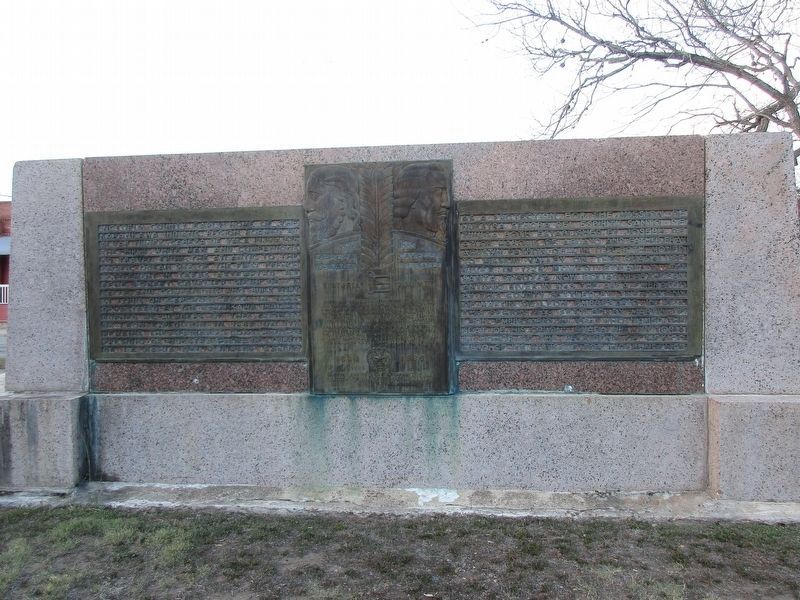
5. Victoria County Marker
Credits. This page was last revised on April 13, 2026. It was originally submitted on January 10, 2023, by Dave W of Co, Colorado. This page has been viewed 373 times since then and 31 times this year. Last updated on February 13, 2024, by Jeff Leichsenring of Garland, Texas. Photos: 1, 2, 3. submitted on January 10, 2023, by Dave W of Co, Colorado. 4. submitted on February 15, 2026, by Dave W of Co, Colorado. 5. submitted on April 13, 2026, by Jeff Leichsenring of Garland, Texas. • James Hulse was the editor who published this page.
