
Saint James in Dublin in County Dublin, Leinster, Ireland — Mid-East (and Dublin)
Wellington
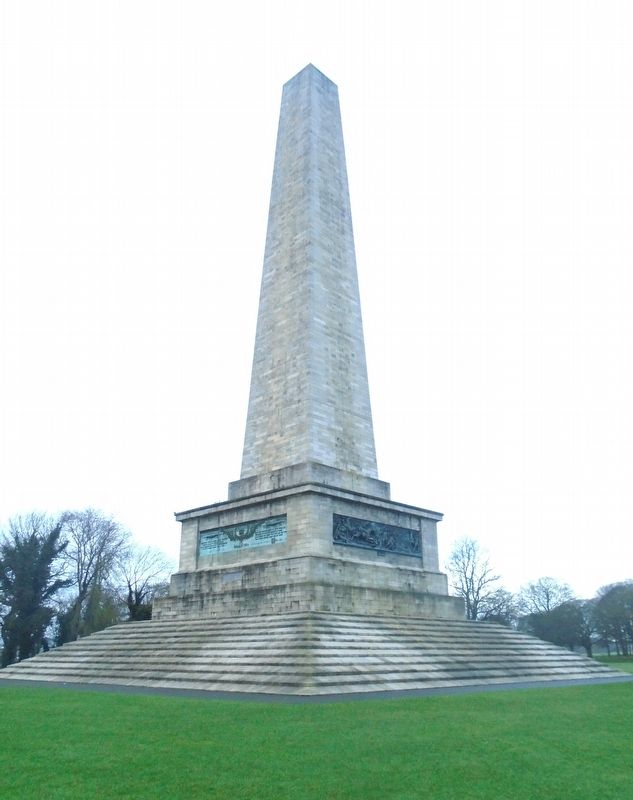
Photographed by William Fischer, Jr., February 7, 2024
1. Wellington Monument

Invincible in war thy deathless name,
Now round thy brow the civic oak we twine
That every earthly glory may be thine.
Invictum bello te coluere ducem,
Nuns unbrata ceris cimili tempora quercu
Ut desit famæ gloria nulla tu æ
[Bas relief panels]
Waterloo • India • [Civil and Religious Liberty]
Topics. This memorial is listed in these topic lists: Colonial Era • Patriots & Patriotism • Wars, Non-US. A significant historical year for this entry is 1815.
Location. 53° 20.944′ N, 6° 18.187′ W. Memorial is in Dublin, Leinster, in County Dublin. It is in Saint James. It is on Chesterfield Avenue 0.4 kilometers west of Parkgate Street/Conyngham Road (Route R109), on the left when traveling west. The monument is in Phoenix Park. Touch for map. Touch for directions.

Regionally, this memorial is in the Ancient East. Globally, it is on the Atlantic Ocean, in the North Atlantic Region, in Europe, on the Island of Ireland, on the Celtic Fringe, in the European Union, in Atlantic Europe, on one of the British Isles, in the Western World, and in the Anglosphere.
Other nearby markers. At least 8 other markers are within walking distance of this marker: The People's Flower Gardens / Gaírdíní Bláthanna an Phobaíl (about 150 meters away, measured in a direct line); Droichead
this page online
Regarding Wellington. From National Inventory of Architectural Heritage:
Freestanding granite obelisk, 62 metres tall, designed by Sir Robert Smirke as testimonial to Arthur Wellesley, Duke of Wellington. Foundation stone laid 1817, completed June 1861. Tapering, four-sided shaft with pyramidal apex, on three-stepped monumental pedestal. Each face contains bronze plaque cast from cannons captured at Waterloo. Bas-relief to north and west and south, that to north by Thomas Farrell depicts Battle of Waterloo, that to west by John Hogan depicts Civil and Religious Liberty, that to south by Joseph Kirk depicts Indian Wars. To east face inscription in Latin
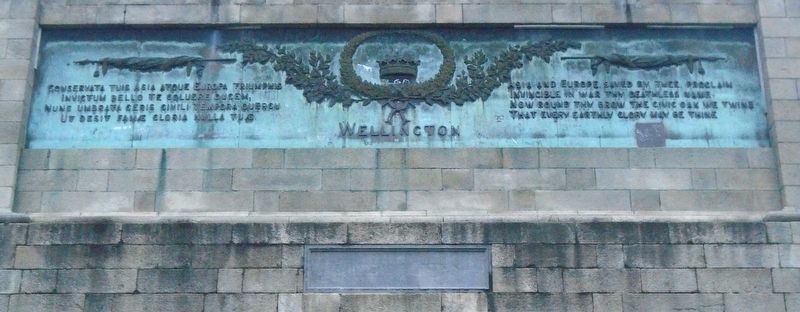
Photographed by William Fischer, Jr., February 7, 2024
2. Wellington Monument Dedication
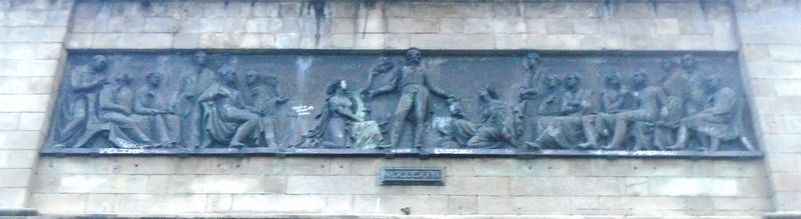
Photographed by William Fischer, Jr., February 7, 2024
3. Wellington Monument Civil and Religious Liberty Bas Relief
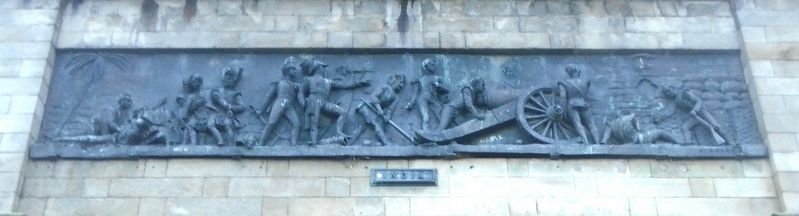
Photographed by William Fischer, Jr., February 7, 2024
4. Wellington Monument India Bas Relief
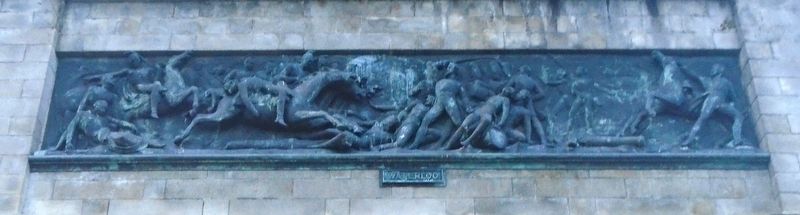
Photographed by William Fischer, Jr., February 7, 2024
5. Wellington Monument Waterloo Bas Relief
Credits. This page was last revised on February 16, 2024. It was originally submitted on February 15, 2024, by William Fischer, Jr. of Reynoldsburg, Ohio. This page has been viewed 164 times since then and 27 times this year. Photos: 1, 2, 3, 4, 5. submitted on February 15, 2024, by William Fischer, Jr. of Reynoldsburg, Ohio.
