Downtown Brooklyn in Kings County, New York — The American Northeast (Mid-Atlantic)
Clumber Corner
1.46 acres
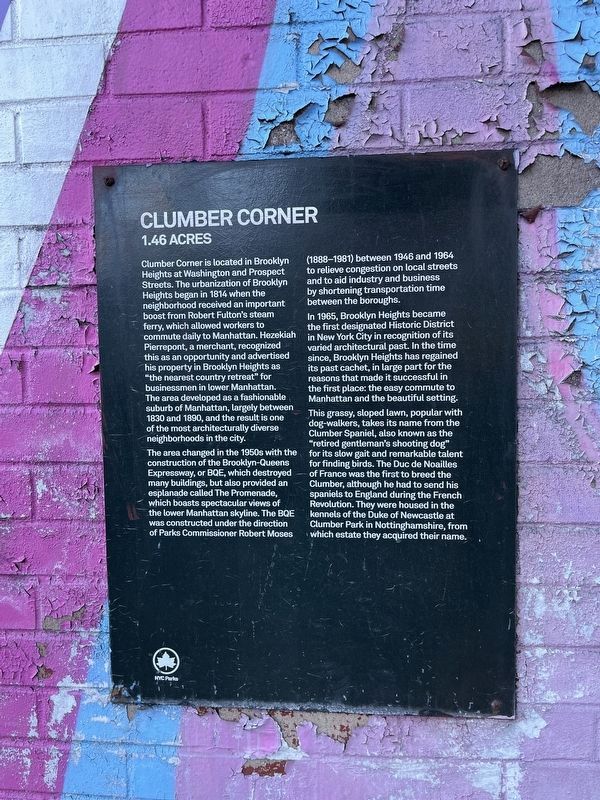
Clumber Corner is located in Brooklyn Heights at Washington and Prospect Streets. The urbanization of Brooklyn Heights began in 1814 when the neighborhood received an important boost from Robert Fulton's steam ferry, which allowed workers to commute daily to Manhattan. Hezekiah Pierrepont, a merchant, recognized this as an opportunity and advertised his property in Brooklyn Heights as "the nearest country retreat" for businessmen in lower Manhattan. The area developed as a fashionable suburb of Manhattan, largely between 1830 and 1890, and the result is one of the most architecturally diverse neighborhoods in the city.
The area changed in the 1950s with the construction of the Brooklyn-Queens Expressway, or BQE, which destroyed many buildings, but also provided an esplanade called The Promenade, which boasts spectacular views of the lower Manhattan skyline. The BQE was constructed under the direction of Parks Commissioner Robert Moses (1888-1981) between 1946 and 1964 to relieve congestion on local streets and to aid industry and business by shortening transportation time between the boroughs.
In 1965, Brooklyn
this page online
This grassy, sloped lawn, popular with dog-walkers, takes its name from the Clumber Spaniel, also known as the "retired gentleman's shooting dog" for its slow gait and remarkable talent for finding birds. The Duc de Noailles of France was the first to breed the Clumber, although he had to send his spaniels to England during the French Revolution. They were housed in the kennels of the Duke of Newcastle at Clumber Park in Nottinghamshire, from which estate they acquired their name.
Erected by NYC Parks.
Topics and series. This historical marker is listed in these topic lists: Animals • Parks & Recreational Areas • Roads & Vehicles • Waterways & Vessels. In addition, it is included in the NYC Parks series list. A significant historical year for this entry is 1814.
Location. 40° 42.047′ N, 73° 59.332′ W.
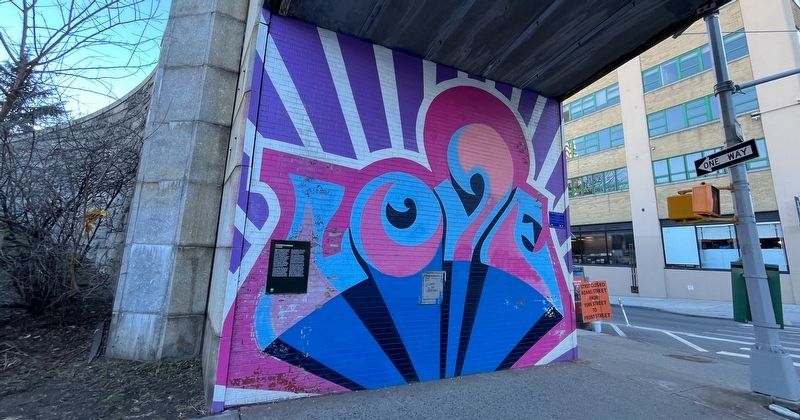

Regionally, this marker is in New York City and on Long Island. It is also in the American Northeast, in the Mid-Atlantic, and on the Eastern Seaboard. Globally, it is in the North Atlantic Region, North America, the Western Hemisphere, the Western World, and the Anglosphere. Historically, it finds itself in what was once New Netherland and also one of the original Thirteen Colonies.
Other nearby markers. At least 8 other markers are within walking distance of this marker: Heritage (about 400 feet away, measured in a direct line); a different marker also named Heritage (about 400 feet away); William Jay Gaynor (about 600 feet away); Maritcha R. Lyons Park (about 600 feet away); Dumbo Historic District (approx. 0.2 miles
Photographed by Devry Becker Jones (CC0), February 16, 2024
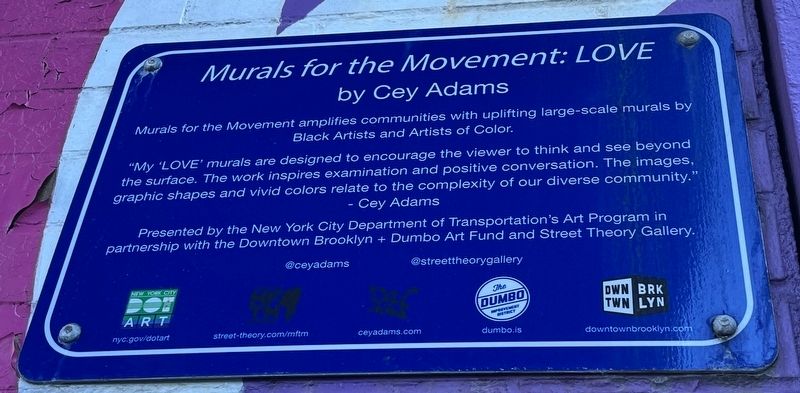
3. Interpretive sign for the mural behind the marker
Credits. This page was last revised on January 22, 2025. It was originally submitted on February 19, 2024, by Devry Becker Jones of Washington, District of Columbia. This page has been viewed 290 times since then and 29 times this year. Photos: 1, 2, 3. submitted on February 19, 2024, by Devry Becker Jones of Washington, District of Columbia.
