Donaldsonville in Ascension Parish, Louisiana — The American South (West South Central)
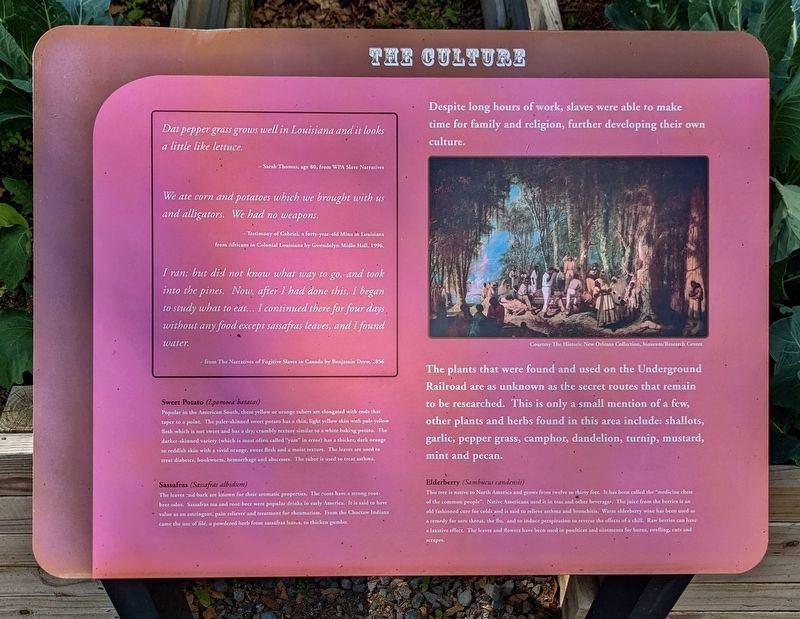
The Culture
Photographed by Cajun Scrambler, March 30, 2024
1. The Culture Marker
Despite long hours of work, slaves were able to make time for family and religion, further developing their own culture.
The plants that were found and used on the Underground Railroad are as unknown as the secret routes that remain to be researched. This is only a small mention of a few, other plants and herbs found in this area include: shallots, garlic, pepper grass, camphor, dandelion, turnip, mustard, mint and pecan.
Dat pepper grass grows well in Louisiana and it look a little like lettuce. - Sarah Thomas, age 80, from WPA Slave Narratives
We ate corn and potatoes which we brought with us and alligator. We had no weapons. - Testimony of Gabriel, a forty-year-old Mina in Louisiana from Africans in Colonial Louisiana by Gwendolyn Midlo Hall, 1996
I ran; but did not know what way to go and took into the pines. Now, after I had done this, I began to study what to eat... I continued there for four days without any food except sassafras leaves, and I found water. - from The Narratives of Fugitive Slaves in Canada by Benjamin Drew, 1856
Sweet Potatoes (Ipomoea batatas)
Popular in the American South, these yellow or orange tubers are elongated with ends that taper to a point. The paler-skinned sweet potato has a thin, light yellow skin with pale yellow flesh which is not sweet and has a dry, crumbly texture similar to a white baking potato. The darker-skinned variety (which is most often called "yam" in error) has a thicker, dark orange to reddish skin with a vivid orange, sweet flesh and a moist texture. The leaves are used to treat diabetes, hookworm, hemorrhage and abscesses. The tuber is used to treat asthma.
Sassafras (Sassafras albidum)
The leaves and bark are known for their aromatic properties. The roots have a strong root- beer odor. Sassafras tea and root-beer were popular drinks in early America. It is said to have value as an astringent, pain reliever and treatment for rheumatism. From the Choctaw Indians came the use of filé, a powdered herb from sassafras leaves, to thicken gumbo.
Elderberry (Sambucus candensis)
This tree is native to North America and grows from twelve to thirty feet. It has been called the "medicine chest of the common people". Native Americans used it in teas and other beverages. The juice from the berries is an old fashioned cure for colds and is said to relieve asthma and bronchitis. Warm elderberry wine has been used as a remedy for sore throat, the flu, and to induce perspiration to reverse the effects of a chill. Raw berries can have a laxative effect. The leaves and flowers have been used in poultices and ointments for burns, swelling, cuts and scrapes.
Erected by African
this page online
Topics. This historical marker is listed in these topic lists: Abolition & Underground RR • Agriculture.
Location. 30° 6.035′ N, 90° 59.326′ W. Marker is in Donaldsonville, Louisiana, in Ascension Parish. It can be reached from Williams Street east of Lessard Street, on the right when traveling east. Touch for map. Marker is at or near this postal address: 511 Williams Street, Donaldsonville LA 70346, United States of America. Touch for directions.

Regionally, this marker is in one of the River Parishes, in Acadiana — Cajun Country, and in Greater Baton Rouge. It is also in the American South, specifically in the Deep South, and in the Great River Road Region. Globally, it is in North America, a Gulf of Mexico state, the Western Hemisphere, the Western World, and the Anglosphere. Historically, it finds itself in what was once New Spain, the territory of the Mississippian Culture, the Louisiana Purchase, one of the Confederate States of America, and the Antebellum South.
Other nearby markers. At least 8 other markers are within walking

Photographed by Cajun Scrambler, March 30, 2024
2. The Culture Marker
Marker is second on left.
More about this marker. Located in the Freedom Garden, a community garden sponsored by the River Road African American Museum. Address given is for the museum, the Charles Street address has a locked gate.
Credits. This page was last revised on April 7, 2024. It was originally submitted on March 31, 2024, by Cajun Scrambler of Assumption, Louisiana. This page has been viewed 285 times since then and 34 times this year. Photos: 1, 2. submitted on March 31, 2024, by Cajun Scrambler of Assumption, Louisiana.
