Near Kinderhook in Columbia County, New York — The American Northeast (Mid-Atlantic)
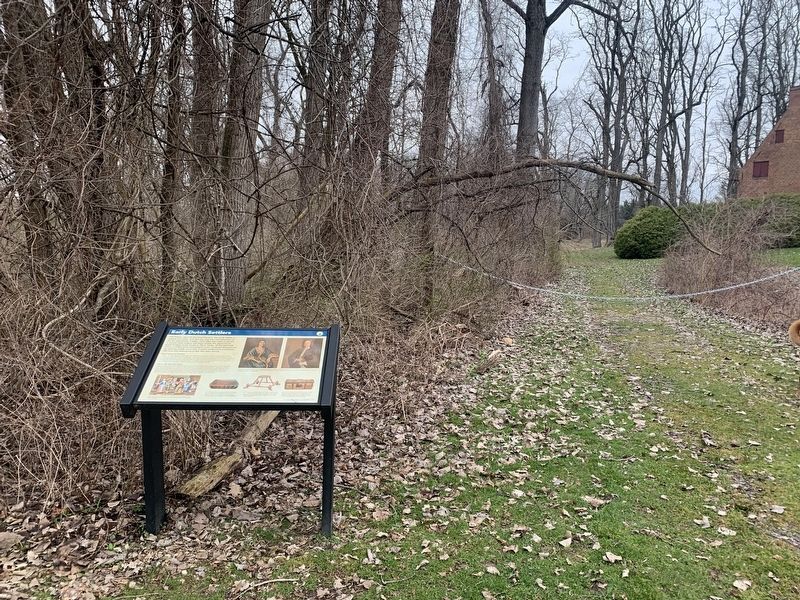
Early Dutch Settlers

Photographed by Steve Stoessel, March 28, 2024
1. Early Dutch Settlers Marker
The Dutch came to the New World in the early 1600s in search of riches, and quickly saw the vast potential of the fur and timber trades. Only after the need arose for a steady food supply did they realize the agricultural possibilities of the Hudson River Valley. At Kinderhook. Dutch settlers from Beverwyck (later renamed Albany) set up trading posts, sawmills, a small settlement and farms, like this one belonging to the Van Alen family.
Generations of Farmers
Lourens Van Alen was one of the early Dutch settlers at Kinderhook. In the 1600's, Lourens and his business partners began acquiring land from the native Mohican Indians. His Son Luykas built this sturdy and spacious house in 1737, and cultivated a farm that eventually grew to 500 acres. His descendants occupied the house for the next 200 years. By the 1930s, the farm had been reduced to just 33 acres. The last Van Alens to live in the house sold it to a distant cousin who later gave the house, land and funds sufficient for restoration to the Columbia County Historical Society.
Life at the Van Alen Farm
Over the years, as many as twenty people lived in this three
this page online
(photos and illustrations, from top right going clockwise)
Maria Muldor Van Alen (1683-c.1737) and Stephenus Van Alen (c.1800 - 1738/43) were the sister-in-law and brother of Luykas Van Alen. These oil paintings, dating to 1721 and attributed to Nehermiah Partridge, are among the earliest portraits of European settlers in the area that came to be known as Columbia County. Private Collection
The Van Alens kept important documents and precious items, including the family bible, in this keepsake box. Wrapped in beaver fur, the box exemplifies the trade relations between Dutch settlers and native Mohicans during the colonial
Photographed by Steve Stoessel, March 28, 2024
2. Early Dutch Settlers Marker
Children were especially cherished in colonial Dutch culture. This c. 18th century baby walker, made in New York, is typical of an early style of walker made in the Netherlands known as a loopwagen, designed to give toddlers secure mobility CCHS Collection
This Van Alen family bible, printed in Dutch and dating to 1741, represents the family’s adherence to the Dutch Reformed Church and continued use of the Dutch language at home/ As a register of births and deaths. It was also a repository of family history. CCHS Collection
This detail view from an 18" century serving tray depicts a Dutch-American family celebrating the birth of twins with their extended family and neighbors. CCHS Collection
Erected by Columbia County Historical Society.
Topics. This historical marker is listed in these topic lists: Agriculture • Colonial Era • Settlements & Settlers. A significant historical year for this entry is 1737.
Location. 42° 22.839′ N, 73° 41.469′ W. Marker is near Kinderhook, New York, in Columbia County. It can be reached from New York State Route 9H 0.2 miles north of Fischer Road, on the right when traveling south. Marker can be reached on foot from the Ichabod Crane Schoolhouse parking lot. Touch for map. Marker is at or near this postal address: 2589 NY-9H, Kinderhook NY 12106, United States of America. Touch for directions.

Regionally, this marker is in Upstate New York and in the Hudson Valley. It is also in the American Northeast and in the Mid-Atlantic. Globally, it is in North America, the Western Hemisphere, the Western World, and the Anglosphere. Historically, it finds itself in what was once New Netherland and also one of the original Thirteen Colonies.
Other nearby markers. At least 8 other markers are within walking distance of this marker: Eleanor Roosevelt at Ichabod Crane (a few steps from this marker); One-Room Schoolhouses (within shouting distance of this marker); Washington Irving (within shouting distance of this marker); Enslavement In The Hudson Valley (within shouting distance of this marker); Ichabod Crane (within shouting distance of this marker); Colonial Dutch Houses (1690-1750) (within shouting distance of this marker); The Original Ichabod Crane (within shouting distance of this marker); Van Alen Homestead (within shouting distance of this marker). Touch for a list and map of all markers in Kinderhook.
More about this marker. Marker is fifth on the Ichabod Crane Schoolhouse Trail.
Also see . . . Columbia County Historical Society. Listed on marker for information. A video tour of the Van Alen house is available here. (Submitted on April 8, 2024, by Steve Stoessel of Niskayuna, New York.)
Credits. This page was last revised on April 15, 2024. It was originally submitted on April 7, 2024, by Steve Stoessel of Niskayuna, New York. This page has been viewed 354 times since then and 47 times this year. Photos: 1, 2. submitted on April 7, 2024, by Steve Stoessel of Niskayuna, New York. • Michael Herrick was the editor who published this page.
