Osdorp in Amsterdam, North Holland, Netherlands — Northwestern Europe
Trijn Hulleman
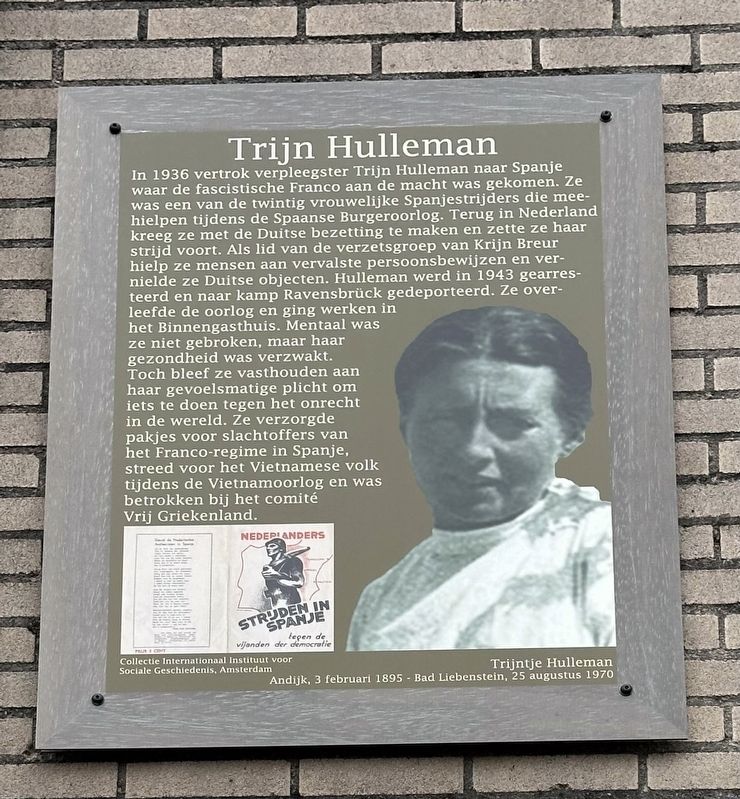
Photographed by Andrew Ruppenstein, March 16, 2024
1. Trijn Hulleman Marker

Andijk, 3 februari 1895 - Bad Liebenstein, 25 augustus 1970
In 1936 vertrok verpleegster Trijn Hulleman naar Spanje waar de fascistische Franco aan de macht was gekomen. Ze was een van de twintig vrouwelijke Spanjestrijders die meehielpen tijdens de Spaanse Burgeroorlog. Terug in Nederland kreeg ze met de Duitse bezetting te maken en zette ze haar strijd voort. Als lid van de verzetsgroep van Krijn Breur hielp ze mensen aan vervalste persoonsbewijzen en vernielde ze Duitse objecten. Hulleman werd in 1943 gearresteerd en naar kamp Ravensbrück gedeporteerd. Ze overleefde de oorlog en ging werken in het Binnengasthuis. Mentaal was ze niet gebroken, maar haar gezondheid was verzwakt. Toch bleef ze vasthouden aan haar gevoelsmatige plicht om iets te doen tegen het onrecht in de wereld. Ze verzorgde pakjes voor slachtoffers van het Franco-regime in Spanje, streed voor het Vietnamese volk tijdens de Vietnamoorlog en was betrokken bij het comité Vrij Griekenland.
In 1936, nurse Trijn Hulleman left for Spain, where the fascist Franco had come to power.
this page online
Erected 2024 by Geef Straten Een Gezicht.
Topics and series. This memorial is listed in these topic lists: Science & Medicine • War, World II • Women. In addition, it is included in the Give Streets a Face / Geef Straten Een Gezicht, and the Heroes of the Dutch Resistance (GSEG) series lists. A significant historical date for this entry is February 3, 1895.
Location. 52° 21.13′ N, 4° 47.05′ E.

Photographed by Andrew Ruppenstein, March 16, 2024
2. Trijn Hulleman Marker - wide view

Regionally, it is in Europe, the European Union, Atlantic Europe, the Benelux Low Countries, the Schengen Area, Western Europe, and the Western World. Historically, it finds itself in what was once the Holy Roman Empire.
Other nearby markers. At least 8 other markers are within walking distance of this marker: Irawan Soejono (here, next to this marker); Verzetsmonument / Resistance Monument (within shouting distance of this marker); Joop Woortman (within shouting distance of this marker); Jacob Paff (within shouting distance of this marker); Jan Peppink (within shouting distance of this marker); Eduard Hellendoorn (about 90 meters away, measured in a direct line); Cornelis Dijksterhuis (about 120 meters away); Geertruida van Lier (about 120 meters away). Touch for a list and map

Photographed by Ada Nanning, November 12, 2020
3. Trijn Hulleman Marker
Trijn and plane to spain
Also see . . . HULLEMAN, Trijntje (Internationaal Institute voor Sociale Geschiednis, in Dutch).
Excerpt (in translation): From an early age, Trijn felt it was her duty to do something against injustice in the world. As a member of the Social Democratic Party of the Netherlands, she often spoke out sharply about social abuses in society. When fascism continued to advance in Germany and the number of Jewish and political refugees seeking safety in the Netherlands increased, Trijn is committed to helping them wherever she can.(Submitted on April 15, 2024.)
When the 'Aid to Spain' Committee calls on medical personnel to register to be deployed to Spain, Trijn, a qualified nurse, signs up. In October 1936 she left with the first group, together with the doctor Gerrit Kastein, Janny Scheele, Hennie Peeks, Hinke Kerner and her husband Harry Kan, with a Dutch ambulance plane to Spain.
Credits. This page was last revised on February 5, 2025. It was originally submitted on April 15, 2024, by Andrew Ruppenstein of Lamorinda, California. This page has been viewed 409 times since then and 30 times this year. Photos: 1, 2. submitted on April 15, 2024, by Andrew Ruppenstein of Lamorinda, California. 3. submitted on January 28, 2025, by Ada Nanning of Calgary, Alberta.
