Prime Hook Beach in Milford in Sussex County, Delaware — The American Northeast (Mid-Atlantic)
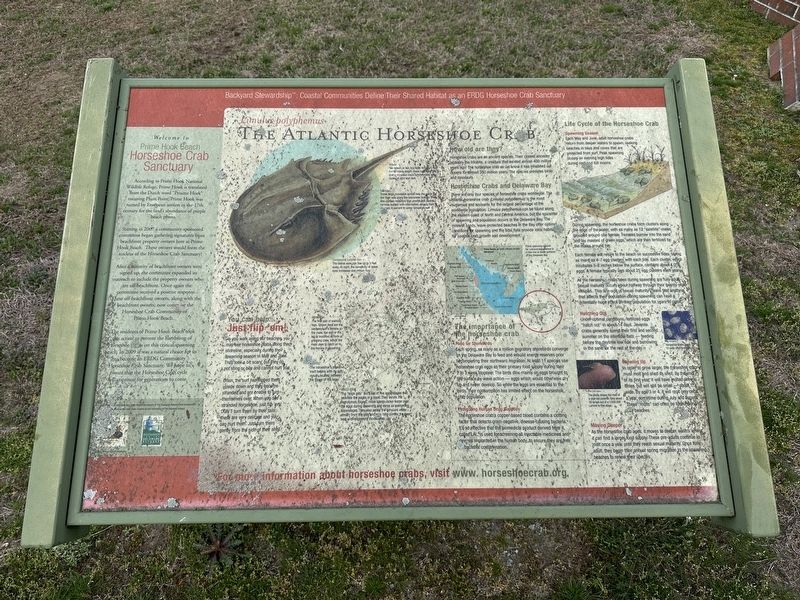
The Atlantic Horseshoe Crab
Limulus polyphemus
| — | Backyard Stewardship Horseshoe Crab Sanctuary Program | — |
Photographed by Pete Skillman, April 14, 2024
1. The Atlantic Horseshoe Crab Marker
According to Prime Hook National Wildlife Refuge, Prime Hook is translated from the Dutch word "Priume Hoek" meaning Plum Point. Prime Hook was named by European settlers in the 17th century for the land's abundance of purple beach plums.
Starting in 2007 a community-sponsored committee began gathering signatures from beachfront property owners here at Prime Hook Beach. These owners would form the nucleus of the Horseshoe Crab Sanctuary!
After a majority of beachfront owners were signed up, the committee expanded its outreach to include the property owners who are off-beachfront. Once again the committee received a positive response. These off-beachfront owners, along with the beachfront owners, now comprise the Horseshoe Crab Community of Prime Hook Beach.
The residents of Prime Hook Beach took this action to prevent the harvesting of Horseshoe Crabs on this critical spawning beach. In 2009 it was a natural choice for us to become an ERDG Community Horseshoe Crab Sanctuary. We hope to ensure that the Horseshoe Crab cycle will continue for generations to come.
You can help…
Just flip em!
As
this page online
Often, the surf has flipped them upside down and they become stranded and are unable to turn themselves over. When you see a stranded horseshoe, just flip 'em! Don't turn them by their tails; these are very delicate and you can hurt them. Just turn them gently from the side of their shell.
How old are they?
Horseshoe crabs are an ancient species. Their closest ancestor is probably the trilobite, a creature that existed almost 500 million years ago! The horseshoe crab as we know it has inhabited our oceans for 450 million years. The species predates birds and dinosaurs.
Horseshoe Crabs and Delaware Bay
There are only species of horseshoe crabs worldwide. The Atlantic horseshoe crab (Limulus polyphemus) is the most numerous and accounts for the largest percentage of the worldwide population. Limulus polyphemus can be found along the eastern coast of North and Central America, but the epicenter of spawning and population
Photographed by Pete Skillman, April 14, 2024
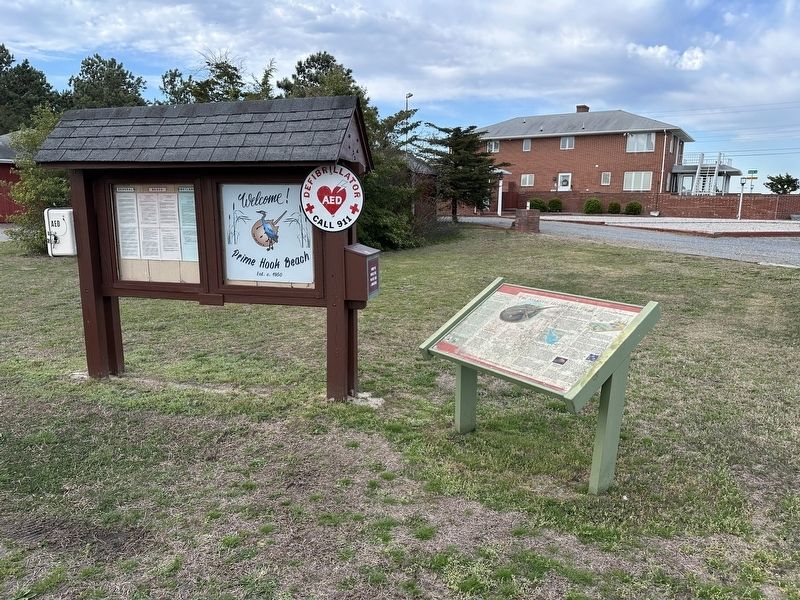
2. The Atlantic Horseshoe Crab Marker wide view
The importance of the horseshoe crab
Food for Shorebirds
Each spring, as many as a million migratory shorebirds converge on the Delaware Bay to feed and rebuild energy reserves prior to completing their northward migration. At least 11 species use horseshoe crab eggs as their primary food supply during their 2 to 3 week stopover. The birds dine mainly on eggs brought to the surface by wave action — eggs which would otherwise dry up and never develop. So while the eggs are essential to the birds, their consumption has limited effect on the horseshoe crab population.
Protecting Human Drug Supplies
The horseshoe crab's copper-based blood contains a clotting factor that detects gram-negative, disease-causing bacteria. It's so effective that the biomedical product derived from it, called LAL, is used for screening all injectable medicines and devices implanted in the human body, to ensure they are free of bacterial contamination.
Life Cycle of the Horseshoe Crab
Spawning Season
Each May and June, adult horseshoe crabs return from deeper waters to spawn, seeking beaches in bays and coves that are protected from surf. Peak spawning occurs on evening high tides during new and full moons.
During spawning, the horseshoe crabs form clusters along the edge of the water, with as many as 12 "satellite" males grouped around one female. Females burrow into the sand and lay masses of green eggs, which are then fertilized by the males around her.
Each female will return to the beach on successive tides, laying as many as 4-7 egg clusters with each tide. Each cluster, which incubates 5-8 inches below the surface, contains about 4,000 eggs. A female typically slays about 25 egg clusters each year.
All the horseshoe crabs seen during spawning are fully adult. Sexual maturity occurs about halfway through their twenty-year lifespan. This late-age of sexual maturity means that anything that affects their population during spawning can have a potentially huge effect on their population for years to come.
Hatching Out
Under optimal conditions, fertilized eggs "hatch out" in about 14 days. Juvenile crabs generally spend their first and second summer on the intertidal flats — feeding before daytime low tide and burrowing in the sand for the rest of the day.
Growing Up
In order to grow larger, the horseshoe crab must molt and shed its shell. By the end of its first year, it will have molted several times, but will still be small — about 1/2" wide. By age 3 or 4, it will molt only once a year, sometime during July and August. These "molts" can often be found along bay beaches.
Moving Deeper
As the horseshoe crab ages, it moves to deeper waters where it can find a larger food supply. These pre-adults continue to molt once a year until they reach sexual maturity. Once fully adult, they begin their annual spring migration to the spawning beaches to renew their species.
Erected by Ecological Research & Development Group and the Town of Prime Hook Beach.
Topics. This historical marker is listed in these topic lists: Animals • Environment • Settlements & Settlers • Waterways & Vessels. A significant historical year for this entry is 2007.
Location. 38° 51.312′ N, 75° 14.649′ W. Marker is in Milford, Delaware, in Sussex County. It is in Prime Hook Beach. It is on Snow Goose Road, on the left when traveling south. Touch for map. Marker is at or near this postal address: 9661 Snow Goose Rd, Milford DE 19963, United States of America. Touch for directions.

Regionally, this marker is in the American Mid-Atlantic, on the Delmarva Peninsula, and on the Eastern Seaboard. Globally, it is in the North Atlantic Region, North America, the Western Hemisphere, the Western World, and the Anglosphere. Historically, it finds itself in what was once New Netherland, one of the original Thirteen Colonies, and the Antebellum South.
Other nearby markers. At least 8 other markers are within 5 miles of this marker, measured as the crow flies: Wood Ducks (approx. 1.6 miles away); The Morris Cemetery (approx. 1.7 miles away); Delaware Bay Initiative (approx. 1.7 miles away); History of Prime Hook National Wildlife Refuge (approx. 1.7 miles away); Songbirds (approx. 2.2 miles away); a different marker also named The Atlantic Horseshoe Crab (approx. 2½ miles away); Cedar Creek Hundred (approx. 4.1 miles away); Zion United Methodist Church (approx. 4.1 miles away).
Additional commentary.
1. About the marker
While the majority of the marker describes the biology of the horseshoe crab, it also serves as a historical marker because it shares how the Town of Prime Hook Beach became involved in protecting the species, as well as some early colonial history of the area.
— Submitted April 15, 2024, by Pete Skillman of Wilmington, Delaware.
Credits. This page was last revised on April 18, 2024. It was originally submitted on April 15, 2024, by Pete Skillman of Wilmington, Delaware. This page has been viewed 203 times since then and 17 times this year. Photos: 1, 2. submitted on April 15, 2024, by Pete Skillman of Wilmington, Delaware. • Bill Pfingsten was the editor who published this page.
