
Nottingham in Nottinghamshire, England, United Kingdom — Northwestern Europe (the British Isles)
Archaeology of the Lace Market (2)
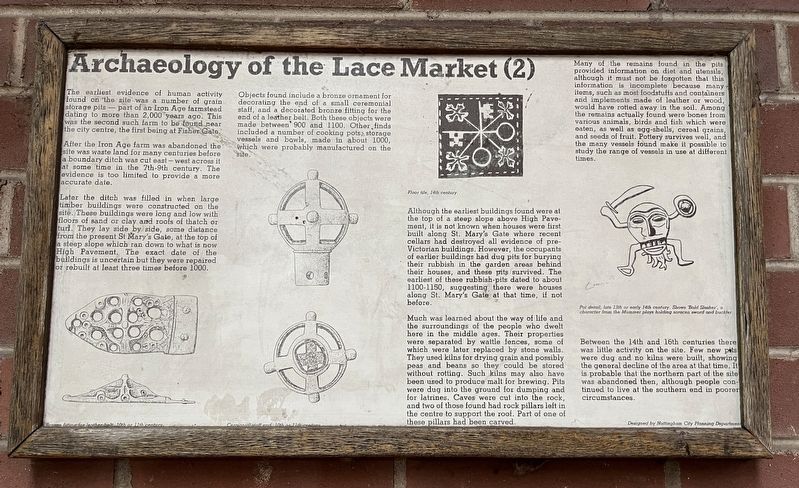
Photographed by Ray Gurganus
1. Archaeology of the Lace Market Marker
After the Iron Age farm was abandoned the site was waste land for many centuries before a boundary ditch was cut east-west across it at some time in the 7th-9th century. The evidence is too limited to provide a more accurate date.
Later the ditch was filled in when larges timber buildings were constructed on the site. These buildings were long and low with floors of sand or clay and tools of thatch or turf. They lay side by side, some distance from the present St Mary's Gate, at the of a steep slope which ran down to what is now High Pavement. The exact date of the buildings is uncertain but they were repaired or rebuilt at least three times before 1000.
Objects found include a bronze ornament for decorating the end of a small ceremonial staff, and a decorated bronze fitting for the end of a leather belt. Both these objects were made between 900 and 1100. Other,
this page online
Although the earliest buildings found were at the top of a steep slope above High Pavement, it is not known when houses were first built along St. Mary's Gate where recent cellars had destroyed all evidence of pre-Victorian buildings. However, the occupants of earlier buildings had dug pits for burying their rubbish in the garden areas behind their houses, and these pits survived. The earliest of these rubbish-pits dated to about 1100-1150, suggesting there were houses along St. Mary's Gate at that time, if not before.
Much was learned about the way of life and the surroundings of the people who dwelt here in the middle ages. Their properties were separated by wattle fences, some of which were later replaced by stone walls. They used kilns for drying grain and possibly peas and beans so they could be stored without rotting. Such kilns may also have been used to produce malt for brewing. Pits were dug into the ground for dumping and for latrines. Caves were cut into the rock, and two of those found had rock pillars left in the centre to support the roof. Part of one of these pillars had been carved.
Many of the remains found in the pits provided information on diet and utensils, although it must not be forgotten that this information is incomplete because many items, such as most foodstuffs and containers and implements made of leather or wood, would have rotted away in the soil. Among the remains actually found were bones from various animals, birds and fish which were eaten, as well as egg-shells, cereal grains, and seeds of fruit. Pottery survives well, and the many vessels found make it possible to study the range of vessels in use at different times.
Between the 14th and 16th centuries there was little activity on the site. Few new pets were dug and no kilns were built, showing the general decline of the area at that time. It is probable that the northern part of the site was abandoned then, although people continued to live at the southern end in poorer circumstances.
Erected by Nottingham City Planning Department. (Marker Number 2.)
Topics. This historical marker is listed in these topic lists: Agriculture • Anthropology & Archaeology • Settlements & Settlers.
Location. 52° 57.088′ N, 1° 8.64′ W. Marker is in Nottingham, England, in Nottinghamshire. It is at the intersection of Saint Mary's Gate and Kayes Walk, on the left when traveling north on Saint Mary's Gate. Touch for map. Marker is at or near this postal address: 44 St Mary's Gate, Nottingham, England NG1 1QN, United Kingdom. Touch for directions.

Regionally, this marker is in England’s Midlands. Globally, it is on the Atlantic Ocean, in the North Atlantic Region, in Europe, in Atlantic Europe, on one of the British Isles, in the Western World, and in the Anglosphere. Historically, it finds itself in what was once the Roman Empire.
Other nearby markers. At least 8 other markers are within walking distance of this marker: Archaeology of the Lace Market (1) (here, next to this marker); Lace Market 19th Century (here, next to this marker); The Lace Market in the 16th, 17th & 18th centuries (here, next to this marker); Robin Hood Dies: The Legend Lives On (within shouting distance of this marker); The Council House and Exchange Buildings (approx. 0.4 kilometers away); Robin Hood and Friar Tuck (approx. half a kilometer away); Robin Hood Meets His Match (approx. half a kilometer away); Rebel City (approx. 0.6 kilometers away). Touch for a list and map of all markers in Nottingham.
Credits. This page was last revised on April 23, 2024. It was originally submitted on April 22, 2024, by Ray Gurganus of Washington, District of Columbia. This page has been viewed 111 times since then and 17 times this year. Photo 1. submitted on April 22, 2024, by Ray Gurganus of Washington, District of Columbia. • Andrew Ruppenstein was the editor who published this page.
