Manassas, Virginia — The American South (Mid-Atlantic)
Wartime Manassas
Prelude to First Manassas
Photographed by Craig Swain, September 2, 2007
1. Wartime Manassas - Prelude to First Manassas Marker
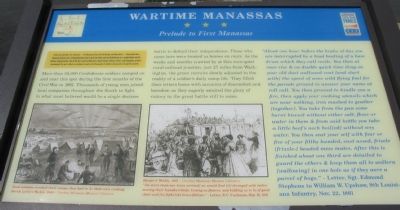
(Preface): During the Civil War, two railroads—the Manassas Gap and the Orange and Alexandria—intersected here. Manassas Junction was strategically important to both the Union and the Confederacy as a supply depot and for military transportation. Two of the war’s great battles were fought nearby. Diaries, letters, and newspaper articles documented the war’s effects on civilians as well as the thousands of soldiers who passed through the junction.
More than 34,000 Confederate soldiers camped on an near this spot during the first months of the Civil War in 1861. Thousands of young men joined local companies throughout the South to fight in what most believed would be a single decisive battle to defend their independence. Those who came here were treated as heroes en route. As the weeks and months crawled by at this once-quiet rural railroad junction, just 27 miles from Washington, the green recruits slowly adjusted to the reality of a soldier’s daily camp life. They filled their letters home with accounts of discomfort and boredom as they eagerly awaited the glory of victory in the great battle still to come.
“About one hour before the brake of day you are interrupted by a loud beating of a base drum which they call revile. You then at once rise & on double quick time drag on your old dust wallowed coat [and start with] the speed of some wild flying fowl for the parade ground to answer your name at roll call. You then proceed to kindle you a fire, then apply your cooking utensils which are near nothing, iron mashed to geather [together]. You take from the pan some burnt biscuit without either salt, flour or water in them & from said kettle you take a little beef’s neck boil[ed] without any water. You then seat your self with four or five of your filthy handed, snot nosed, frisele [frizzle-]headed mess mates. After this is finished about one third are detailed to guard the others & keep them all to wollern [wallowing] in one hole as if they were a parcel of hogs.”
this page online
Erected by Civil War Trails.
Topics and series. This historical marker is listed in this topic list: War, US Civil. In addition, it is included in the Virginia Civil War Trails, and the Virginia, Wartime Manassas Walking Tour series lists. A significant historical date for this entry is October 22, 1688.
Location. 38° 44.97′ N, 77° 28.303′ W. Marker is in Manassas, Virginia. It is on Prince William Street near Main Street, on the right when traveling east. At the entrance to the Manassas Museum. Touch for map. Marker is in this post office area: Manassas VA 20110, United States of America. Touch for directions.

Regionally, this marker is in the Washington Metropolitan Area and in Northern Virginia. It is also in the American South, specifically in the Upper South, and in the Mid-Atlantic. Globally, it is in North America, the Western Hemisphere, the Western World, and the Anglosphere. Historically, it finds itself in what was once the territory of the Mississippian Culture, one of the original Thirteen Colonies, one of the Confederate States
Photographed by Craig Swain, September 2, 2007
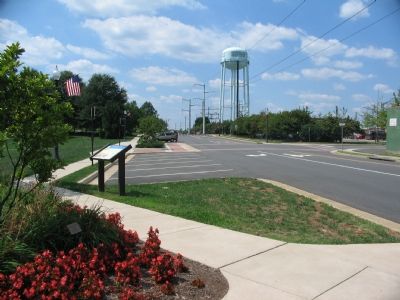
2. Looking West on Prince William Avenue
Across the street, to the right, is the Manassas Junction Station. About a half mile further west down the road is the actual juncture of the two railroads.
Other nearby markers. At least 8 other markers are within walking distance of this marker: Occupation or Liberation (within shouting distance of this marker); Burning of Manassas (within shouting distance of this marker); Jackson's Raid (within shouting distance of this marker); a different marker also named War on the Landscape (within shouting distance of this marker); a different marker also named Manassas (about 300 feet away); Manassas Veterans Memorial (about 300 feet away); Liberty Street / First African-American School (about 300 feet away); a different marker also named Wartime Manassas (about 400 feet away). Touch for a list and map of all markers in Manassas.
Other markers no longer nearby. Manassas 1905 - The Great Fire (was within shouting distance of this marker but has been permanently removed); War on the Landscape (was within shouting distance of this marker but has been replaced with another marker now near it); The Manassas Museum (was about 300 feet away, measured in a direct line but has been replaced with another marker now near it); Manassas (was about 300 feet
Photographed by Craig Swain, September 2, 2007
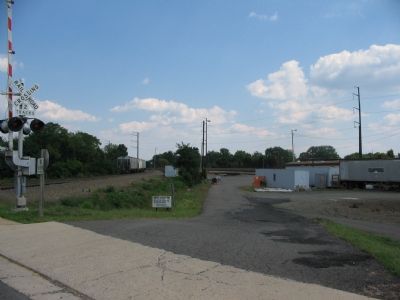
3. Railroad Junction
Not elegant, but non-the-less historic. On the left is the old Manassas Gap Railroad. On the right is what used to be the Orange and Alexandria Railroad. This picture was taken from Stonewall Road, where it crosses into the triangle formed by the junction.
More about this marker. On the lower left, the marker has a drawing of camp life, “Once soldiers reached their camps, they had to do their own cooking.” from Frank Leslie’s Weekly, 1863.
The lower center has a drawing of soldiers departing on a train, from Harper’s Weekly, 1861. “[In every town our train arrived] we would find [it] thronged with ladies moving their handkerchiefs, tossing us flowers, and bidding us to be of good cheer and [to] fight like brave fellows.” —Letter, B.C. Cushman, May 16, 1861.
Related markers. Click here for a list of markers that are related to this marker. To better understand the relationship, study each marker in the order shown.
Also see . . .
1. Orange and Alexandria Railroad. Wikipedia entry (Submitted on October 31, 2023, by Larry Gertner of New York, New York.)
2. Manassas Gap Railroad. Wikipedia entry (Submitted on October 31, 2023, by Larry Gertner of New York, New York.)
Credits. This page was last revised on October 31, 2023. It was originally submitted on September 11, 2007, by Craig Swain of Leesburg, Virginia. This page has been viewed 2,103 times since then and 43 times this year. Photos: 1, 2, 3. submitted on September 11, 2007, by Craig Swain of Leesburg, Virginia. • J. J. Prats was the editor who published this page.
