University in Louisville in Jefferson County, Kentucky — The American South (East South Central)
Freedom Park: A Journey to Freedom
Reconstruction ⎯⎯⎯ Readjustment
Photographed by Darren Jefferson Clay, April 7, 2024
1. Freedom Park: A Journey to Freedom Marker
Inscription.
Freedom Park: A Journey to Freedom. Reconstruction, also, Readjustment. The United States faced two fundamental tasks during the Reconstruction period (1865-1877). One was the need to redefine and renormalize relations between the former Confederate states and the rest of the nation. The other was to redefine the role of race, the meaning of freedom and the place of African Americans in a society in which slavery was no longer legal and in which those formerly enslaved were presumably free and equal. Kentucky was often at odds with national policy during this tumultuous time., Nearly as soon as slavery ended, Kentucky attempted to limit the meaning of black freedom by prohibiting African Americans from testifying in court, serving on juries and voting. Miscegenation was outlawed. Schools were segregated, if there were schools at all. Tax rolls, schools and marriage and other public records were separated by race. Blacks were subject to more severe penalties for various crimes than were whites. Economic opportunities available to African Americans were restricted to menial, domestic or agricultural labor. Lynching was widespread, particularly in the Bluegrass region and there was sufficient racial violence and social turmoil to warrant placing Kentucky under the jurisdiction of the Freedmen's Bureau In January 1866, making Kentucky the only non-Confederate state to earn that dubious distinction. Ultimately, civil rights for African Americans were secured through the 13th, 14th and 15th Amendments, but the ability to exercise those rights was constrained by the continuing opposition of white Kentuckians., The Civil War also disrupted normal political alliances within the state and created a vacuum in which competing interests strove for dominance. The result was a triumphant Democratic party comprised of conservatives and former Confederates who, failing to conquer Kentucky by the bullet, did so by the ballot. By 1877, Kentucky was viewed as Southern in thought and sympathies and the promise of freedom for all Kentuckians had been betrayed. , continued..., continued... , The end of the Civil War brought tremendous energy and optimism to African Americans throughout the United States. In Louisville, African Americans celebrated and paraded well into the summer of 1865. Black population increased by 120 percent between 1860 and 1870, and by another 40 percent between 1870 and 1880 as thousands of dispossessed African Americans from rural Kentucky converged on the city in search of work, safety and community. Rapid population growth produced extreme crowding and prompted the evolution of new black neighborhoods in the city and new black hamlets elsewhere in Jefferson County, each of which soon became home to at least one school and at least one church., Greater numbers, a pre-existing black community structure, and the continued presence of federal troops enabled Louisville African Americans to lead the state in the struggle for freedom and empowerment. In December 1868, Horace Morris was appointed one of the few black cashiers of the Freedmen's Savings and Trust Bank and served until the bank closed in 1874. "Freedom rides" were organized through Quinn Chapel A.M.E. church to challenge segregation on local streetcars as early as 1870. In October 1870, petitions and protests resulted in the first public schools for African Americans in the city and, by 1873, the opening of the Central Colored School at 6th and Kentucky Streets. Also, on November 25, 1879, the Kentucky Normal and Theological Institute opened at 7th and Kentucky streets, later renamed State University In 1882 and Simmons University in 1919., A new leadership class emerged that included ministers, teachers, small business owners, Nathaniel R. Harper, the first black attorney in Kentucky, and Dr. Henry Fitzbutler, the first black physician in the state. Some allied with influential whites and encouraged African Americans to better themselves within the constraints of segregation. Others championed the cause of racial equality and justice, and often demanded a larger role within the Republican Party., By the end of Reconstruction, Louisville African Americans had expanded and strengthened their community and, although still embattled, remained guardedly optimistic.
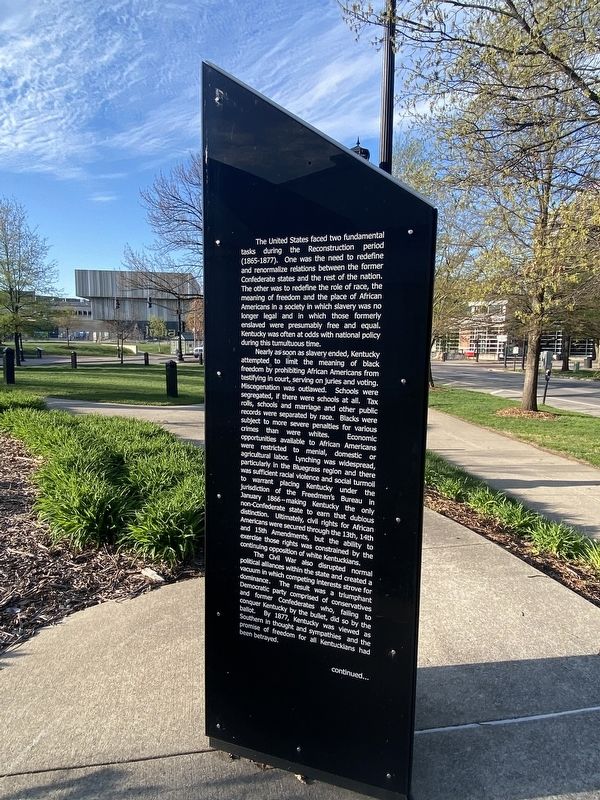
The United States faced two fundamental tasks during the Reconstruction period (1865-1877). One was the need to redefine and renormalize relations between the former Confederate states and the rest of the nation. The other was to redefine the role of race, the meaning of freedom and the place of African Americans in a society in which slavery was no longer legal and in which those formerly enslaved were presumably free and equal. Kentucky was often at odds with national policy during this tumultuous time.
Nearly as soon as slavery ended, Kentucky attempted to limit the meaning of black freedom by prohibiting African Americans from testifying in court, serving on juries and voting. Miscegenation was outlawed. Schools were segregated, if there were schools at all. Tax rolls, schools and marriage and other public records were separated by race. Blacks were subject to more severe penalties for various crimes than were whites. Economic opportunities available to African Americans were restricted to menial, domestic or agricultural labor. Lynching was widespread, particularly in the Bluegrass region and there was sufficient
Click or scan to see this page online
racial violence and social turmoil to warrant placing Kentucky under the jurisdiction of the Freedmen's Bureau In January 1866—making Kentucky the only non-Confederate state to earn that dubious distinction. Ultimately, civil rights for African Americans were secured through the 13th, 14th and 15th Amendments, but the ability to exercise those rights was constrained by the continuing opposition of white Kentuckians.
The Civil War also disrupted normal political alliances within the state and created a vacuum in which competing interests strove for dominance. The result was a triumphant Democratic party comprised of conservatives and former Confederates who, failing to conquer Kentucky by the bullet, did so by the ballot. By 1877, Kentucky was viewed as Southern in thought and sympathies and the promise of freedom for all Kentuckians had been betrayed.
continued...
continued...
The end of the Civil War brought tremendous energy and optimism to African Americans throughout the United States. In Louisville, African Americans celebrated and paraded well into the summer of 1865. Black population increased by 120 percent between 1860
Photographed by Darren Jefferson Clay, April 7, 2024
2. Freedom Park: A Journey to Freedom Marker
and 1870, and by another 40 percent between 1870 and 1880 as thousands of dispossessed African Americans from rural Kentucky converged on the city in search of work, safety and community. Rapid population growth produced extreme crowding and prompted the evolution of new black neighborhoods in the city and new black hamlets elsewhere in Jefferson County, each of which soon became home to at least one school and at least one church.
Greater numbers, a pre-existing black community structure, and the continued presence of federal troops enabled Louisville African Americans to lead the state in the struggle for freedom and empowerment. In December 1868, Horace Morris was appointed one of the few black cashiers of the Freedmen's Savings and Trust Bank and served until the bank closed in 1874. "Freedom rides" were organized through Quinn Chapel A.M.E. church to challenge segregation on local streetcars as early as 1870. In October 1870, petitions and protests resulted in the first public schools for African Americans in the city and, by 1873, the opening of the Central Colored School at 6th and Kentucky Streets. Also, on November 25, 1879,
Photographed by Darren Jefferson Clay, April 7, 2024
3. Freedom Park: A Journey to Freedom Marker
the Kentucky Normal and Theological Institute opened at 7th and Kentucky streets, later renamed State University In 1882 and Simmons University in 1919.
A new leadership class emerged that included ministers, teachers, small business owners, Nathaniel R. Harper, the first black attorney in Kentucky, and Dr. Henry Fitzbutler, the first black physician in the state. Some allied with influential whites and encouraged African Americans to better themselves within the constraints of segregation. Others championed the cause of racial equality and justice, and often demanded a larger role within the Republican Party.
By the end of Reconstruction, Louisville African Americans had expanded and strengthened their community and, although still embattled, remained guardedly optimistic.
Location. 38° 13.188′ N, 85° 45.667′ W. Marker is in Louisville, Kentucky, in Jefferson County. It is in University. It is on South 3rd Street south of West Cardinal Boulevard,
Photographed by Darren Jefferson Clay, April 7, 2024
4. Freedom Park: A Journey to Freedom Marker
on the left when traveling south. Touch for map. Marker is at or near this postal address: 1911 S 3rd St, Louisville KY 40208, United States of America. Touch for directions.
Regionally, this marker is in the American South, specifically in the Upper South, and in the Ohio River Valley. Globally, it is in North America, the Western Hemisphere, the Western World, and the Anglosphere. Historically, it finds itself in what was once the territory of the Mississippian Culture and also the Antebellum South.
Credits. This page was last revised on November 9, 2024. It was originally submitted on April 28, 2024, by Darren Jefferson Clay of Duluth, Georgia. This page has been viewed 292 times since then and 20 times this year. Photos:1, 2, 3, 4. submitted on May 1, 2024, by Darren Jefferson Clay of Duluth, Georgia. • Bernard Fisher was the editor who published this page.