Near De Soto in Vernon County, Wisconsin — The American Midwest (Great Lakes)
Winneshiek’s Landing
1820 · 1854
Photographed by Keith L, October 7, 2009
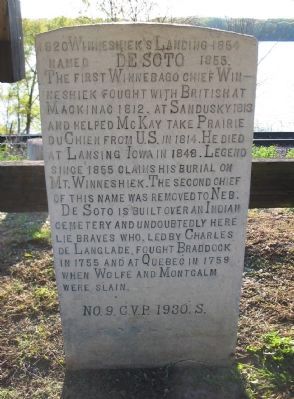
1. Winneshiek's Landing Marker
The first Winnebago chief Winneshiek fought with British at Mackinac 1812, at Sandusky 1813 and helped McKay take Prairie du Chien from U.S. in 1814. He died at Lansing Iowa in 1848. Legend since 1855 claims his burial on Mt. Winneshiek. The second chief of this name was removed to Neb.
De Soto is built over an Indian cemetery and undoubtedly here lie braves who, led by Charles de Langlade, fought Braddock in 1755 and at Quebec in 1759 when Wolfe and Montcalm were slain.
No. 9. C.V.P. 1930. S.
Erected 1930 by Viroqua, Wisconsin historian Dr. C.V. Porter. (Marker Number 9 CVP.)
Topics. This historical marker is listed in these topic lists: Cemeteries & Burial Sites • Wars, US Indian. A significant historical year for this entry is 1855.
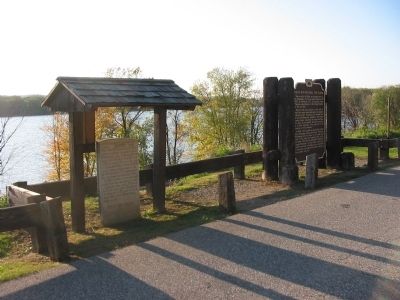
Location. 43° 25.639′ N, 91° 12.238′ W. Marker is near De Soto, Wisconsin, in Vernon County. It is on Great River Road (State Highway 35) 0.4 miles north of Main Street (State Highway 82), on the left when traveling north. Marker is at a highway pull-off. Touch for map. Marker is in this post office area: De Soto WI 54624, United States of America.
this page online

Regionally, this marker is in the American Midwest, in the Corn Belt, in the Driftless Area — Bluff Country, and in the Great River Road Region. Globally, it is in North America, the Western Hemisphere, the Western World, and the Anglosphere. Historically, it finds itself in what was once the territory of the Mississippian Culture and also the Northwest Territory.
Other nearby markers. At least 8 other markers are within 7 miles of this marker, measured as the crow flies: Chief Win-no-shik, the Elder (a few steps from this marker); Black Hawk War (approx. 2.1 miles away); Battle of Bad Axe (approx. 2.1 miles away); Head of Battle Isle (approx. 2.2 miles away); Black Hawks Outpost (approx. 3.4 miles away); Site of Red Bird's Village (approx. 6 miles away); Black Hawk and Winnebago Trail (approx. 6 miles away); Walnut Mound Veterans Memorial (approx. 6.8 miles away). Touch for a list and map of all markers in De Soto.
Also see . . .
1. Chief Winneshiek. (Submitted on November 21, 2009.)
2. Battle of Mackinac Island. (Submitted on November 21, 2009.)
3. The Battle of Prairie du Chien.
Photographed by Keith L, October 7, 2009
2. Winneshiek's Landing Marker
4. The Battle of Monongahela 1755. (Submitted on November 21, 2009.)
5. The Battle of Quebec 1759. (Submitted on November 21, 2009.)
Additional commentary.
1. Winnieshek/Winneshiek, Winnebago chiefs
I am interested in the history of the Winnebago during white settlement period. I appreciate this resource showing the Winnieshiek Landing road marker. I've been messing with online NARA map of this same area that was used during the land office period in white settlement where the landing is also shown, dating from early 1840s: Cartographic Records: Bureau of Indian Affairs / Bureau of Land Management Series: Territorial Papers of the United States for the Territory of Wisconsin Page 600 I had not heard of Winneshiek Landing as a placename. I have found a Winnieshek village on another map, down by Illinois in the Lead Region, where I assume the family's original village from the early 19th century lay.
Wisconsin's history shows that the Winnebago got pushed out of that place and they were pushed here and there by Indian Office policy as whites clammored for the various lands. The Winneshiek
Photographed by Keith L, October 7, 2009
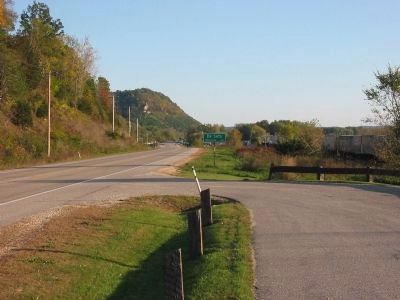
3. Looking towards De Soto
The 1846 treaty at Washington allowed them to choose a different place and it ended up to be Long Prairie in the future Minnesota, which was purchased from the Leech Lake and Fond du Lac Ojibwe. They lived there 7 years before being moved to the Blue Earth area which they had originally requested many years earlier. Then after the Dakota violence of 1862, they were removed to Nebraska on the other side of the Missouri, but many remained still in Wisconsin and are there to this day.
Winneshiek/Winnieshiek II was one of the accommodationists, I think, who remained in vicinity of Long Prairie during the 1848-1855 period; others of the tribe removed themselves to Watab Prairie (north of today's St. Cloud, Minn.) to be closer to the Mississippi. These were probably the ones who drove the governors of Minn. & Wisc. nuts by taking off for Iowa and Wisc. whenever the spirit moved them. Eventually the Indian Agency ran two annuity events, one at Long Prairie and one at Watab Prairie, being unable to enforce unity (as was usual in working with this tribe).
Winnieshiek II was a wise person and apparently a good leader and so was his father.
I wish I knew more about this site—was it a single event "landing" or was it the water access for a village of Winnebago living nearby?
During the Black Hawk War, the Winnebago got caught between the U.S. Army plus the local militia and the Sak and Fox militants, who were being pushed across the Mississippi also. At that time, many Winnebago bands lived in vicinity of Lake Winnebago and Madison, but historically had had control at Portage also. During the Black Hawk War, the Winnebago were chased to the Mississippi and a large number of them were drowned or slaughtered.
The historian who appears to have been the spark to create the Vernon-area signage deserves notice.
I would love to correspond with those who are also interested in this topic. Ask an editor for my contact information. Note To Editor only visible by Contributor and editor
— Submitted August 15, 2025, by Linda Louise Bryan of Maplewood, Minnesota.
Additional keywords. Win-no-shik
Credits. This page was last revised on August 29, 2025. It was originally submitted on November 21, 2009, by Keith L of Wisconsin Rapids, Wisconsin. This page has been viewed 2,596 times since then and 176 times this year. Photos: 1, 2, 3. submitted on November 21, 2009, by Keith L of Wisconsin Rapids, Wisconsin. • J. J. Prats was the editor who published this page.
