Boonville in Cooper County, Missouri — The American Midwest (Upper Plains)
The Civil War in Boonville
Missouri's Civil War
| — | 1861-1865 | — |
Photographed by Jason Voigt, May 15, 2024
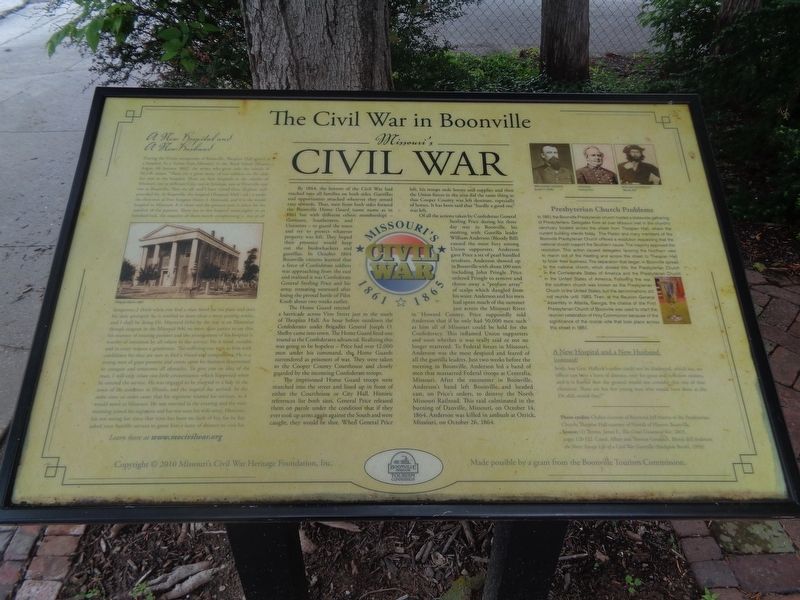
1. The Civil War in Boonville Marker
The Home Guard erected a barricade across Vine Street just to the south of Thespian Hall. An hour before sundown the Confederates under Brigadier General Joseph O. Shelby came into town. The Home Guard fired one round as the Confederates advanced. Realizing this was going to be hopeless - Price had over 12,000 men under his command, the Home Guards surrendered as prisoners of war. They were taken to the Cooper
this page online
The imprisoned Home Guard troops were marched into the street and lined up in front of either the Courthouse or City Hall. Historic references list both sites. General Price released them on parole under the condition that if they ever took up arms again against the South and were caught, they would be shot. When General Price left, his troops stole horses and supplies and then the Union forces in the area did the same thing so that Cooper County was left destitute, especially of horses. It has been said that "hardly a good one" was left.
Of all the actions taken by Confederate General Sterling Price during his three day stay in Boonville, his meeting with Guerilla leader William Anderson (Bloody Bill) caused the most fury among Union supporters. Anderson gave Price a set of pearl handled resolvers. Anderson showed up in Boonville with about 100 men including John Pringle. Price ordered Pringle to remove and throw away a "profuse array" of scalps which dangled from his waist. Anderson and his men had spent much of the summer just across the Missouri River
Photographed by Jason Voigt, May 15, 2024
2. The Civil War in Boonville Marker
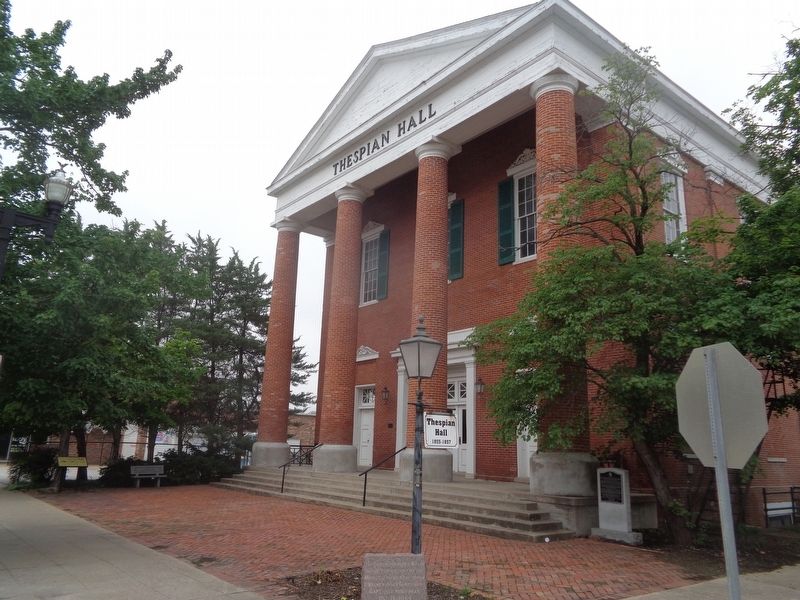
Marker is outside Thespian Hall (to the left under the tree)
A New Hospital and a New Husband
During the Union occupation of Boonville, Thespian Hall served as a hospital. In a 'Letter from Missouri' in the 'Rock Island (Illinois) Argus, 08 January 1862', the writer who gives only the initials of M.S.B. states: "There are a great many of our soldiers on the sick-list and in the hospital. There are four hospitals in the interior of Missouri, one at Jefferson City, one at Syracuse, one at Otterville and one at Boonville. They are all, and I have visited three of them, well provided for. At Boonville, the hospital (Thespian Hall - ed.) is under the direction of Post Surgeon Henry J. Maynard, and it is the model hospital in Missouri. It is clean and the greatest care is taken for the comfort of the patients. There are in this hospital some eighty or an hundred sick, the majority of them merely complaining - not at all dangerous. I think when you find a man fitted for his place and does his duty promptly he is entitled to more than a mere passing notice, and I shall be doing Dr. Maynard (who by the way is an Illinoisan though surgeon in the Missouri 9th) no more than justice to say that his manner of treating patients and the arrangement of his hospital is worthy of imitation by all others in the service. He is kind, sociable and in every respect a gentleman. The suffering can turn to him with confidence for they are sure to find a friend and sympathizer. He is a young man of great promise and enters upon his business determined to conquer and overcome all obstacles. To give you an idea of the man, I will only relate one little circumstance which happened when he entered the service. He was engaged to be married to a lady in the town of his residence in Illinois, and the nuptial day arrived. At the same time an order came that his regiment wanted his services, as it would move to Missouri. He was married in the evening and the next morning joined his regiment and has not seen his wife since. However, his not seeing her since that time has been no fault of his, for he has asked your humble servant to grant him a leave of absence to visit his bride, but Gen. Halleck's orders could not be disobeyed, which say, no officer can have a leave of absence, only for great and sufficient rations, and it is fearful that the general would not consider this one of that character. There are but few young men who would have done as the Dr. did, would they?"
Presbyterian Church Problems
In 1861 the Boonville Presbyterian church hosted a statewide gathering of Presbyterians. Delegates from all over Missouri met in the church's sanctuary located across the street from Thespian Hall, where the current building stands today. The Pastor and many members of the Boonville Presbyterian Church offered a resolution requesting that the national church support the Southern cause. The majority approved the resolution. This action caused delegates favoring the Northern view to march out of the meeting and across the street to Thespian Hall to finish their business. The separation that began in Boonville spread to the national church, which divided into the Presbyterian Church in the Confederate States of America and the Presbyterian Church in the United States of America. Following the way, the southern church was known as the Presbyterian Church in the United States, but the denominations did not reunite until 1983. Then, at the Reunion General Assembly in Atlanta, Georgia, the chalice of the First Presbyterian Church of Boonville was used to start the reunion celebration of Holy Communion because of the significance of the crucial vote that took place across this street in 1861.
Erected 2010 by Boonville Tourism Commission and Missouri's Civil War Heritage Foundation, Inc.
Topics and series. This historical marker is listed in these topic lists: Religion & Religious Structures • Science & Medicine • War, US Civil. In addition, it is included in the Missouri’s Civil War series list. A significant historical date for this entry is January 8, 1862.
Location. 38° 58.429′ N, 92° 44.591′ W. Marker is in Boonville, Missouri, in Cooper County. It is on Main Street (U.S. 40) north of Vine Street, on the right when traveling north. Marker is outside Thespian Hall. Touch for map. Marker is at or near this postal address: 522 Main St, Boonville MO 65233, United States of America. Touch for directions.

Regionally, this marker is in the Missouri River Corridor. It is also in the American Midwest, in the Lewis & Clark Corridor, in the Corn Belt, and on the Santa Fe Trail Corridor. Globally, it is in North America, the Western Hemisphere, the Western World, and the Anglosphere. Historically, it finds itself in what was once the territory of the Mississippian Culture, the Louisiana Purchase, and the Antebellum South.
Other nearby markers. At least 8 other markers are within walking distance of this marker: Thespian Hall (a few steps from this marker); Capture of Union Troops (a few steps from this marker); In Memory of Hannah Cole (about 700 feet away, measured in a direct line); Hannah Allison Cole (approx. 0.2 miles away); David Barton (approx. 0.2 miles away); James Milton Turner (approx. 0.2 miles away); Walter Williams (approx. 0.2 miles away); Frederick T. Kemper (approx. 0.2 miles away). Touch for a list and map of all markers in Boonville.
Regarding The Civil War in Boonville. The website address (www.mocivilwar.org) on the marker for Missouri's Civil War Heritage Foundation, Inc. is inaccessible as of May 2024.
Credits. This page was last revised on May 25, 2024. It was originally submitted on May 25, 2024, by Jason Voigt of Glen Carbon, Illinois. This page has been viewed 607 times since then and 82 times this year. Photos: 1, 2. submitted on May 25, 2024, by Jason Voigt of Glen Carbon, Illinois.
