
Morro Bay in San Luis Obispo County, California — The American West (Pacific Coastal)
The First Landing of Filipinos in the Continental United States
Historic Site
Photographed by Andrew Ruppenstein, September 5, 2008
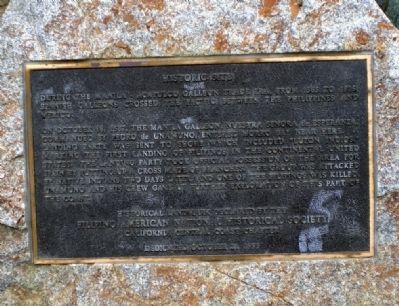
1. The First Landing of Filipinos in the Continental United States Marker
During the Manila-Acapulco Galleon Trade Era from 1565 to 1815 Spanish galleons crossed the Pacific between the Philippines and Mexico.
On October 18, 1587, the Manila Galleon Nuestra Senora de Esperanza commanded by Pedro de Unamuno entered Morro Bay near here. A landing party was sent to shore which included Luzon Indios, marking the first landing of Filipinos in the continental United States. The landing party took official possession of the area for Spain by putting up a cross made of branches. The group was attacked by native Indians two days later, and one of the Filipinos was killed. Unamuno and his crew gave up further exploration of this part of the coast.
Erected 1995 by California Central Coast Chapter of the Filipino American National Historical Society.
Topics. This historical marker is listed in these topic lists: Exploration • Notable Events • Waterways & Vessels. A significant historical date for this entry is October 18, 1587.
Location. 35° 22.334′ N, 120° 51.663′ W.
this page online

Regionally, this marker is on the Central Coast and specifically on the Coast Ranges. It is also on the American Pacific Coast. Globally, it is in North America, on the Ring of Fire, in the Pacific Rim, in the Western Hemisphere, in the Western World, and in the Anglosphere. Historically, it finds itself in what was once New Spain and also Mexico’s Alta California.
Other nearby markers. At least 8 other markers are within walking distance of this marker: Gifts From The Sea (within shouting distance of this marker); Landing of the First Filipinos - October 18, 1587 (about 500 feet away, measured in a direct line); USCG in Morro Bay (approx. 0.2 miles away); Endearing & Endangered (approx. 0.2 miles away); Morro Rock (approx. ¼ mile away); Commercial Deepwater Groundfish Fishery (approx. 0.4 miles away); a different marker also named Morro Rock (approx. half a mile
Photographed by Andrew Ruppenstein, September 5, 2008
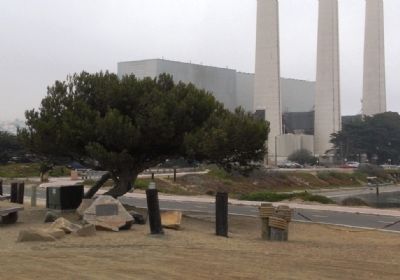
2. The First Landing of Filipinos in the Continental United States Marker - Wide Shot
This shot of the marker and surroundings, looking east from the marker site, shows the Morro Bay Power Plant in the background. Completed in 1955, the steam electric plant was the first to employee seawater evaporators for the industrial production of fresh water in the US.
More about this marker. The marker is mounted on a rock near the picnic tables and tree nearest to Coleman Drive in Coleman Park. The park is located only a few hundred yards from Morro Rock, a landmark visible for miles, and so is easy to find.
Also see . . .
1. Did Pedro de Unamuno Really Land in Morro Bay in 1587? Probably Not!. A discussion of the issue of whether the Nuestra Senora de Esperanza actually landed in Morro Bay or at a different location. (Submitted on November 22, 2009.)
2. 422 years ago. Rodel Rodis' article on the Nuestra Senora de Buena Esperanza's landing on the central California coast, offering much more historical detail than is contained on the marker. (Submitted on November 22, 2009.)
Additional keywords. Pinoy
Photographed by Andrew Ruppenstein, September 5, 2008
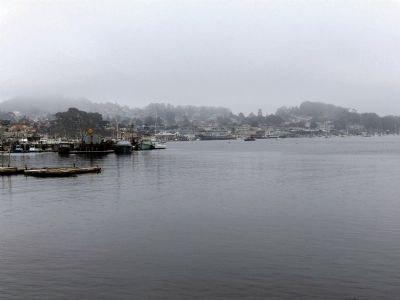
3. Morro Bay as seen from the marker site
Credits. This page was last revised on March 16, 2025. It was originally submitted on November 22, 2009. This page has been viewed 4,601 times since then and 318 times this year. Last updated on March 15, 2025. Photos: 1, 2, 3. submitted on November 22, 2009, by Andrew Ruppenstein of Lamorinda, California. • Devry Becker Jones was the editor who published this page.
