Boonville in Cooper County, Missouri — The American Midwest (Upper Plains)
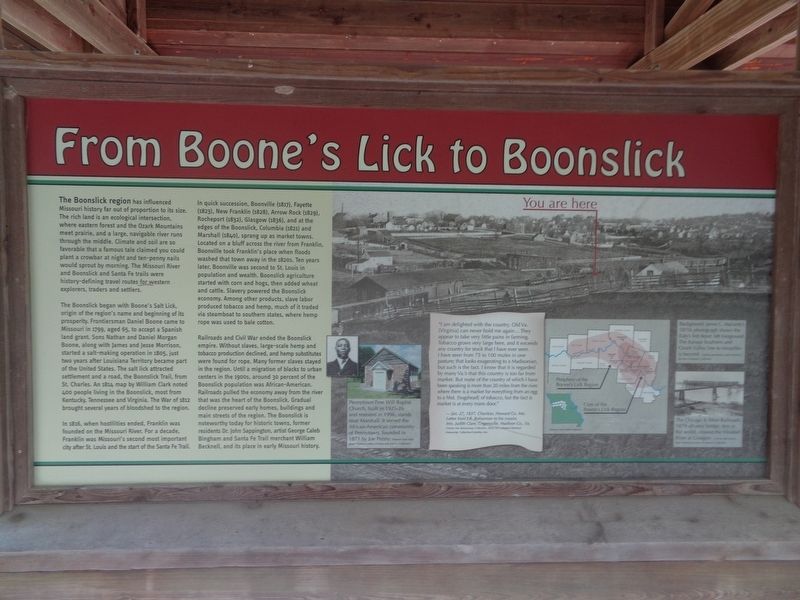
From Boone's Lick to Boonslick
Photographed by Jason Voigt, May 14, 2024
1. From Boone's Lick to Boonslick Marker
The Boonslick began with Boone's Salt Lick, origin of the region's name and beginning of its prosperity. Frontiersman Daniel Boone came to Missouri in 1799, aged 65, to accept a Spanish land grant. Sons Nathan and Daniel Morgan Boone, along with James and Jesse Morrison, started a salt-making operation in 1805, just two years after Louisiana Territory became part of the United States. The salt lick attracted settlement and a road, the Boonslick Trail, from St. Charles. An 1814 map by William Clark noted 400 people living in the Boonslick, most from Kentucky, Tennessee and Virginia. The War of 1812 brought
this page online
In 1816, when hostilities ended, Franklin was founded on the Missouri River. For a decade, Franklin was Missouri's second most important city after St. Louis and the start of the Santa Fe Trail. In quick succession, Boonville (1817), Fayette (1823), New Franklin (1828), Arrow Rock (1829), Rocheport (1832), Glasgow (1836), and at the edges of the Boonslick, Columbia (1821) and Marshall (1840), sprang up as market towns. Located on a bluff across the river from Franklin, Boonville took Franklin's place when floods washed that town away in the 1820s, Ten years later, Boonville was second to St. Louis in population and wealth. Boonslick agriculture started with corn and hogs, then added wheat and cattle. Slavery powered the Boonslick economy. Among other products, slave labor produced tobacco and hemp, much of it traded via steamboat to southern states, where hemp rope was used to bale cotton.
Railroads and Civil War ended the Boonslick empire. Without slaves, large-scale hemp and tobacco production declined, and hemp substitutes were found for rope. Many former slaves stayed in the region.
Photographed by Jason Voigt, May 14, 2024
2. From Boone's Lick to Boonslick Marker
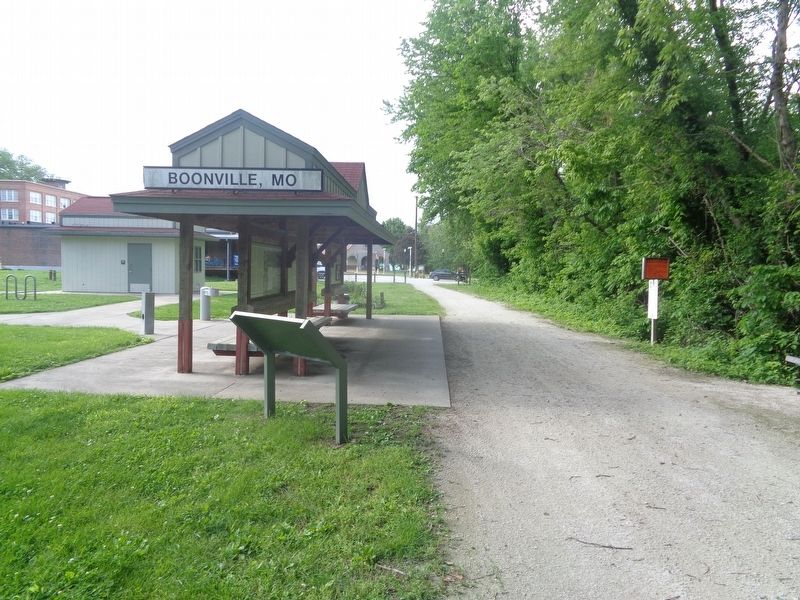
Marker is the far left panel (facing the trail) at the Katy Trail Boonville Trailhead.
Erected by Missouri State Parks.
Topics and series. This historical marker is listed in these topic lists: African Americans • Agriculture • Roads & Vehicles • Settlements & Settlers. In addition, it is included in the Katy Trail State Park series list. A significant historical year for this entry is 1799.
Location. 38° 58.424′ N, 92° 44.943′ W. Marker is in Boonville, Missouri, in Cooper County. It can be reached from the intersection of Spring Street and 1st Street. Marker is located at the Katy Trail Boonville Trailhead. Touch for map. Marker is at or near this postal address: 100 W Spring St, Boonville MO 65233, United States of America. Touch for directions.

Regionally, this marker is in the Missouri River Corridor. It is also in the American Midwest, in the Lewis & Clark Corridor, in the Corn Belt, and on the Santa Fe Trail Corridor. Globally, it is in North America, the Western Hemisphere, the Western World, and the Anglosphere. Historically, it finds itself in what was once the territory of the Mississippian Culture, the Louisiana Purchase, and the Antebellum South.
Other nearby markers. At least 8 other markers are within walking distance of this marker: Boonville to Pilot Grove (here, next to this marker); Boonville to New Franklin (here, next to this marker); History of Boonville (here, next to this marker); 25th Anniversary (a few steps from this marker); Boonville Depot (about 500 feet away, measured in a direct line); The End of the Line (about 500 feet away); "Caboose #134" (about 500 feet away); Kemper Military School & College 1844-2002 (approx. ¼ mile away). Touch for a list and map of all markers in Boonville.
Credits. This page was last revised on May 26, 2024. It was originally submitted on May 26, 2024, by Jason Voigt of Glen Carbon, Illinois. This page has been viewed 373 times since then and 62 times this year. Photos: 1, 2. submitted on May 26, 2024, by Jason Voigt of Glen Carbon, Illinois.
