Riverview in St. Louis, Missouri — The American Midwest (Upper Plains)
Living on the Edge
The Best of Two Worlds
Photographed by Jason Voigt, May 27, 2024
1. Living on the Edge Marker
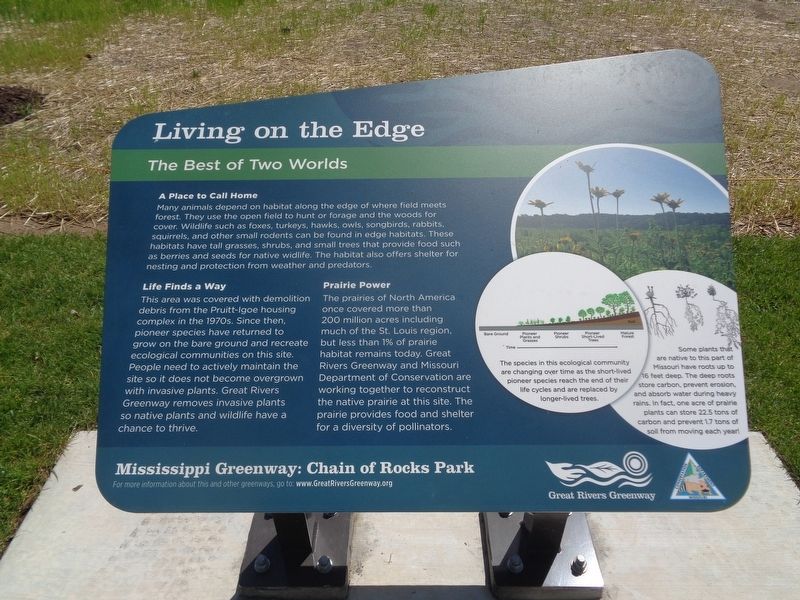
A Place to Call Home
Many animals depend on habitat along the edge of where field meets forest. They use the open field to hunt or forage and the woods for cover. Wildlife such as foxes, turkeys, hawks, owls, songbirds, rabbits, squirrels, and other small rodents can be found in edge habitats. These habitats have tall grasses, shrubs, and small trees that provide food such as berries and seeds for native wildlife. The habitat also offers shelter for nesting and protection from weather and predators.
Life Finds a Way
This area was covered with demolition debris from the Pruitt-Igoe housing complex in the 1970s. Since then, pioneer species have returned to grow on the bare ground and recreate ecological communities on this site. People need to actively maintain the site so it does not become overgrown with invasive plants. Great Rivers Greenway removes invasive plants so native plants and wildlife have a chance to thrive.
Prairie Power
The prairies of North America once covered more than 200 million acres including much of the St. Louis region, but less than 1% of prairie habitat remains today. Great Rivers Greenway
this page online
(captions:)
·The species in this ecological community are changing over time as the short-lived pioneer species reach the end of their life cycles and are replaced by longer-lived trees.
·Some plants are native to this part of Missouri have roots up to 16 feet deep. The deep roots store carbon, prevent erosion, and absorb water during heavy rains. In fact, one acre of prairie plants can store 22.5 tons of carbon and prevent 1.7 tons of soil from moving each year!
Erected 2024 by Great Rivers Greenway and Missouri Conservation Department.
Topics. This historical marker is listed in these topic lists: Animals • Environment • Natural Features.
Location. 38° 45.864′ N, 90° 10.909′ W. Marker is in St. Louis, Missouri. It is in Riverview. It can be reached from Riverview Drive south of Interstate 270. Marker is located at the Missouri end of the Chain of Rocks Bridge park area. Touch for map.
Photographed by Jason Voigt, May 27, 2024
2. Living on the Edge Marker
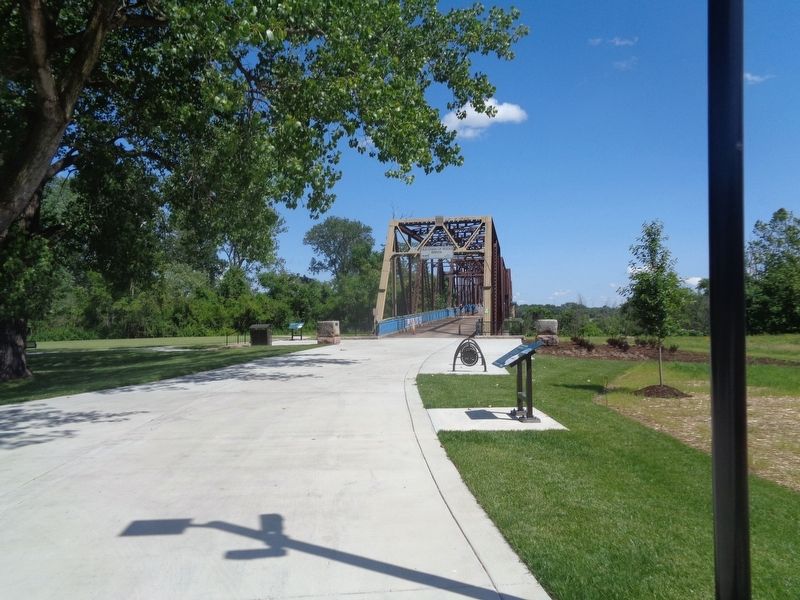
Marker (on the right) is located at the Old Chain of Rocks Bridge park (Missouri side)

Regionally, this marker is in the American Midwest, in the Lewis & Clark Corridor, in the Corn Belt, and in the Great River Road Region. Globally, it is in North America, the Western Hemisphere, the Western World, and the Anglosphere. Historically, it finds itself in what was once the territory of the Mississippian Culture, the Louisiana Purchase, and the Antebellum South.
Other nearby markers. At least 8 other markers are within 4 miles of this marker, measured as the crow flies: Old Chain of Rocks Bridge (within shouting distance of this marker); a different marker also named Old Chain of Rocks Bridge (approx. one mile away in Illinois); The Twillman House (approx. 2.4 miles away); a different marker also named North Riverfront Park (approx. 2.6 miles away); Spanish Lake (approx. 2.7 miles away); The Power of Plants (approx. 3.1 miles away); Columbia Bottom Conservation Area (approx. 3.2 miles away); American Hornbeam / Cottonwood (approx. 3.6 miles away). Touch for a list and map of all markers in St. Louis.
Another marker is no longer nearby. North Riverfront Park (was approx. 2.6 miles away but has been replaced with another marker now near it).
Regarding Living on the Edge. A new park area opened in April 2024 on the Missouri side of the Old Chain of Rocks Bridge, to celebrate its Route 66 heritage. Previously, it was not recommended to park or go anywhere in this area but because of its status on Route 66 and its connection to bike trails, this was intended to be visitor and kid-friendly. A large shelter, bike pathways, parking lot and restrooms were placed there. Three markers also went up (including this one), but the other two talk about the nature aspect of the park.
Credits. This page was last revised on June 4, 2024. It was originally submitted on May 31, 2024, by Jason Voigt of Glen Carbon, Illinois. This page has been viewed 179 times since then and 21 times this year. Photos: 1, 2. submitted on May 31, 2024, by Jason Voigt of Glen Carbon, Illinois.
