Near Petersburg in Howard County, Missouri — The American Midwest (Upper Plains)
People of the Spring
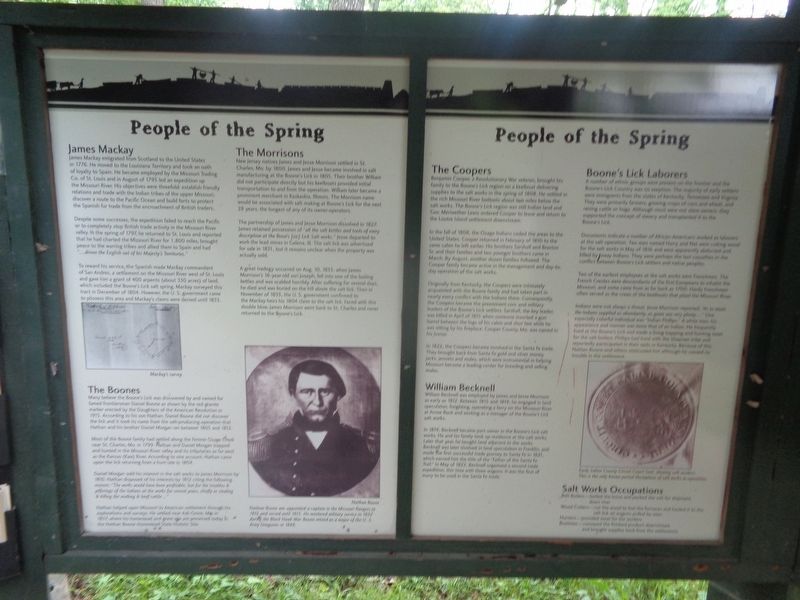
Photographed by Jason Voigt, May 15, 2024
1. People of the Spring Marker
(left column:)
James Mackay
James Mackay emigrated from Scotland to the United States in 1776. He moved to the Louisiana Territory and took an oath of loyalty to Spain. He became employed by the Missouri Trading Co. of St. Louis and in August of 1795 led an expedition up the Missouri River. His objectives were threefold: establish friendly relations and trade with the Indian tribes of the upper Missouri, discover a route to the Pacific Ocean and build forts to protect the Spanish fur trade from the encroachment of British traders.
Despite some successes, the expedition failed to reach the Pacific or to completely stop British trade activity in the Missouri River valley. In the spring of 1797, he returned to St. Louis and reported that he had charted the Missouri River for 1,800 miles, brought peace to the warring tribes and allied them to Spain and had "…driven the English out of his Majesty's Territories."
To reward his service, the Spanish made Mackay commandant of San Andres, a settlement on the Missouri River west of St. Louis and gave him a grant of 400 arpents (about 330 acres) of land, which included the
this page online
The Boones
Many believe the Boone's Lick was discovered by and named for famed frontiersman Daniel Boone as shown by the red granite marker erected by the Daughters of the American Revolution in 1913. According to his son Nathan, Daniel Boone did not discover the lick and it took its name from the salt-producing operation that Nathan and his brother Daniel Morgan ran between 1805 and 1812.
Most of the Boone family had settled along the Femme Osage Creek near St. Charles, Mo., in 1799. Nathan and Daniel Morgan trapped and hunted in the Missouri River valley and its tributaries as far west as the Kansas (Kaw) River. According to one account, Nathan came upon the lick returning from a hunt late in 1804.
Daniel Morgan sold his interest in the salt works to James Morrison by 1810. Nathan disposed of his interests by 1812 citing the following reason: "The works would have been profitable, but for the troubles & pilferings of the Indians at the works for several
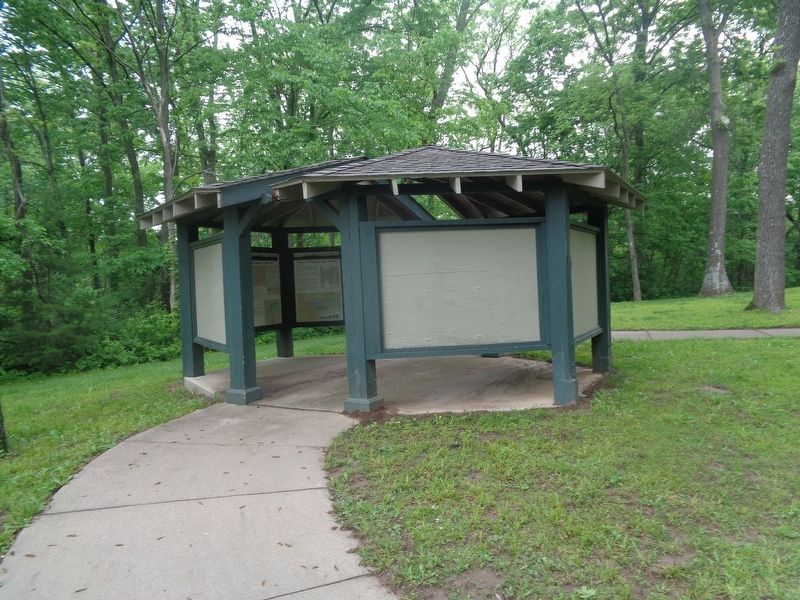
Photographed by Jason Voigt, May 15, 2024
2. People of the Spring Marker
Marker is with other markers at Boone's Lick State Historic Site.
Nathan helped open Missouri to American settlement through his explorations and surveys. He settled near Ash Grove, Mo in 1837, where his homestead and grave site are preserved today in the Nathan Boone Homestead State Historic Site.
The Morrisons
New Jersey natives James and Jesse Morrison settled in St. Charles, Mo by 1800. James and Jesse became involved in salt manufacturing at the Boone's lick in 1805. Their brother William did not participate directly but his keelboats provided initial transportation to and from the operation. William later became a prominent merchant in Kaskaskia, Illinois. The Morrison name would be associated with salt making at Boone's lick for the next 28 years, the longest of any of its owner operators.
The partnership of James and Jesse Morrison dissolved in 1827. James retained possession of "all the salt kettles and tools of every description at the Boon's [sic] Lick Salt works." Jesse departed to work the lead mines in Galena, Ill. The salt lick was advertised for sale in 1831, but it remains unclear when the property was actually sold.
A great tragedy occurred on Aug. 10, 1833, when James Morrison's 16-year-old son Joseph, fell into one of the boiling kettles and was scalded horribly. After suffering for several days, he died and was buried on the hill above the salt lick. Then in November of 1833, the U.S. government confirmed to the Mackay heirs his 1804 claim to the salt lick. Faced with this double blow, James Morrison went back to St. Charles and never returned to the Boone's Lick.
(right column:)
The Coopers
Benjamin Cooper, a Revolutionary War veteran, brought his family to the Boone's Lick region on a keelboat delivering supplies to the salt works in the spring of 1808. He settled in the rich Missouri River bottoms about two miles below the salt works. The Boone's Lick region was still Indian land and Gov. Meriwether Lewis ordered Cooper to leave and return to the Loutre Island settlement downstream.
In the fall of 1808, the Osage Indians ceded the areas to the United States. Cooper returned in February of 1810 to the same cabin he left earlier. His brother Sarshall and Braxton Sr. and their families and two younger brothers came in March. By August, another dozen families followed. The Cooper family became active in the management and day-to-day operation of the salt works.
Originally from Kentucky, the Coopers were intimately acquainted with the Boone family and had taken part in nearly every conflict with the Indians there. Consequently, the Coopers became the preeminent civic and military leaders of the Boone's Lick settlers. Sarshall, the key leader, was killed in April of 1815 when someone inserted a gun barrel between the logs of his cabin and shot him while he was sitting by his fireplace. Cooper County, Mo. Was named in his honor.
In 1822, the Coopers became involved in the Santa Fe trade. They brought back from Santa Fe gold and silver money, jacks, jennets and mules, which were instrumental in helping Missouri become a leading center for breeding and selling mules.
William Becknell
William Becknell was employed by James and Jesse Morrison as early as 1812. Between 1815 and 1819, he engaged in land speculation, freighting, operating a ferry on the Missouri River at Arrow Rock and working as a manager of the Boone's Lick salt works.
In 1819, Becknell became part owner in the Boone's Lick salt works. He and his family took up residence at the salt works. Later that year, he bought land adjacent to the works. Becknell was later involved in land speculation in Franklin, and made the first successful trade journey to Santa Fe in 1821, which earned him the title of the "Father of the Santa Fe Trail." In May of 1822, Becknell organized a second trade expedition, this time with three wagons. It was the first of many to be used in the Santa Fe trade.
Boone's Lick Laborers
A number of ethnic groups were present on the frontier and the Boone's Lick Country was no exception. The majority of early settlers were immigrants from the states of Kentucky, Tennessee and Virginia. They were primarily farmers, growing crops of corn and wheat, and raising cattle or hogs. Although most were not slave-owners, they supported the concept of slavery and transplanted it to the Boone's Lick.
Documents indicate a number of African-Americans worked as laborers at the salt operation. Two men named Harry and Nat were cutting wood for the salt works in May of 1816 and were apparently abducted and killed by Ioway Indians. They were perhaps the last casualties in the conflict between Boone's Lick settlers and native peoples.
Two of the earlies employees at the salt works were Frenchmen. The French Creoles were descendants of the first Europeans to inhabit the Missouri, and some came from as far back as 1700. Hardy Frenchmen often served as the crews of the keelboats that piled the Missouri River.
Indians were not always a threat. Jesse Morrison reported, "As to meat, the Indians supplied us abundantly, as game was very plenty…" One especially colorful individual was "Indian Phillips." A white man, his appearance and manner was more that of an Indian. He frequently lived at the Boone's Lick and made a living trapping and hunting meat for the salt boilers. Phillips had lived with the Shawnee tribe and reportedly participated in their raids in Kentucky. Because of this, Nathan Boone and others mistrusted him although he caused no trouble in the settlement.
Salt Works Operations
Salt Boilers - boiled the brine and packed the salt for shipment down river
Wood Cutters - cut the wood to fuel the furnaces and hauled it to the salt lick on wagons pulled by oxen
Hunters - provided meat for the workers
Boatmen - conveyed the finished product downstream and brought supplies back from the settlements
Erected by Missouri State Parks.
Topics. This historical marker is listed in these topic lists: Industry & Commerce • Roads & Vehicles • Settlements & Settlers • Waterways & Vessels. A significant historical month for this entry is February 1810.
Location. 39° 4.92′ N, 92° 52.749′ W. Marker is near Petersburg, Missouri, in Howard County. It is on Missouri Route 187. Marker is at Boone's Lick State Historic Site. It is located off a road from Missouri 187 (where it ends). Touch for map. Marker is at or near this postal address: 1091 MO-187, Franklin MO 65250, United States of America. Touch for directions.

Regionally, this marker is in Little Dixie and in the Missouri River Corridor. It is also in the American Midwest, in the Lewis & Clark Corridor, in the Corn Belt, and on the Santa Fe Trail Corridor. Globally, it is in North America, the Western Hemisphere, the Western World, and the Anglosphere. Historically, it finds itself in what was once the territory of the Mississippian Culture, the Louisiana Purchase, and the Antebellum South.
Other nearby markers. At least 8 other markers are within 4 miles of this marker, measured as the crow flies: The Boone's Lick Country (here, next to this marker); Salt Springs In This Area (here, next to this marker); History in Boone's Lick Country (here, next to this marker); Settlement History of the Spring (a few steps from this marker); Boone's Lick Today (a few steps from this marker); Operation of the Spring (a few steps from this marker); Boone's Lick (within shouting distance of this marker); The Lewis and Clark Expedition Across Missouri (approx. 3½ miles away). Touch for a list and map of all markers in Petersburg.
Credits. This page was last revised on June 8, 2024. It was originally submitted on June 6, 2024, by Jason Voigt of Glen Carbon, Illinois. This page has been viewed 229 times since then and 36 times this year. Photos: 1. submitted on June 6, 2024, by Jason Voigt of Glen Carbon, Illinois. 2. submitted on June 8, 2024, by Jason Voigt of Glen Carbon, Illinois.
