Old City in Philadelphia in Philadelphia County, Pennsylvania — The American Northeast (Mid-Atlantic)
St. Augustine's
1796
| — | Old Philadelphia Congregations | — |
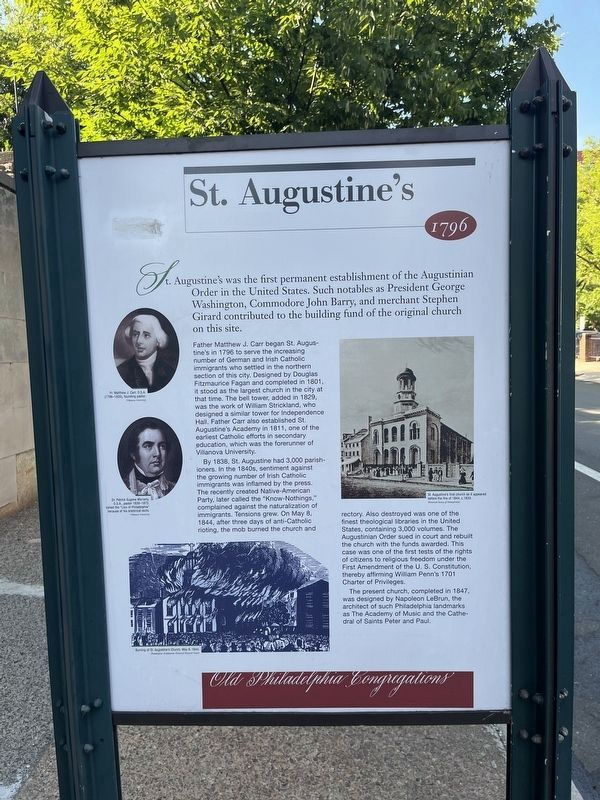
St. Augustine's was the first permanent establishment of the Augustinian Order in the United States. Such notables as President George Washington, Commodore John Barry, and merchant Stephen Girard contributed to the building fund of the original church on this site.
Father Matthew J. Carr began St. Augustine's in 1796 to serve the increasing number of German and Irish Catholic immigrants who settled in the northern section of this city. Designed by Douglas Fitzmaurice Fagan and completed in 1801, it stood as the largest church in the city at that time. The bell tower, added in 1829, was the work of William Strickland, who designed a similar tower for Independence Hall. Father Carr also established St. Augustine's Academy in 1811, one of the earliest Catholic efforts in secondary education, which was the forerunner of Villanova University.
By 1838, St. Augustine had 3,000 parishioners. In the 1840s, sentiment against the growing number of Irish Catholic immigrants was inflamed by the press. The recently created Native-American Party, later called the "Know-Nothings," complained against the naturalization of immigrants.
this page online
The present church, completed in 1847, was designed by Napoleon LeBrun, the architect of such Philadelphia landmarks as The Academy of Music and the Cathedral of Saints Peter and Paul.
[Captions:]
Fr. Matthew J. Carr, O.S.A. (1796-1820), founding pastor.
Dr. Patrick Eugene Moriarty, O.S.A., pastor 1839-1875, called the "Lion of Philadelphia" because of his oratorical skills.
Burning of St. Augustine's Church, May 8, 1844.
St. Augustine's first church as it appeared before the fire of 1844, c. 1830.
It was in Philadelphia, alone of America's colonial cities, that Quakers, Jews, Catholics and Protestants "experienced the difficulties of fruitful coexistence that American democracy was to offer."* Philadelphia is a city that not only tolerated but welcomed diverse modes of religious practice from its beginning.
That
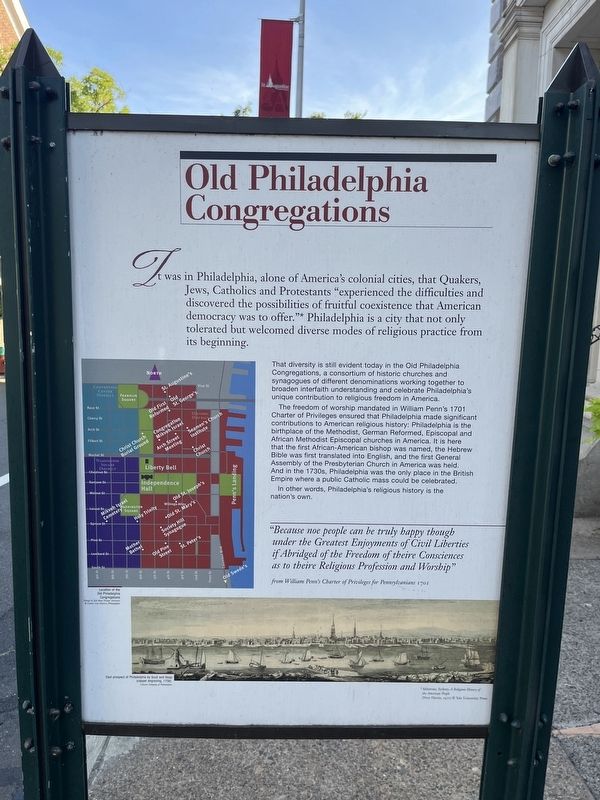
The freedom of worship mandated in William Penn's 1701 Charter of Privileges ensured that Philadelphia made significant contributions to American religious history: Philadelphia is the birthplace of the Methodist, German Reformed, Episcopal and African Methodist Episcopal churches in America. It is here that the first African-American bishop was named, the Hebrew Bible was first translated into English, and the first General Assembly of the Presbyterian Church in America was held. And in the 1730s, Philadelphia was the only place in the British Empire where a public Catholic mass could be celebrated.
In other words, Philadelphia's religious history is the nation's own.
"Because noe people can be truly happy though under the Greatest Enjoyments of Civil Liberties if Abridged of the Freedom of theire Consciences as to theire Religious Profession and Worship"
from William Penn's Charter for Privileges for Pennsylvanians 1701
Topics.
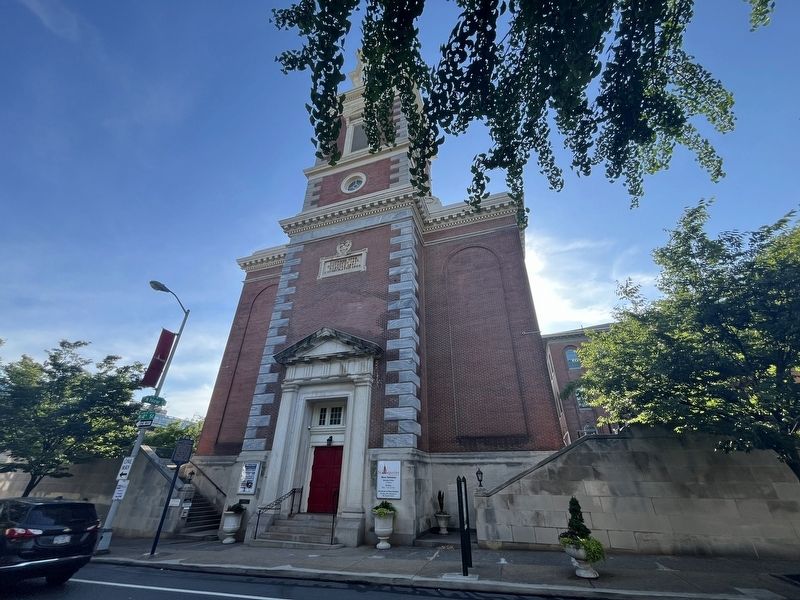
Location. 39° 57.333′ N, 75° 8.772′ W. Marker is in Philadelphia, Pennsylvania, in Philadelphia County. It is in Old City. It is at the intersection of North 4th Street and New Street, on the right when traveling south on North 4th Street. Touch for map. Marker is at or near this postal address: 250 N 4th St, Philadelphia PA 19106, United States of America. Touch for directions.

Regionally, this marker is in Southeast Pennsylvania. It is also in the American Northeast and in the Mid-Atlantic. Globally, it is in North America, the Western Hemisphere, the Western World, and the Anglosphere. Historically, it finds itself in what was once the Haudenosaunee (Iroquois) Confederacy, New Netherland, and one of the original Thirteen Colonies.
Other nearby markers. At least 8 other markers are within walking distance of this marker: St. Augustine's Roman Catholic Church (a few steps from this marker); Nicola Monachesi (a few steps from this marker); Old St. George's United Methodist Church (within shouting distance of this marker); Old St. George's (within shouting distance of this marker); St. George's Church (within shouting distance of this marker); The Methodist Book Concern (within shouting distance of this marker); St. Augustine's R.C. Church (within shouting distance of this marker); Old York Road (about 500 feet away, measured in a direct line). Touch for a list and map of all markers in Philadelphia.
Credits. This page was last revised on June 22, 2024. It was originally submitted on June 22, 2024, by Devry Becker Jones of Washington, District of Columbia. This page has been viewed 197 times since then and 21 times this year. Photos: 1, 2, 3. submitted on June 22, 2024, by Devry Becker Jones of Washington, District of Columbia.
