Ibapah in Tooele County, Utah — The American Mountains (Southwest)
Atrocities and Hostilities

Photographed by Jeremy Snow, June 23, 2024
1. Atrocities and Hostilities Marker
American Indians inhabited lands along the Pony Express Trail for thousands of years before the Pony began its historic run. From the 1840s through the 1860s, they watched swarms of white settlers cross their homelands-impacting traditional hunting grounds with cattle and oxen grazing prairie grasses down to bare ground, and then the senseless killing of thousands of buffalo.
A long history of hostilities on both sides, combined with the terrible atrocities committed by hordes of miners during the 1859-60 rush for silver and gold at the Comstock Lode Mine in western Nevada, launched several years of conflict throughout the Great Basin area. Emigrant wagon trains, Pony Express riders, and station keepers alike began experiencing the angry reactions of regional tribes.
Pony Express riders and station workers alike were frequent targets of attack. Because they could hide safely behind cabin walls during an attack, one might think that workers in the station were safer than the riders were. Not so-more station workers were killed than riders were. Unlike riders who could usually outrun threats, station keepers were sitting
this page online
British adventurer, Sir Richard Burton, on his way west from Salt Lake City in 1860, made this observation on the stations: "On this line there are two kinds of stations, the mail stations, where there is an agent in charge of five or six 'boys,' and the express station-where there is only a master and an express rider... It is a hard life, setting aside the chance of death—no less than three murders have been committed by the Indians during this year."
Caption The original station, located about three miles west of here, was burned down in an Indian attack, rebuilt with stones on this site, and renamed Canyon Station.
Erected by National Pony Express Association.
Topics. This historical marker is listed in these topic lists: Indigenous Peoples and Communities • Industry & Commerce • Roads & Vehicles. A significant historical year for this entry is 1860.
Location. 40° 2.684′ N, 113° 48.243′ W. Marker is in Ibapah, Utah, in Tooele County. It is on Pony Express Overland
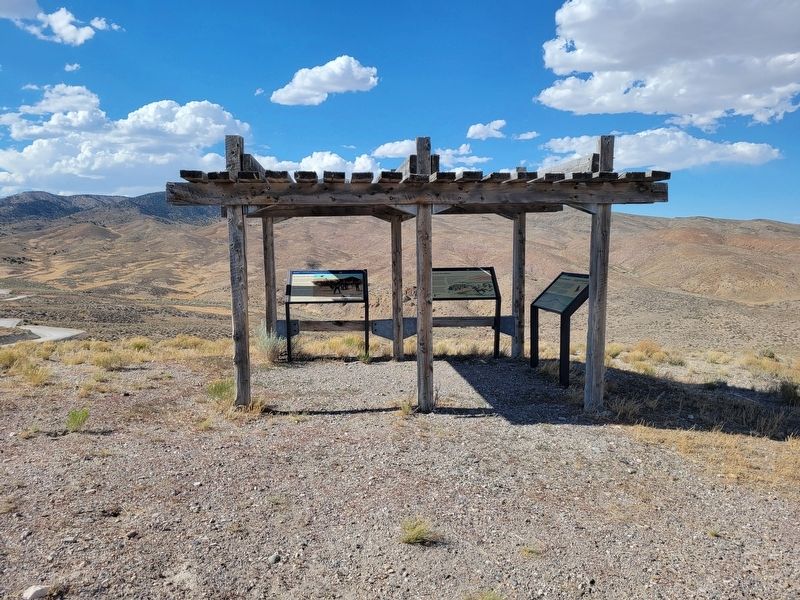
Photographed by Jeremy Snow, June 23, 2024
2. Atrocities and Hostilities Marker

Regionally, this marker is in the Wasatch Front, in the West Desert, and in Greater Salt Lake. It is also in the American Mountain West and on the Colorado Plateau. Globally, it is in North America, the Rocky Mountains, the Western Hemisphere, the Western World, and the Anglosphere. Historically, it finds itself in what was once New Spain and also Mexico’s Alta California.
Other nearby markers. At least 8 other markers are within 10 miles of this marker, measured as the crow flies: The Crowds Cheered On... (here, next to this marker); Eyewitness Accounts (a few steps from this marker); Burnt Station (approx. 3.1 miles away); Central Overland Trail - Deep Creek Summit (approx. 5½ miles away); Deep Creek Station (approx. 9½ miles away); Early Settlers of Ibapah (approx. 9½ miles away); The Lincoln Highway (approx. 9½ miles away); Goshute Tribe (approx. 9½ miles away). Touch for a list and map of all markers in Ibapah.
Credits. This page was last revised on July 7, 2024. It was originally submitted on June 24, 2024, by Jeremy Snow of Cedar City, Utah. This page has been viewed 193 times since then and 16 times this year. Photos: 1, 2. submitted on June 24, 2024, by Jeremy Snow of Cedar City, Utah. • J. Makali Bruton was the editor who published this page.
