Forest Home Cemetery in Forest Park in Cook County, Illinois — The American Midwest (Great Lakes)
Joseph Carter Corbin
Mar. 26, 1833 – Jan. 9, 1911

Photographed by Sean Flynn, June 26, 2024
1. Joseph Carter Corbin Marker
Thanks for the gift of education to countless generations
Erected 2013 by Arkansas Black History Commission; Alumni and Friends of University of Arkansas at Pine Bluff.
Topics and series. This historical marker is listed in these topic lists: African Americans • Cemeteries & Burial Sites • Civil Rights • Education. In addition, it is included in the Historically Black Colleges and Universities, and the National Register of Historic Places (NRHP) series lists. A significant historical date for this entry is March 26, 1833.
Location. 41° 52.311′ N, 87° 49.412′ W. Marker is in Forest Park, Illinois, in Cook County. It is in Forest Home Cemetery. It is on Des Plaines Avenue south of Eisenhower Expressway (Interstate 290). The memorial is in front of Corbin's gravesite in section F of Forest Home Cemetery, a short distance from the cemetery's northern border at the Eisenhower Expressway. It is about ½-mile drive west from the cemetery's primary entrance on Des Plaines Avenue. Touch for map. Marker is
this page online

Regionally, this marker is in Greater Chicago. It is also in the American Midwest. Globally, it is in North America, on the Great Lakes, in the Western Hemisphere, in the Western World, and in the Anglosphere. Historically, it finds itself in what was once the Viceroyalty of New France, the territory of the Mississippian Culture, and the Northwest Territory.
Other nearby markers. At least 8 other markers are within walking distance of this marker: Haymarket Martyrs' Monument (approx. ¼ mile away); a different marker also named Haymarket Martyrs’ Monument (approx. ¼ mile away); Phil Sheridan G.A.R. Post No. 615 Memorial (approx. 0.3 miles away); Waldheim (approx. 0.3 miles away); Ancient Indian Trail (approx. 0.3 miles away); Columbia Post No. 706 (approx. 0.4 miles away); Anton C. Hesing (approx. 0.4 miles away); Maria Werkmeister (approx. 0.4 miles away). Touch for a list and map of all markers in Forest Park.
More about this marker. Joseph Corbin is interred beneath a large rectangular slab

Photographed by Sean Flynn, June 26, 2024
2. The rear of the Joseph Carter Corbin Marker
The Arkansas-Pine Bluff memorial is just west of those headstones. It was erected with the hope of better calling out Corbin's contributions as a pioneer in Black education. The 2013 ceremony dedicating it included a speech by U.S. Rep. Danny Davis (D-Ill.), a graduate of Arkansas-Pine Bluff (when it was called Arkansas Agricultural, Mechanical & Normal College) whose congressional district includes Forest Home Cemetery within its boundaries.
Corbin's grave is one of two sites

Photographed by Sean Flynn, June 26, 2024
3. Joseph Carter Corbin gravesite
The Corbin family gravestone is in the back, the gravestone for Joseph Corbin's wife and two sons in the middle, and the black stone dedicated in 2013 in the front (the back of that memorial, visible here, indicates who dedicated the marker). The Eisenhower Expressway (Interstate 290) runs on the left side of the photo, a short distance away from the gravesite.
The marker is visible from the Eisenhower Expressway and lines up with mile marker 20.60.
Regarding Joseph Carter Corbin. Joseph Carter Corbin was a math professor and an education leader who opened Arkansas's first institution of higher education dedicated to African Americans.
Carter was born in Chillicothe, Ohio, in 1833 to two freed Black parents. He later moved to Louisville, Kentucky, to work as a teacher, and later attended Ohio University. He later worked in Cincinnati, where he met his wife Mary Ward, whom he married in 1866. In 1872, the family moved to Little Rock, Arkansas, where he fast became one of the state's most important figures in establishing education for freed Blacks in the Reconstruction era. Starting in 1873, he served for two years as superintendent of public instruction and president of the University of Arkansas Board of Trustees.
In 1875, he spearheaded the opening of Branch Normal College in Pine Bluff, Arkansas, the state's first college for

Photographed by Sean Flynn, June 26, 2024
4. Joseph Corbin National Register of Historic Places marker
This plaque, on the west-facing side of his gravestone, was added in 2024, a year after his gravesite was added to the National Register of Historic Places.
Click for more information.
Click for more information.
As the Reconstruction era waned, however, Corbin struggled against forces trying to re-segregate the state and oust him. Finally in 1902, the college's board of trustees voted to replace him. Corbin spent the last 10 years of his life as the principal of Merrill High School in Arkansas.
Corbin owned land on the south side of Chicago, and in 1909, he acquired a plot of six graves at German Waldheim Cemetery in Forest Park, which, according to the Historical Society of Forest Park, did not have racially restrictive burial covenants. (German Waldheim today is part of Forest Home
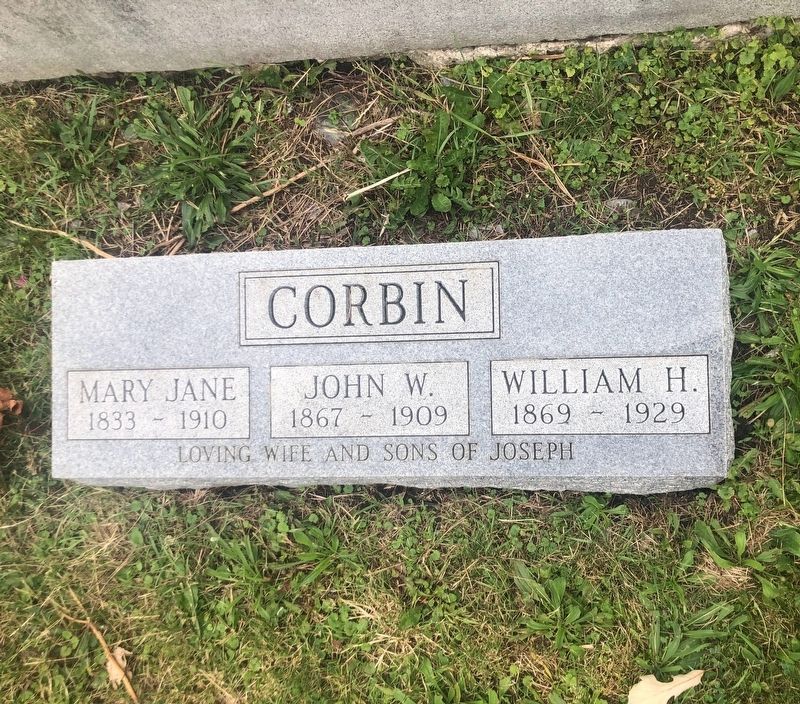
Photographed by Sean Flynn, circa June 26, 2024
5. Corbin family gravestone
Dedicated to Joseph Corbin's wife and two sons.
The gravesite's placement on the National Register of Historic Places was dependent on there being no other logical places in existence that are tied to his significance. While a few sites on the Arkansas-Pine Bluff campus are named after Corbin, none of the properties from his time at Branch Normal remain in existence, his home in Pine Bluff is today an empty lot, and Merrill High School closed in 1971 when school segregation ended. So, some 575 miles north of where he made his mark in Arkansas, Joseph Carter Corbin is honored in Forest Park, Illinois, for his contributions to Black education in the post-war South.
Related marker. Click here for another marker that is related to this marker. Joseph Corbin historical marker in Pine Bluff, Ark.
Also see . . .
1. Letter from the Archives' Director: Joseph Corbin Day. David Ware, director of the Arkansas State Archives and state historian, discusses Joseph Corbin's life and impact in a 2023 article. (Submitted on June 27, 2024, by Sean P. Flynn of Oak Park, Illinois.)
2. Unveiling of Plaque & Dedication of Dr. Joseph Carter Corbin Gravesite as a National Historic Place.

Courtesy of Arkansas State Archives
6. Joseph Carter Corbin (1833-1911)
Excerpt: "He had a second residence in South Township Chicago and had purchased a plot of six graves in 1909 at German Waldheim Cemetery which did not have racially restrictive burial covenants. His son was the first to be buried there, followed by his wife in 1910. He was interred January 14, 1911, at the German Waldheim Cemetery (now Forest Home Cemetery) in Forest Park, Illinois, according to his desire, design, and last will."(Submitted on June 27, 2024, by Sean P. Flynn of Oak Park, Illinois.)

Courtesy of the Butler Center for Arkansas Studies, Central Arkansas Library System, circa 1880
7. Branch Normal College
Credits. This page was last revised on August 24, 2025. It was originally submitted on June 26, 2024, by Sean P. Flynn of Oak Park, Illinois. This page has been viewed 638 times since then and 78 times this year. Photos: 1. submitted on June 26, 2024, by Sean P. Flynn of Oak Park, Illinois. 2, 3, 4, 5, 6, 7. submitted on June 27, 2024, by Sean P. Flynn of Oak Park, Illinois.
