Cartersville in Bartow County, Georgia — The American South (South Atlantic)
Mound C - Ceremonial Mortuary
Etowah Indian Mounds State Historic Site
Photographed by Brandon D Cross
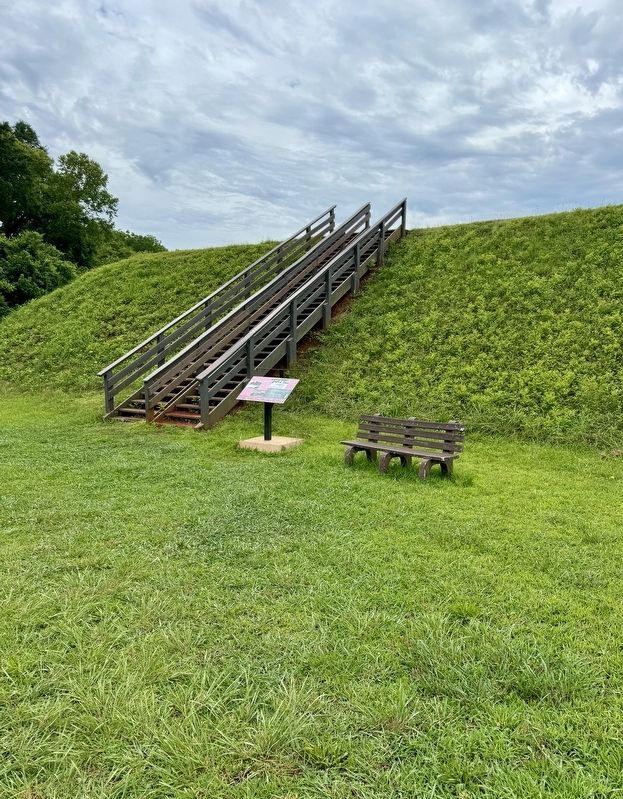
1. Mound C - Ceremonial Mortuary Marker
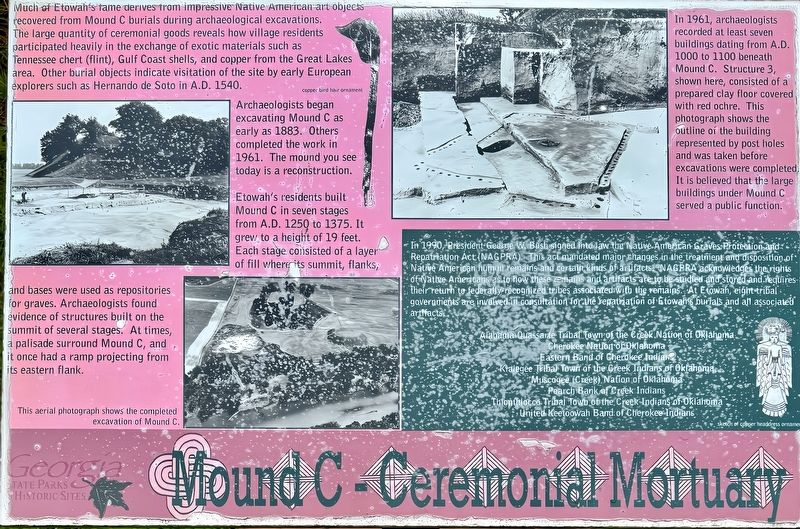
Archaeologists began excavating Mound C as early as 1883. Others completed the work in 1961. The mound you see today is a reconstruction.
Etowah's residents built Mound C in seven stages from A.D. 1250 to 1375. It grew to a height of 19 feet. Each stage consisted of a layer of fill where its summit, flanks; and bases were used as repositories for graves. Archaeologists found evidence of structures built on the summit of several stages. At times, a palisade surround Mound C, and it once had a ramp projecting from its eastern flank.
In 1961, archaeologists recorded at least seven buildings dating from A.D. 1000 to 1100 beneath Mound C. Structure
this page online
Sidebar:
In 1990, President George W. Bush signed into law the Native American Graves Protection and Repatriation Act (NAGPRA). This act mandated major changes in the treatment and disposition of Native American human remains and certain kinds of artifacts. NAGPRA acknowledges the rights of Native Americans as to how these remains and artifacts are to be studied and stored and requires their return to federally recognized tribes associated with the remains. At Etowah, eight tribal governments are involved in consultation for the repatriation of Etowah’s burials and all associated artifacts.
Cherokee Nation of Oklahoma
Eastern Band of Cherokee Indians
Kialegee Tribal Town of the Creek Indians of Oklahoma
Muskogee (Creek) Nation of Oklahoma
Poarch Bank of Creek Indians
Thiophlocco
Photographed by Brandon D Cross
2. Mound C - Ceremonial Mortuary Marker
United Keetoowah Band of Cherokee Indians
(captions)
copper bird hair ornament
This aerial photograph shows the completed excavation of Mound
sketch of copper headdress ornament
Erected by Georgia Council on American Indian Concerns.
Topics. This historical marker is listed in these topic lists: Anthropology & Archaeology • Indigenous Peoples and Communities. A significant historical year for this entry is 1961.
Location. 34° 7.442′ N, 84° 48.453′ W. Marker is in Cartersville, Georgia, in Bartow County. It can be reached from Indian Mound Road SE 0.2 miles south of Glen Cove Drive, on the right when traveling north. On Indian Mound Road SE 0.2 south of Glen Cove Drive on right traveling north. Touch for map. Marker is at or near this postal address: 813 Indian Mound Road SE, Cartersville GA 30120, United States of America. Touch for directions.

Regionally, this marker is in the Mountains. It is also in the American South and specifically in the Deep South. Globally, it is in North America, the Western Hemisphere, the Western World, and the Anglosphere. Historically, it finds itself in what was once the original Cherokee Nation, the territory of the Mississippian Culture, one of the original Thirteen Colonies, one of the Confederate States of America, and the Antebellum South.
Other nearby markers. At least 8 other markers are within walking distance of this marker: Etowah’s Past, Present, and Future (about 300 feet away, measured in a direct line); Mound B and Structure 3 (about 400 feet away); Mound A - Symbol of a Chiefdom (about 500 feet away); Etowah’s River Cane (approx. 0.2 miles away); A Chiefly Village on the Etowah (approx. 0.2 miles away); A Return to Native Grasses (approx. ¼ mile away); The Defensive Ditch/Borrow Pit (approx. ¼ mile away); Etowah’s Wattle and Daub House (approx. ¼ mile away). Touch for a list and map of all markers in Cartersville.
Also see . . . Etowah Indian Mounds State Historic Site. (Submitted on July 2, 2024, by Brandon D Cross of Flagler Beach, Florida.)
Credits. This page was last revised on July 4, 2024. It was originally submitted on July 2, 2024, by Brandon D Cross of Flagler Beach, Florida. This page has been viewed 329 times since then and 106 times this year. Photos: 1, 2. submitted on July 2, 2024, by Brandon D Cross of Flagler Beach, Florida. • Andrew Ruppenstein was the editor who published this page.
