Clarkdale in Yavapai County, Arizona — The American Mountains (Southwest)
The Pueblo's Plaza
Photographed by James Hulse, June 20, 2024
1. The Pueblo's Plaza Marker
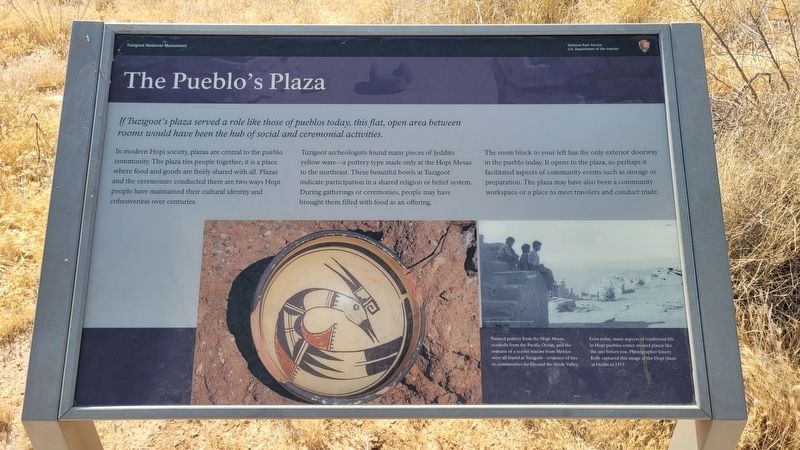
In modern Hopi society, plazas are central to the pueblo community. The plaza ties people together; it is a place where food and goods are freely shared with all. Plazas and the ceremonies conducted there are two ways Hopi people have maintained their cultural identity and cohesiveness over centuries.
Tuzigoot archeologists found many pieces of Jeddito yellow ware-a pottery type made only at the Hopi Mesas to the northeast. These beautiful bowls at Tuzigoot indicate participation in a shared religion or belief system. During gatherings or ceremonies, people may have brought them filled with food as an offering.
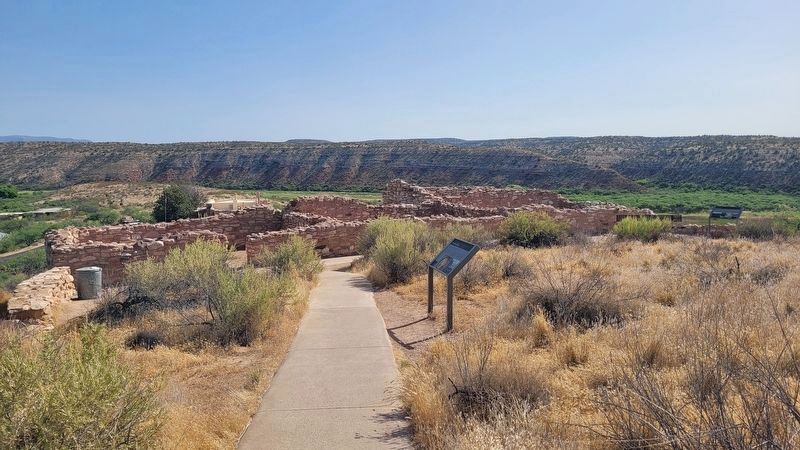
The room block to your left has the only exterior doorway in the pueblo today. It opens to the plaza, so perhaps it facilitated aspects of community events such as storage or preparation. The plaza may have also been a community workspace or a place to meet travelers and conduct trade.
Captions
Painted pottery from the Hopi Mesas, seashells from the Pacific Ocean, and the remains of a scarlet macaw from Mexico were all found at Tuzigoot-evidence of ties to communities far beyond the Verde Valley.
Even today, many aspects of traditional life in Hopi pueblos center around plazas like the one before you. Photographer Emery Kolb captured this image of the Hopi płaza at Oraibi in 1913.
Clint Library, Northern Arizona University
Erected by Tuzigoot
this page online
Topics. This historical marker is listed in these topic lists: Anthropology & Archaeology • Indigenous Peoples and Communities. A significant historical year for this entry is 1913.
Location. 34° 46.15′ N, 112° 1.613′ W. Marker is in Clarkdale, Arizona, in Yavapai County. It is on Tuzigoot Road east of Sycamore Canyon Road. The marker is located in the Tuzigoot National Monument along the hiking loop trail. Touch for map. Marker is at or near this postal address: 25 Tuzigoot Rd, Clarkdale AZ 86324, United States of America. Touch for directions.

Regionally, this marker is in Arizona’s Verde Valley and in the Yavapai-Apache Nation. It is also in the American Southwest and in the Mountain West. Globally, it is in North America, the Western Hemisphere, the Western World, and the Anglosphere. Historically, it finds itself in what was once New Spain and also Mexico’s Alta California.
Other nearby markers. At least 8 other markers are within walking distance of this marker: Moving On (a few steps from this marker); Rich in Minerals (a few steps from this marker); An Evolving Village (within shouting
Photographed by James Hulse, June 20, 2024
2. The view of the Pueblo's Plaza and Marker
More about this marker. The marker is located in the Tuzigoot National Monument along the hiking loop trail. There is a small entrance fee to visit the archeological ruins.
Also see . . . Tuzigoot Human History. Tuzigoot National Monument
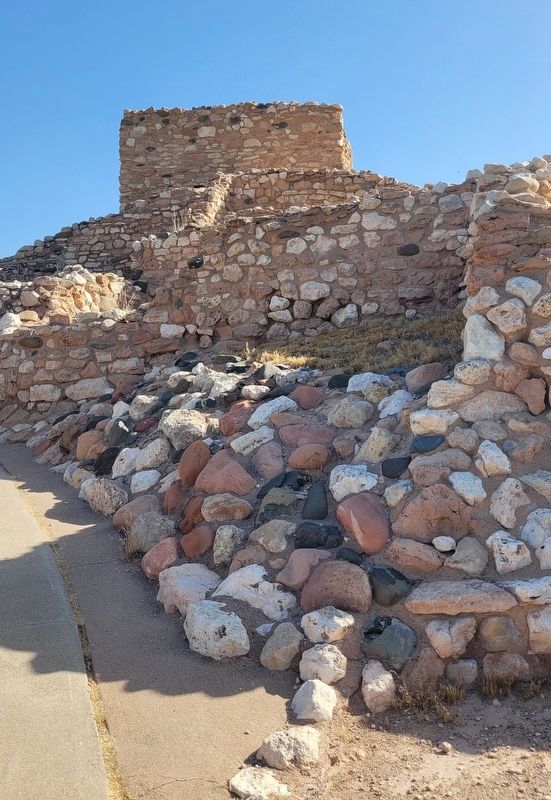
The first people - The human history of the Verde Valley begins around ten thousand years ago, when the southwest was cooler and wetter than it is today. Paleolithic hunter-gatherers traveled through a greener, woodier Verde Valley, filled with pinyon pine, shrub live oak, and juniper. Today we know of their presence from a handful of Clovis points - distinctive stone points that were probably used with spears - that have been found in and near the valley. Clovis points(Submitted on July 4, 2024, by James Hulse of Medina, Texas.)are found all across North America and parts of South America, indicating that these ancient people traveled widely across the continents, probably following game animals, the growth of edible plants, and other resources.Photographed by James Hulse, June 20, 20243. A view of the reconstructed pueblo at the top of the hill
Credits. This page was last revised on July 5, 2024. It was originally submitted on July 3, 2024, by James Hulse of Medina, Texas. This page has been viewed 201 times since then and 29 times this year. Photos: 1, 2, 3. submitted on July 5, 2024, by James Hulse of Medina, Texas.
