West Colorado Springs in Manitou Springs in El Paso County, Colorado — The American Mountains (Southwest)
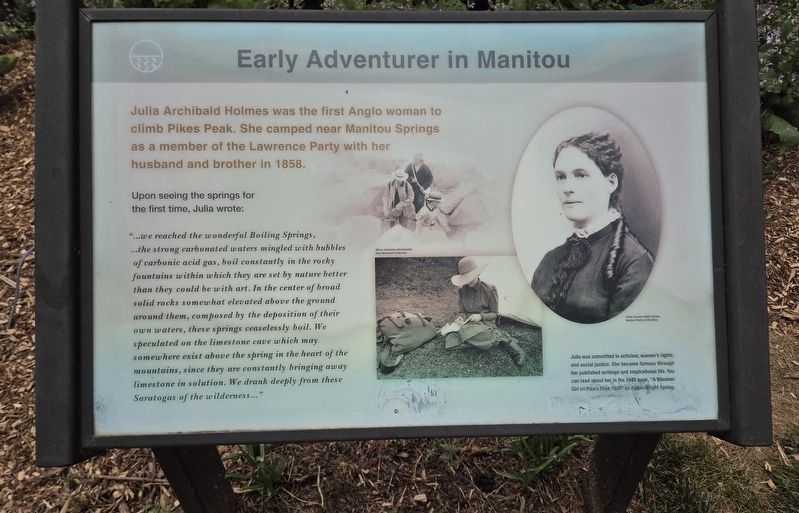
An Early Adventurer in Manitou
Photographed by Mark Parker, July 2, 2024
1. An Early Adventurer in Manitou Marker
Upon seeing the springs for the first time, Julia wrote:
...we reached the wonderful Boiling Springs...the strong carbonated waters mingled with bubbles of carbonic acid gas, boil constantly in the rocky fountains within which they are set by nature better than they could be with art. In the center of broad solid rocks somewhat elevated above the ground around them, composed by the deposition of their own waters, these springs ceaselessly boil. We speculated on the limestone cave which may somewhere exist above the spring in the heart of the mountains, since they are constantly bringing away limestone in solution. We drank deeply from these Saratogas of the wilderness...
(text bottom right) Julia was committed to activism, women's rights, and social justice. She became famous through her published writings and inspirational life. You can read about her in the 1949 book, "A Bloomer Girl on Pike's Peak 1858" by Agnes Wright Spring.
(photo
this page online
Middle: Above and below photographs from Wolverton Collection
Holmes Middle right: Photo: Denver Public Library Western History Collection
Topics. This historical marker is listed in these topic lists: Exploration • Natural Features • Women. A significant historical year for this entry is 1858.
Location. 38° 51.517′ N, 104° 54.695′ W. Marker is in Manitou Springs, Colorado, in El Paso County. It is in West Colorado Springs. It is at the intersection of Washington Avenue and El Paso Boulevard, on the left when traveling north on Washington Avenue. Marker is at Seven Minute Spring Park. Touch for map. Marker is at or near this postal address: 422 Washington Avenue, Manitou Springs CO 80829, United States of America. Touch for directions.

Regionally, this marker is in Colorado’s Front Range and in Pikes Peak Region. It is also in the American Mountain West. Globally, it is in North America, the Rocky Mountains, the Western Hemisphere, the Western World, and the Anglosphere. Historically, it finds itself in what was once the Comanchería.
Other nearby markers. At least 8 other markers are within walking
Photographed by Mark Parker, July 2, 2024
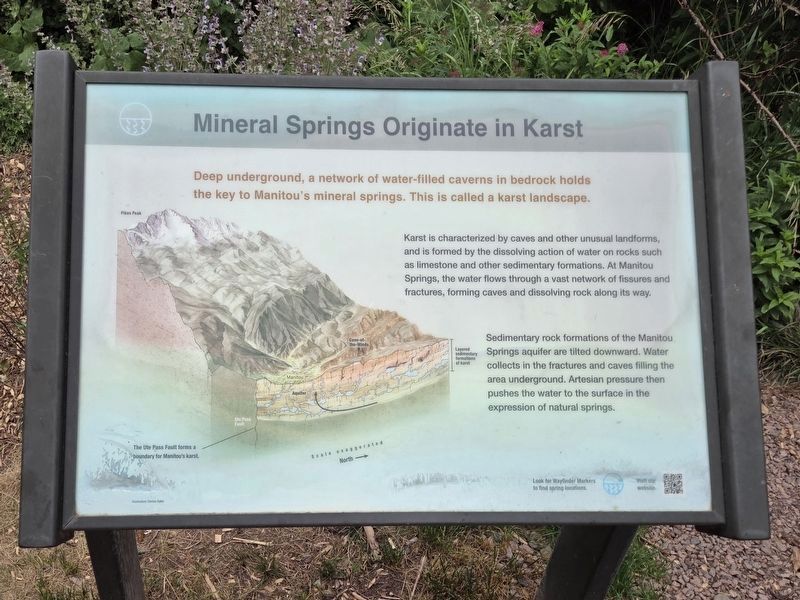
2. Mineral Springs Originate in Karst (spring origins referred to in the marker)
Deep underground, a network of water-filled caverns in bedrock holds the key to Manitou's mineral springs. This is called a karst landscape.
Karst is characterized by caves and other unusual landforms, and is formed by the dissolving action of water on rocks such as limestone and other sedimentary formations. At Manitou Springs, the water flows through a vast network of fissures and fractures, forming caves and dissolving rock along its way.
Sedimentary rock formations of the Manitou Springs aquifer are tilted downward. Water collects in the fractures and caves filling the area underground. Artesian pressure then pushes the water to the surface in the expression of natural springs.
Karst is characterized by caves and other unusual landforms, and is formed by the dissolving action of water on rocks such as limestone and other sedimentary formations. At Manitou Springs, the water flows through a vast network of fissures and fractures, forming caves and dissolving rock along its way.
Sedimentary rock formations of the Manitou Springs aquifer are tilted downward. Water collects in the fractures and caves filling the area underground. Artesian pressure then pushes the water to the surface in the expression of natural springs.
More about this marker. At Seven Minute Spring Park, look for the gazebo near the intersection of Washington and El Paso. The marker is to the southeast of the gazebo. The spring referred to is to the east.

Photographed by Mark Parker, July 2, 2024
3. An Early Adventurer in Manitou Marker facing the gazebo at Seven Minute Spring Park

Photographed by Mark Parker, July 2, 2024
4. Seven Minute Spring is to the far right
Credits. This page was last revised on July 9, 2024. It was originally submitted on July 8, 2024, by Mark Parker of Hickory, North Carolina. This page has been viewed 230 times since then and 18 times this year. Photos: 1, 2, 3, 4. submitted on July 8, 2024, by Mark Parker of Hickory, North Carolina. • Andrew Ruppenstein was the editor who published this page.
