Manitou Springs in El Paso County, Colorado — The American Mountains (Southwest)
Manitou Mineral Water Company Bottling Plant
Manitou Mineral Water Park and Bath Company Bath House
Photographed by Mark Parker, July 2, 2024
1. Manitou Mineral Water Company Bottling Plant /Manitou Mineral Water Park and Bath Company Bath House
Manitou Mineral Water Company
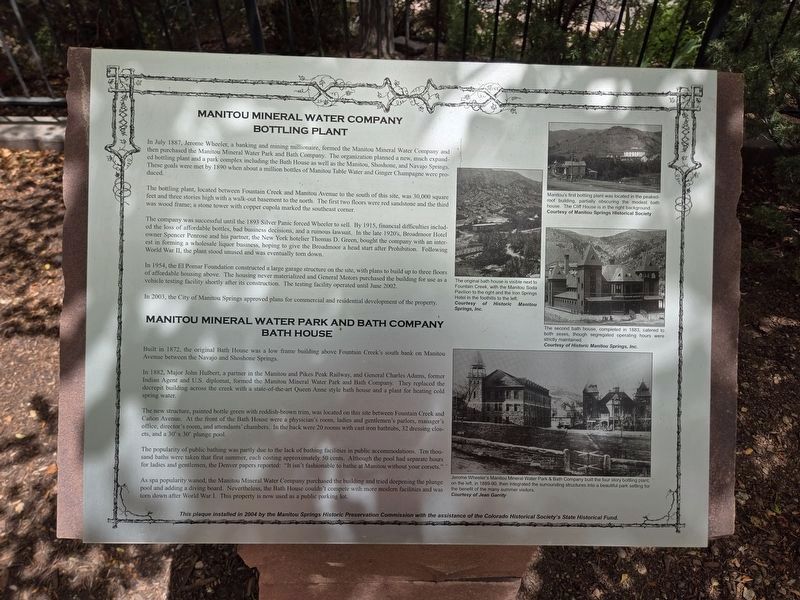
In July 1887, Jerome Wheeler, a banking and mining millionaire, formed the Manitou Mineral Water Company and then purchased the Manitou Mineral Water Park and Bath Company. The organization planned a new, much expanded bottling plant and a park complex including the Bath House as well as the Manitou, Shoshone, and Navajo Springs. These goals were met by 1890 when about a million bottles of Manitou Table Water and Ginger Champagne were produced.
The bottling plant, located between Fountain Creek and Manitou Avenue to the south of this site, was 30,000 square feet and three stories high with walk-out basement to the north. The first two floors were red sandstone and the third was wood frame; a stone tower with copper cupola marked the southeast corner.
The company was successful until the 1893 Silver Panic forced Wheeler to sell. By 1915, financial difficulties included the loss of affordable bottles, bad business decisions, and a ruinous lawsuit. In the late 1920's, Broadmoor Hotel owner Spencer Penrose and his partner, the New York hotelier Thomas D. Green, bought the company with an interest in forming a wholesale liquor business, hoping to give the Broadmoor head start after Prohibition. Following World War II, the plant stood
this page online
In 1954, the El Pomar Foundation constructed a large garage structure on the site, with plans to build up to three floors of affordable housing above. The housing never materialized and General Motors purchased the building for use as a vehicle testing facility shortly after its construction. The testing facility operated until June 2002.
In 2003, the City of Manitou Springs approved plans for commercial and residential development of the property.
Manitou Mineral Water Park and Bath Company Bath House
Built in 1872, the original Bath House was a low frame building above Fountain Creek's south bank on Manitou Avenue between the Navajo and Shoshone Springs.
In 1882, Major John Hulbert, a partner in the Manitou and Pikes Peak Railway, and General Charles Adams, former Indian Agent and U.S. diplomat, formed the Manitou Mineral Water Park and Bath Company. They replaced the decrepit building across the creek with a state-of-the-art Queen Anne style bath house and a plant for heating cold spring water.
The new structure, painted bottle green with reddish-brown trim, was located on this site between Fountain Creek and Cañon Avenue. At the front of the Bath House were a physician's room ladies and gentlemen's parlors, manager office,
Photographed by Mark Parker, July 2, 2024
2. Historic photos of Bottling Plant and Bath Company Bath House
photo captions on right side of marker, top to bottom
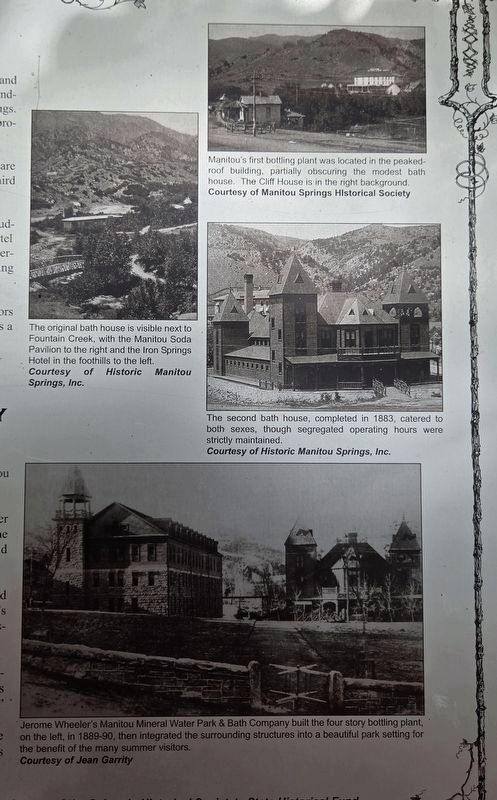
Manitou's first bottling plant was located in the peaked-roof building, partially obscuring the modest bath house. The Cliff House is in the right background. Courtesy of Manitou Springs Historical Society
The original bath house is visible next to Fountain Creek, with the Manitou Soda Pavilion to the right and the lron Springs Hotel in the foothills to the left. Courtesy of Historic Manitou Springs, Inc.
The second bath house, completed in 1883, catered to both sexes, though segregated operating hours were strictly maintained. Courtesy of Historic Manitou Springs, Inc.
Jerome Wheeler's Manitou Mineral Water Park & Bath Company built the four story botting plant, on the left, in 1889-90, then integrated the surrounding structures into a beautiful park setting for on the benefit of the many summer visitors. Courtesy of Jean Garrity
Manitou's first bottling plant was located in the peaked-roof building, partially obscuring the modest bath house. The Cliff House is in the right background. Courtesy of Manitou Springs Historical Society
The original bath house is visible next to Fountain Creek, with the Manitou Soda Pavilion to the right and the lron Springs Hotel in the foothills to the left. Courtesy of Historic Manitou Springs, Inc.
The second bath house, completed in 1883, catered to both sexes, though segregated operating hours were strictly maintained. Courtesy of Historic Manitou Springs, Inc.
Jerome Wheeler's Manitou Mineral Water Park & Bath Company built the four story botting plant, on the left, in 1889-90, then integrated the surrounding structures into a beautiful park setting for on the benefit of the many summer visitors. Courtesy of Jean Garrity
The popularity of public bathing was partly due to the lack of bathing facilities in public accommodations. Ten thousand baths were taken that first summer, each costing approximately 50 cents. Although the pool had separate hours for ladies and gentlemen, the Denver papers reported: "It isn't fashionable to bathe at Manitou, without your corsets."
As spa popularity waned, the Manitou Mineral Water Company purchased the building and tried deepening the plunge pool and adding a diving board. Nevertheless, the Bath House couldn't compete with more modern facilities and was torn down after World War I. This property is now used as a public parking lot.
Erected 2004 by Manitou Springs Historic Preservation Commission, Colorado Historical Society's State Historic Fund.
Topics. This historical marker is listed in these topic lists: Industry & Commerce • Parks & Recreational Areas • Science & Medicine. A significant historical month for this entry is June 1887.
Location. 38° 51.492′ N, 104° 55.035′ W. Marker is in Manitou Springs, Colorado, in El Paso County. It can be reached from the intersection of Manitou Avenue (Business U.S. 24) and Navajo Avenue, on the right when traveling west. Located behind Shoshone Spring. Touch for map. Marker is at or near this postal address: 902 Manitou Avenue, Manitou Springs CO 80829, United States of America. Touch for directions.

Regionally, this marker is in the Front Range and in Pikes Peak Region. It is also in the American Mountain West. Globally, it is in North America, the Rocky Mountains, the Western Hemisphere, the Western World, and the Anglosphere. Historically, it finds itself in what was once the Comanchería.
Other nearby markers. At least 8 other markers are within walking distance of this marker: Healing Waters (here, next to this marker); Bank of Manitou (within
Photographed by Mark Parker, July 2, 2024
3. Manitou Mineral Water Company Bottling Plant /Manitou Mineral Water Park and Bath Company Bath House
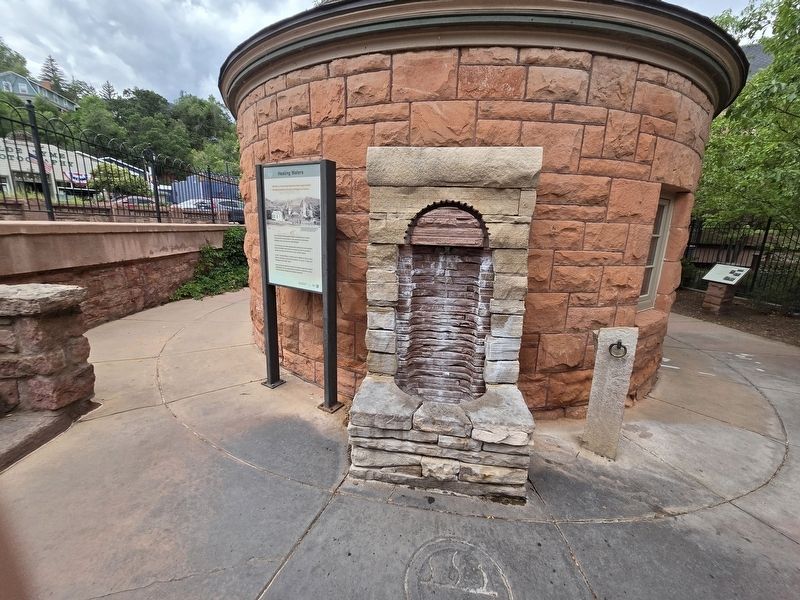
Location is around the back of the Shoshone Spring brick house, on the right in this picture. Staircase to the left.
More about this marker. Marker is behind sandstone brick structure from Shoshone Spring. From sidewalk, go down steps and circle to the back for the marker
Credits. This page was last revised on December 10, 2024. It was originally submitted on July 8, 2024, by Mark Parker of Hickory, North Carolina. This page has been viewed 1,541 times since then and 257 times this year. Photos: 1, 2, 3. submitted on July 8, 2024, by Mark Parker of Hickory, North Carolina. • Andrew Ruppenstein was the editor who published this page.
