Bensenville in DuPage County, Illinois — The American Midwest (Great Lakes)
Oak Savanna
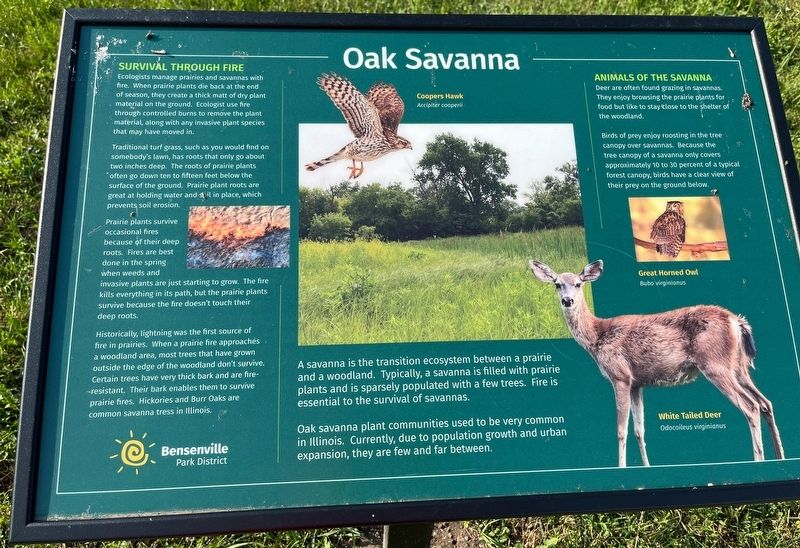
Photographed by Sean Flynn, July 10, 2024
1. Oak Savanna Marker
Survival Through Fire
Ecologists manage prairies and savannas with fire. When prairie plants die back at the end of season, they create a thick matt of dry plant material on the ground. Ecologist use fire through controlled burns to remove the plant material, along with any invasive plant species that may have moved in.
Traditional turf grass, such as you would find on somebody's lawn, has roots that only go about two inches deep. The roots of prairie plants often go down ten to fifteen feet below the surface of the ground. Prairie plant roots are great at holding water and soil in place, which prevents soil erosion.
Prairie plants survive occasional fires because of their deep roots. Fires are best done in the spring when weeds and invasive plants are just starting to grow. The fire kills everything in its path, but the prairie plants survive because the fire doesn't touch their deep roots.
Historically, lightning was the first source of fire in prairies. When a prairie fire approaches a woodland area, most trees that have grown outside the edge of the woodland don't survive. Certain trees have very thick bark
this page online
A savanna is the transition ecosystem between a prairie and a woodland. Typically, a savanna is filled with prairie plants and is sparsely populated with a few trees. Fire is essential to the survival of savannas.
Oak savanna plant communities used to be very common in Illinois. Currently, due to population growth and urban expansion, they are few and far between.
Animals of the Savanna
Deer are often found grazing in savannas. They enjoy browsing the prairie plants for food but like to stay close to the shelter of the woodland.
Birds of prey enjoy roosting in the tree canopy over savannas. Because the tree canopy of a savanna only covers approximately 10 to 30 percent of a typical forest canopy, birds have a clear view of their prey on the ground below.
Erected by Bensenville Park District.
Topics. This historical marker is listed in these topic lists: Environment • Horticulture & Forestry • Parks & Recreational Areas.
Location. 41° 56.964′ N,
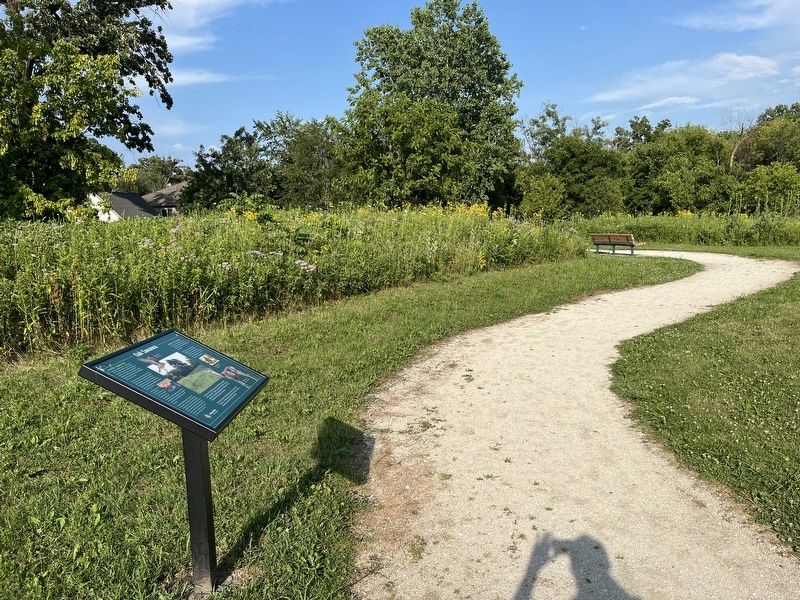
Photographed by Sean Flynn, July 10, 2024
2. Oak Savanna Marker

Regionally, this marker is in Greater Chicago. It is also in the American Midwest. Globally, it is in North America, on the Great Lakes, in the Western Hemisphere, in the Western World, and in the Anglosphere. Historically, it finds itself in what was once the territory of the Mississippian Culture and also the Northwest Territory.
Other nearby markers. At least 8 other markers are within walking distance of this marker: Breiter-Palm Park History (within shouting distance of this marker); The Peace Pole (within shouting distance of this marker); Breiter-Palm Prairie (about 300 feet away, measured in a direct line); Bensenville Fire Prevention District 9/11 Memorial (approx. 0.7 miles away); Bensenville Memorial Fountain (approx. 0.7 miles away); 1944 (approx. 0.7 miles away); Lynn C. Huffman (approx. 0.7 miles away); Bensenville Veterans Memorial (approx. 0.7 miles away). Touch for a list and map of all markers in Bensenville.
Credits. This page was last revised on July 11, 2024. It was originally submitted on July 11, 2024, by Sean P. Flynn of Oak Park, Illinois. This page has been viewed 133 times since then and 22 times this year. Photos: 1, 2. submitted on July 11, 2024, by Sean P. Flynn of Oak Park, Illinois.
