Corona Heights in San Francisco City and County, California — The American West (Pacific Coastal)
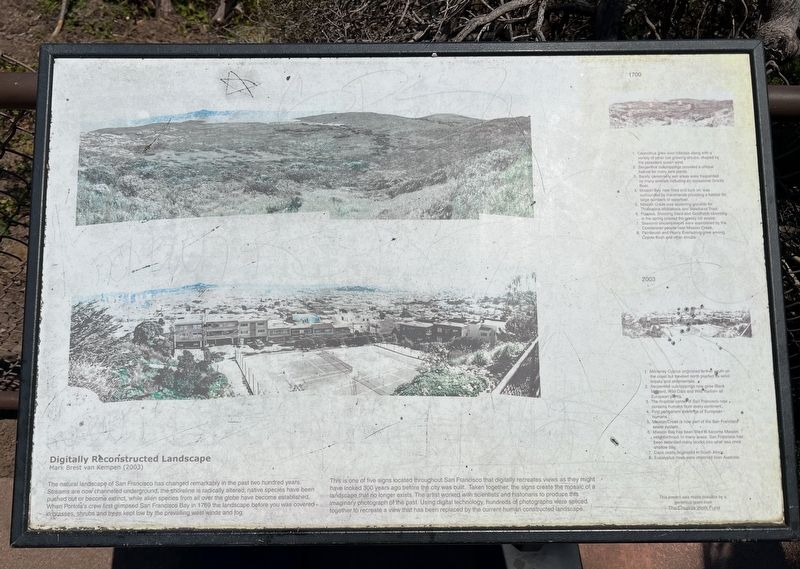
Digitally Reconstructed Landscape
Mark Brest van Kempen (2003)
Photographed by Sam Skeen, July 12, 2024
1. Digitally Reconstructed Landscape Marker
This is one of the five signs located throughout San Francisco that digitally recreates views as they might have looked 300 years ago before the city was built. Taken together, the songs create the mosaic of landscape that no longer exists. The artist worked with scientists and historians to produce this imaginary photograph of the past. Using digital technology, hundreds of photographs were spliced together to recreate a view that has been replaced by the current human constructed landscape.
1700
1.Ceonolhus grew over hillsides along with a variety of other low growing shrubs, shaped by the persistent ocean wind.
2. Serpentine outcroppings provided a unique
this page online
3. Sandy, perennially wet areas were frequented by many animals including an occasional Grizzly Bear.
4. Mission Bay, now filled and built on, was surrounded by marshlands providing a habitat for large numbers of waterfowl.
5. Mission Creek was spawning grounds for Threespine stickleback and Steelhead Trout.
6. Poppies, Shooting Stars and Goldfields blooming in the spring colored the grassy hill slopes.
7. Seasonal encampments were maintained by the Coastanoan people near Mission Creek.
8. Paintbrush and Pearly Everlasting grew among Coyote Bush and other shrubs.
2003
1. Monterey Cyprus originated farther south on the coast but traveled north planted as wind breaks and ornamentals.
2. Serpentine outcroppings now grow Black Mustard, Wild Oats and Wild Radish all European plants.
3. The financial center of San Francisco now contains humans from every continent.
4. First permanent dwellings of European humans.
5. Mission Creek is now part of the San Francisco sewer system.
6. Mission Bay has been filled to become Mission neighborhood. In many areas, San Francisco has been extended many blocks
Photographed by Sam Skeen, July 12, 2024
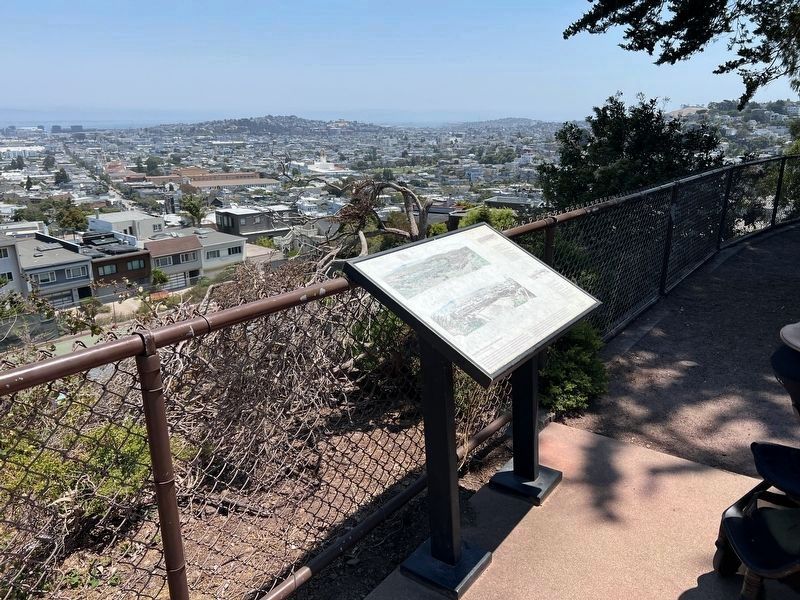
2. Digitally Reconstructed Landscape Marker
7. Cape oxalls originated in South Africa.
8. Eucalyptus trees were imported from Australia.
Erected by The Creative Work Fund.
Topics. This historical marker is listed in these topic lists: Colonial Era • Environment • Settlements & Settlers. A significant historical year for this entry is 1769.
Location. 37° 45.869′ N, 122° 26.259′ W. Marker is in San Francisco, California, in San Francisco City and County. It is in Corona Heights. It can be reached from Museum Way. Located behind the Randall Museum along the walking path. Touch for map. Marker is at or near this postal address: 199 Museum Way, San Francisco CA 94114, United States of America. Touch for directions.

Regionally, this marker is on the Coast Ranges. It is also on the American Pacific Coast. Globally, it is in North America, on the Ring of Fire, on the Pacific Rim, in the Western Hemisphere, in the Western World, and in the Anglosphere. Historically, it finds itself in what was once New Spain and also Mexico’s Alta California.
Other nearby markers. At least 8 other markers are within walking distance of this
Photographed by Sam Skeen, July 12, 2024
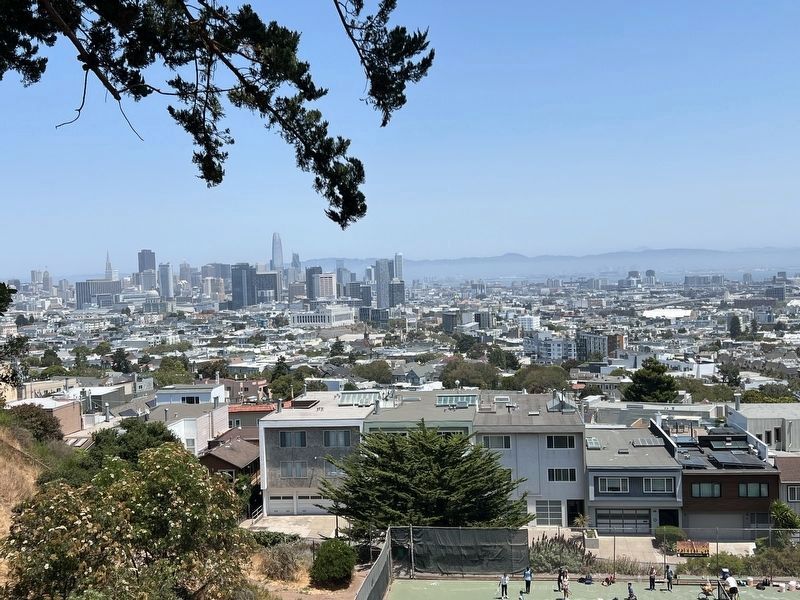
3. San Francisco skyline
Credits. This page was last revised on July 13, 2024. It was originally submitted on July 12, 2024, by Sam Skeen of State College, Pennsylvania. This page has been viewed 233 times since then and 20 times this year. Photos: 1. submitted on July 12, 2024, by Sam Skeen of State College, Pennsylvania. 2, 3. submitted on July 13, 2024, by Sam Skeen of State College, Pennsylvania. • Andrew Ruppenstein was the editor who published this page.
