Three Rivers in Otero County, New Mexico — The American Mountains (Southwest)
Tularosa Basin

Photographed by James Hulse, June 25, 2024
1. Tularosa Basin Marker
White Sands National Monument is 30 miles to the southwest. The origin of the white sand is Lake Lucero, at the base of the San Andres Mountains. Seasonal rains fill the ancient playa lake bed. As the water evaporates, the fine gypsum sediments dry, and are blown downwind. In this manner, the vast gypsum dunes are slowly advancing further south and east. Volcanic lava flows, known as the Malpais, are about 20 miles to the northwest. This Spanish word means "bad lands." The last lava flow occurred as recently as 1,500 to 2,000 years ago. One can only imagine what the prehistoric inhabitants of the time thought
this page online
The lava spread southward 44 miles, covering 125 square miles. At its thickest point, the lava is 160 feet thick. It is a rough terrain. Despite its ruggedness and its formidable name, the lava flows are a fertile environment for a diversity of plant life. Animals inhabiting the Malpais include mule deer, Barbary sheep, coyotes, foxes, and birds. Some rodents, lizards, and a type of snake inhabiting the lava flows have adapted to their environment by developing a darker coloring. They blend with their surroundings, making it difficult for predators to spot them. The same species that are dark-colored in the Malpais are light-colored in the White Sands National Monument.
The Tularosa Basin has been inhabited by humans for 10,000 years or more. The past residents left behind various traces of their ways of life, including petroglyphs, pottery, stone tools, and village ruins like those here at Three Rivers. Europen-descended settlers arrived in the Tularosa Basin in the late 1800's. They used the land for mining, farming, and ranching. Many ranching families had to give up their holdings in the 1950's

Photographed by James Hulse, June 25, 2024
2. The Tularosa Basin and Marker
Erected by Bureau of Land Management.
Topics. This historical marker is listed in these topic lists: Animals • Indigenous Peoples and Communities • Parks & Recreational Areas.
Location. 33° 20.812′ N, 106° 0.676′ W. Marker is in Three Rivers, New Mexico, in Otero County. It is on 3 Rivers Road 4.7 miles east of U.S. 54. The marker is located along the middle section of the petroglyphs hiking trail in the Three Rivers Petroglyph Site. Touch for map. Marker is at or near this postal address: 455 3 Rivers Road, Tularosa NM 88352, United States of America. Touch for directions.

Regionally, this marker is in the Pecos Valley. It is also in the American Borderlands and in the Southwest. Globally, it is in North America, the Western Hemisphere, the Western World, and the Anglosphere. Historically, it finds itself in what was once New Spain, the Comanchería, and the Republic of
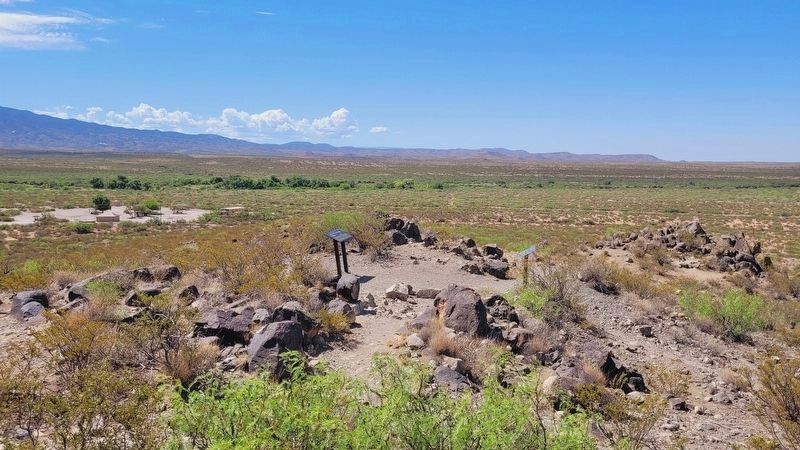
Photographed by James Hulse, June 25, 2024
3. The view of the markers looking back at the visitors center
Other nearby markers. At least 8 other markers are within walking distance of this marker: Sacramento Mountains (here, next to this marker); Three Rivers Petroglyph Site (approx. 0.2 miles away); The First People (approx. ¼ mile away); Prehistoric Village (approx. 0.3 miles away); Leave Only Footprints (approx. 0.4 miles away); Home - 1000 Years Ago (approx. 0.4 miles away); Adobe Surface House (approx. 0.4 miles away); Building of a Later Period (approx. 0.4 miles away). Touch for a list and map of all markers in Three Rivers.
More about this marker. There is a small entrance fee to visit the Three Rivers Petroglyph Site.
Also see . . . Tularosa Basin. Wikipedia
The Tularosa Basin is a graben basin in the Basin and Range Province and within the Chihuahuan Desert, east of the Rio Grande in southern New Mexico and West Texas, in the Southwestern United States.(Submitted on July 13, 2024, by James Hulse of Medina, Texas.)

Photographed by James Hulse, June 25, 2024
4. Petroglyph along the hiking trail
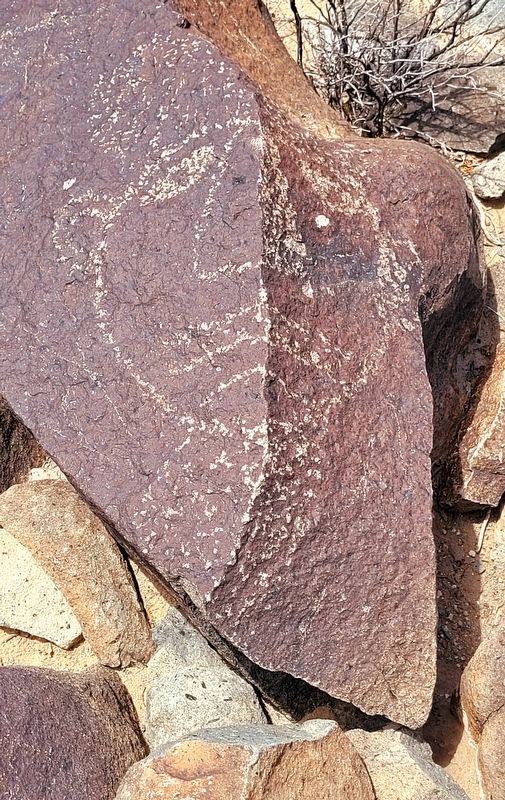
Photographed by James Hulse, June 25, 2024
5. Petroglyph along the hiking trail
Credits. This page was last revised on July 13, 2024. It was originally submitted on July 12, 2024, by James Hulse of Medina, Texas. This page has been viewed 265 times since then and 29 times this year. Photos: 1, 2, 3, 4, 5. submitted on July 13, 2024, by James Hulse of Medina, Texas.
