Clearfield in Clearfield County, Pennsylvania — The American Northeast (Mid-Atlantic)
Clearfield's Early Inhabitants
Pennsylvania Wilds
Photographed by William Fischer, Jr., July 12, 2024
1. Clearfield's Early Inhabitants Marker
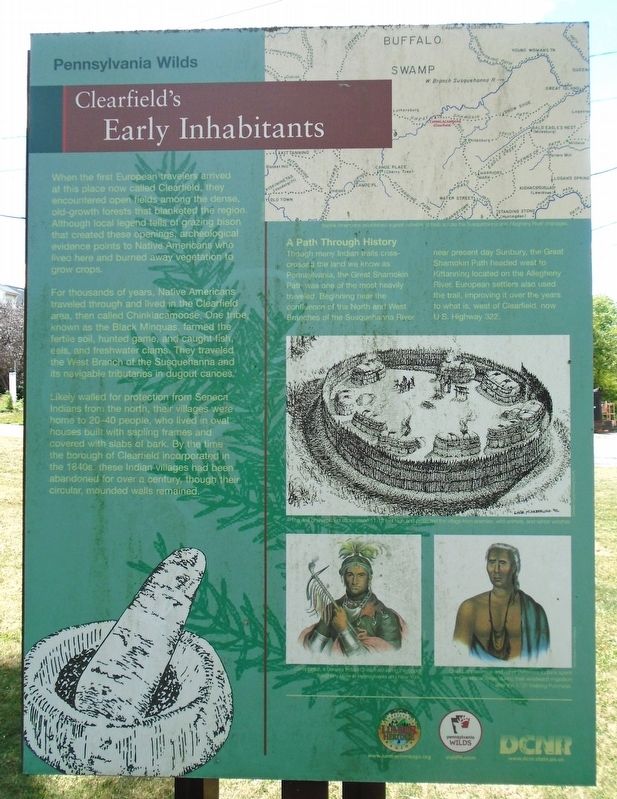
When the first European travelers arrived at this place now called Clearfield, they encountered open fields among the dense, old-growth forests that blanketed the region. Although local legend tells of grazing bison that created these openings, archeological evidence points to Native Americans who lived here and burned away vegetation to grow crops.
For thousands of years, Native Americans traveled through and lived in the Clearfield area, then called Chinklacamoose. One tribe, known as the Black Minquas, farmed the fertile soil, hunted game, and caught fish, eels, and freshwater clams. They traveled the West Branch of the Susquehanna and its navigable tributaries in dugout canoes.
Likely walled for protection from Seneca Indians from the north, their villages were home to 20-40 people, who lived in oval houses built with sapling frames and covered with slabs of bark. By the time the borough of Clearfield incorporated in the 1840s. these Indian villages had been abandoned for over a century, though their circular, mounded walls remained.
A Path Through History
Though many Indian trails crisscrossed
this page online
[Photo captions, top to bottom, read]
• Native Americans established a great network of trails across the Susquehanna and Allegheny River drainages.
• The wall of sharpened sticks stood 11-12 feet high and protected the village from enemies, wild animals, and winter weather.
• Cornplanter, a Seneca Indian Chief, lived along the upper Allegheny River in Pennsylvania and New York.
• Chief Lappawinsoe and other Delaware Indians spent time in Chinklacamoose during their westward migration after the 1737 Walking Purchase.
Erected by PA DCNR, PA Wilds, and PA Lumber Heritage Region.
Topics. This historical marker is listed in these topic lists: Indigenous Peoples and Communities • Roads & Vehicles • Settlements & Settlers. A significant historical year for this entry is 1737.
Location. 41° 1.404′ N,
Photographed by William Fischer, Jr., July 12, 2024
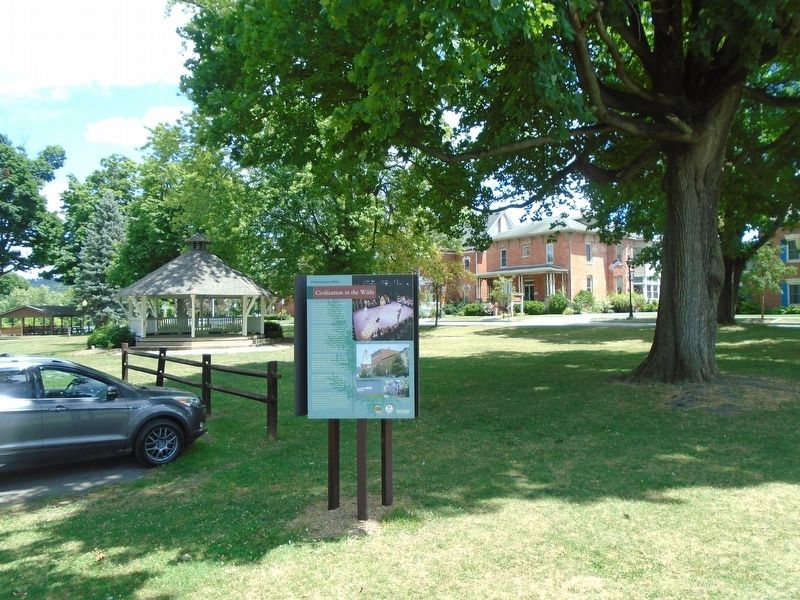
2. Clearfield's Early Inhabitants Marker

Regionally, this marker is in the Pennsylvania Wilds. It is also in the American Northeast, in the Mid-Atlantic, in Appalachia, and specifically in Northern Appalachia. Globally, it is in North America, the Western Hemisphere, the Western World, and the Anglosphere. Historically, it finds itself in what was once the Haudenosaunee (Iroquois) Confederacy and also one of the original Thirteen Colonies.
Other nearby markers. At least 8 other markers are within walking distance of this marker: Civilization in the Wilds (here, next to this marker); Discover the Lumber Heritage Region (here, next to this marker); West Branch Susquehanna River Water Trail (within shouting distance of this marker); Roger W. Bell (within shouting distance of this marker); Clearfield County Historical Society (about 400 feet away, measured in a direct line); Clearfield County (about 400 feet away); Old Town Historic District (about 500 feet away); Bigler House (about 500 feet away). Touch for a list and map of all markers in Clearfield.
Also see . . .
1. The Great Shamokin Path. (Submitted on July 14, 2024, by William Fischer, Jr. of Reynoldsburg, Ohio.)
2. Pennsylvania Wilds. (Submitted on July 14, 2024, by William Fischer, Jr. of Reynoldsburg, Ohio.)
3. Lumber Heritage Region. (Submitted on July 14, 2024, by William Fischer, Jr. of Reynoldsburg, Ohio.)
4. Clearfield (Chinklacamoose). (Submitted on July 14, 2024, by William Fischer, Jr. of Reynoldsburg, Ohio.)
Credits. This page was last revised on July 19, 2025. It was originally submitted on July 14, 2024, by William Fischer, Jr. of Reynoldsburg, Ohio. This page has been viewed 1,204 times since then and 221 times this year. Photos: 1, 2. submitted on July 14, 2024, by William Fischer, Jr. of Reynoldsburg, Ohio.
