Newport in Newport County, Rhode Island — The American Northeast (New England)
Touro Park
| — | Walking Tour of the Historic Hill | — |
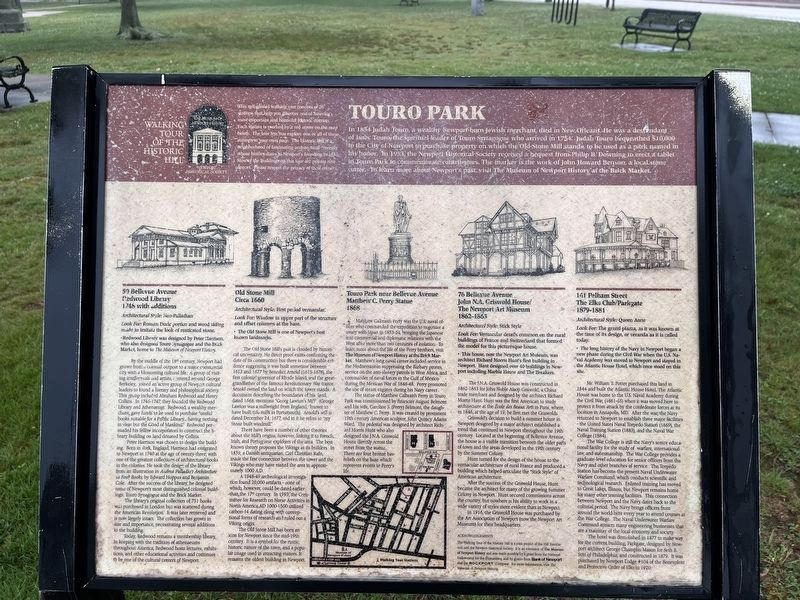
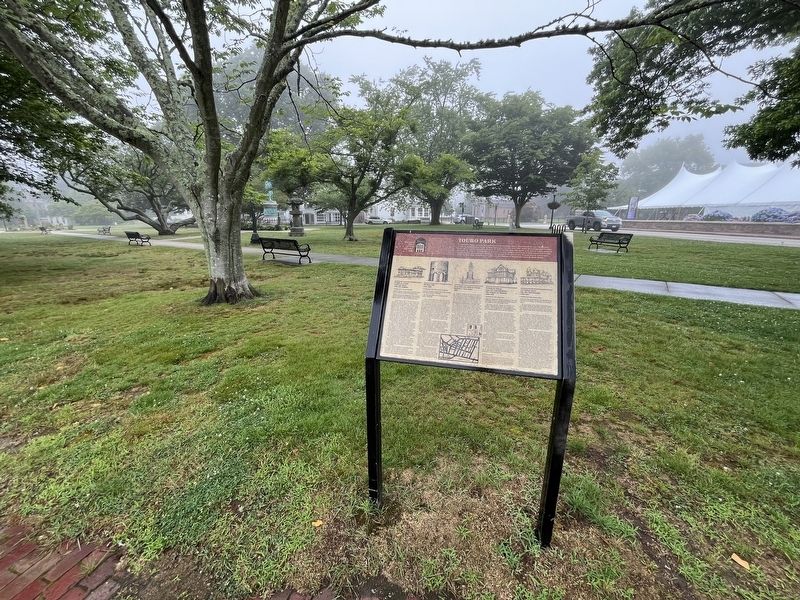
In 1854 Judah Touro, a wealthy Newport-born Jewish merchant, died in New Orleans. He was a descendant of Isaac Touro, the spiritual leader of Tuoro Synagogue who arrived in 1754. Judah Touro bequeathed $10,000 to the City of Newport to purchase property on which the Old Stone Mill stands to be used as a park named in his honor. In 1953, the Newport Historical Society received a bequest from Philip B. Downing to erect a tablet in Touro Park to commemorate contributors. The marker is the work of John Howard Benson, a local stone cutter. To learn more about Newport's past, visit The Museum of Newport History at the Brick Market.
50 Bellevue Avenue
Redwood Library
1748 with additions
Architectural Style: Neo-Palladian
Look For: Roman Doric portico and wood siding made to imitate the look of rusticated stone.
• Redwood Library was designed by Peter Harrison, who also designed Touro Synagogue and the Brick Market, home to The Museum of Newport History.
By the middle of the 18th century, Newport had grown from a colonial outpost to a major commercial city with the blossoming cultural life. A group of visiting intellectuals
this page online
Peter Harrison was chosen to design the biulding. Born in York, England, Harrison had emigrated to Newport in 1740 at the age of twenty-three, with one of the greatest collections of architectural books in the colonies. He took the design of the library from an illustration in Andrea Palladio's Architecture in Four Books, by Edward Hoppus and Benjamin Cole. After the success of the library, he designed some of Newport's most distinguished colonial buildings: Touro Synagogue and the Brick Market.
The library's original collection of 751 books was purchased in London but was scattered during the American Revolution.
Today, Redwood remains a membership library. In keeping with the tradition of athenaeums throughout America, Redwood hosts lectures, exhibitions, and other educational activities and continues to be one of the cultural centers of Newport.
Old Stone Mill
Circa 1660
Architectural Style: First period vernacular.
Look For: Window in upper part of the structure and offset columns at the base.
• The Old Stone Mill is one of Newport's best known landmarks.
The Old Stone Mill's past is clouded by historical uncertainty. No direct proof exists confirming the date of its construction but there is considerable evidence suggesting it was built sometime between 1653 and 1677 by Benedict Arnold (1615-1678), the first colonial governor of Rhode Island, and the great-grandfather of the famous Revolutionary War traitor. Arnold owned the land on which the tower stands. A document describing the boundaries of his land, dated 1668, mentions "Georg Lawton's Mill" (George Lawton was a millwright from
Photographed by Devry Becker Jones (CC0), July 10, 2024
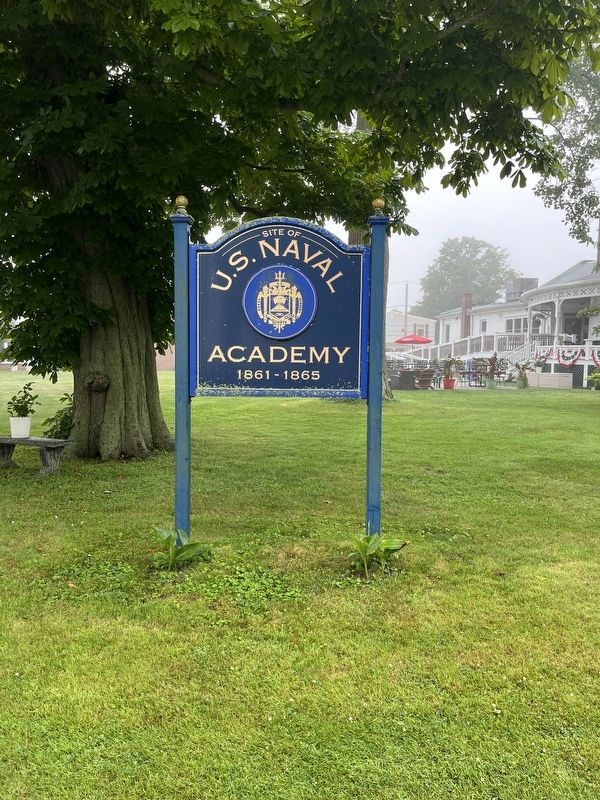
3. Signage on the grounds of the Elks Club
U.S. Naval
Academy
1861 - 1865
There have been a number of other theories about the Mill's origins, however, linking it to French, Irish, and Portuguese explorers of the area. The best known theory proposes Vikings as its builders. In 1839, a Danish antiquarian, Carl Christian Rafn, made the first connection between the tower and the Vikings who may have visited the area in approximately 1000 A.D.
A 1948-49 archeological investigation found 20,000 artifacts — none of which, however, could be dated earlier than the 17th century. In 1993, the Committee for Research on Norse Activities in North America AD 1000-1500 utilized carbon-14 dating along with conventional forms of research and ruled out a Viking origin.
The Old Stone Mill has been an icon for Newport since the mid-19th century. It is a symbol for the rustic, historic nature of the town, and a popular image used in attracting visitors. It remains the oldest building in Newport.
Touro Park near Bellevue Avenue
Matthew C. Perry Statue
1868
Matthew Calbraith
The statue of Matthew Calbraith Perry in Touro Park was commissioned by financier August Belmont and his wife, Caroline S. (Perry) Belmont, the daughter of Matthew C. Perry. It was created by prominent 19th century American sculptor, John Quincy Adams Ward. The pedestal was designed by architect Richard Morris Hunt who also designed the J.N.A. Griswold House directly across the street from the statue. there are four bronze bas-reliefs on the base which represent events in Perry's life.
76 Bellevue Avenue
John N.A. Griswold House/The Newport Art Museum
1862-1863
Architectural Style: Stick Style
• This house, now the Newport Art Museum, was architect Richard Morris Hunt's first building in Newport. Hunt designed over 40 buildings in Newport including Marble House and The Breakers.
The
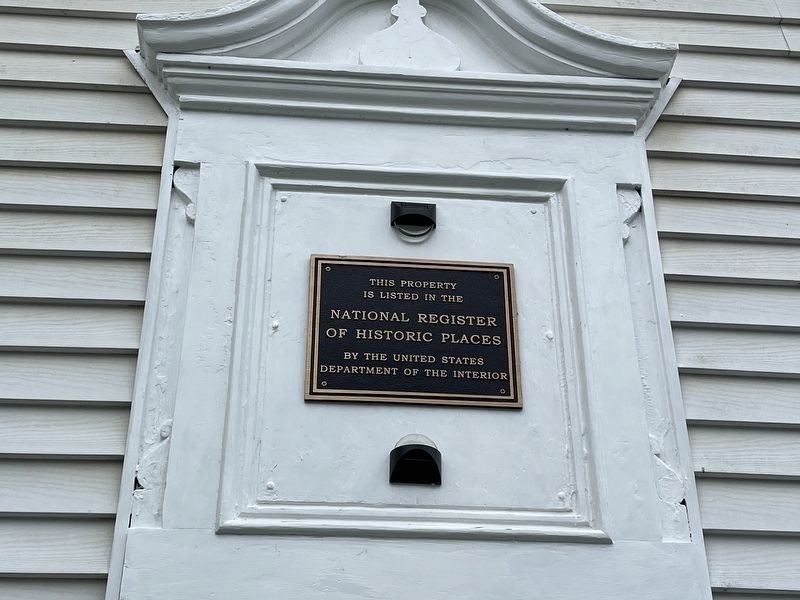
Photographed by Devry Becker Jones (CC0), July 10, 2024
5. National Register of Historic Places plaque on the Elks Club Building
is listed in the
National Register
of Historic Places
by the United States
Department of the Interior
Griswold's decision to build a summer house in Newport designed by a major architect established a trend that continued in Newport throughout the 19th century. Located at the beginning of Bellevue Avenue, the house is a visible transition between the older parts of town and the areas developed in the 19th century by the Summer Colony.
Hunt turned for the design of the house to the vernacular architecture of rural France and produced a building which helped articulate the "Stick Style" of American architecture.
After the success of the Griswold House, Hunt became the architect for many of the growing Summer Colony in Newport. Hunt secured commissions across the country, but nowhere is his ability to work in a wide variety of styles more evident than in Newport.
In 1916, the Griswold House was purchased by the Art Association of Newport (now the Newport Art Museum) for their headquarters.
141 Pelham Street
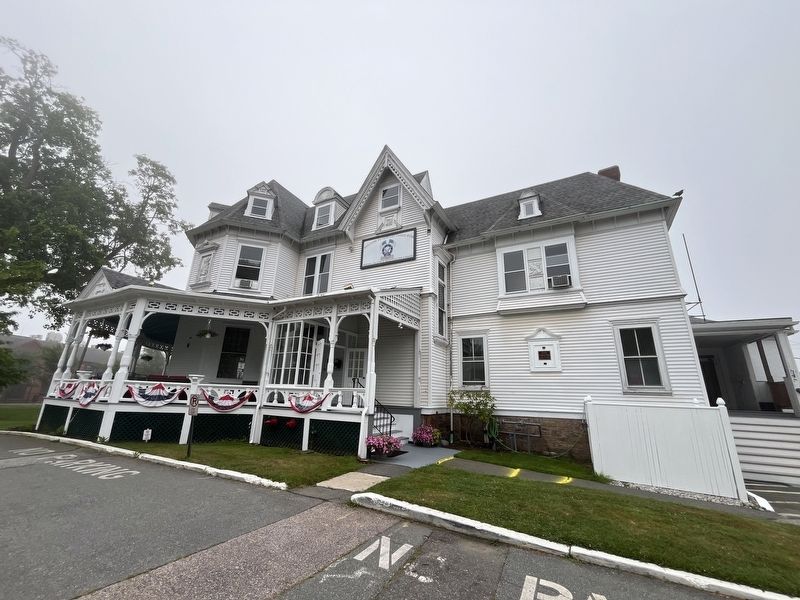
The Elks Club/Parkgate
1879-1881
Architectural Style: Queen Anne
Look For: The grand piazza, as it was known at the time of its design, or veranda as it is called today.
• The long history of the Navy in Newport began a new phase during the Civil War when the U.S. Naval Academy was moved to Newport and stayed in the Atlantic House Hotel, which once stood on this site.
Mr. William T. Potter purchased this land in 1844 and built the Atlantic House Hotel. The Atlantic House was home to the U.S. Naval Academy during the Civil War, (1861-65) when it was moved here to protect it from attack by the confederate forces at its location in Annapolis, MD. After the war, the Navy returned to Newport to establish three major facilities - the United States Naval Torpedo Station (1869), the Naval Training Station (1883), and the Naval War College (1884).
The War College is still the Navy's senior educational facility for the study of warfare, international law, and statesmanship. The War College provides a graduate-level education for senior officers from the Navy and other branches of service. The Torpedo Station has become the present Naval Underwater Warfare Command, which conducts scientific and technological research. Enlisted training has moved to Great Lakes, Illinois, but Newport remains home for many other training facilities. This connection between Newport and the Navy dates back to the colonial period. The Navy brings officers from around the world here every year to attend courses at the War College. The Naval Underwater Warfare Command attracts many engineering businesses that are a mainstay of the local economy and society.
The hotel was demolished in 1877 to make way for the current building, Parkgate, designed by Newport architect George Champlin Mason for Seth B. Stitt of Philadelphia, and constructed in 1879. It was purchased by Newport Lodge #104 of the Benevolent and Protective Order of the Elks in 1920.
Erected by Newport Historical Society.
Topics. This historical marker is listed in these topic lists: Architecture • Arts, Letters, Music • Colonial Era • Parks & Recreational Areas. A significant historical date for this entry is December 24, 1677.
Location. 41° 29.12′ N, 71° 18.542′ W. Marker is in Newport, Rhode Island, in Newport County. It is on Pelham Street west of Bellevue Avenue, on the right when traveling west. Touch for map. Marker is at or near this postal address: 141 Pelham St, Newport RI 02840, United States of America. Touch for directions.

Regionally, this marker is on Rhode Island’s Narragansett Bay and in Newport and Aquidneck Island. It is also in the American Northeast, in New England, and on the Eastern Seaboard. Globally, it is in the North Atlantic Region, North America, the Western Hemisphere, the Western World, and the Anglosphere. Historically, it finds itself in what was once one of the original Thirteen Colonies.
Other nearby markers. At least 8 other markers are within walking distance of this marker: The League of American Wheelmen (within shouting distance of this marker); The 2012 Shimoda Tomodachi Declaration (within shouting distance of this marker); Matthew Perry Monument (within shouting distance of this marker); a different marker also named Touro Park (within shouting distance of this marker); Redwood Library (about 400 feet away, measured in a direct line); Bellevue Ave. at John St. (about 500 feet away); Christopher Columbus (about 700 feet away); Serenity Inn Newport (about 700 feet away). Touch for a list and map of all markers in Newport.
Credits. This page was last revised on July 14, 2024. It was originally submitted on July 14, 2024, by Devry Becker Jones of Washington, District of Columbia. This page has been viewed 347 times since then and 57 times this year. Photos: 1, 2, 3, 4, 5. submitted on July 14, 2024, by Devry Becker Jones of Washington, District of Columbia.
