Artesia in Eddy County, New Mexico — The American Mountains (Southwest)
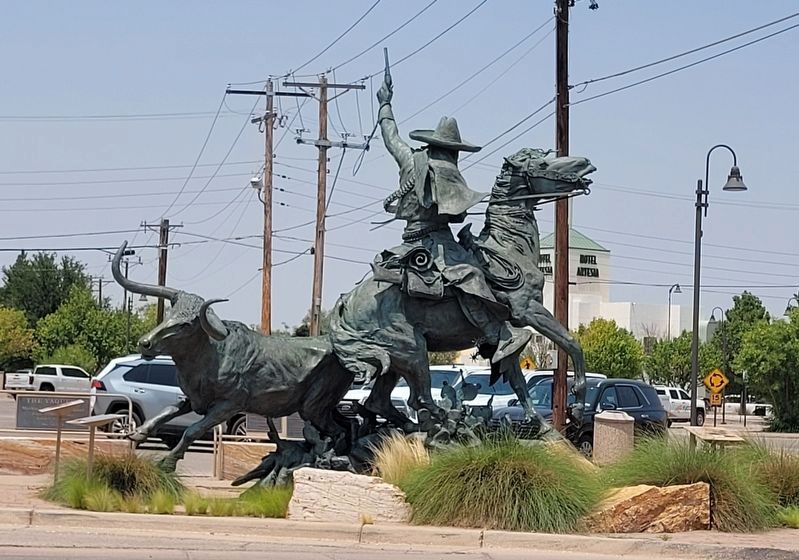
El Vaquero
The Hispanic Influence
Photographed by James Hulse, June 25, 2024
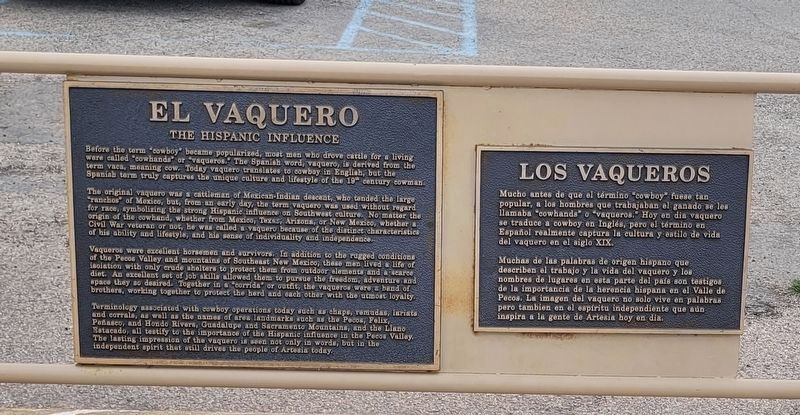
1. El Vaquero Marker and Spanish Plaque
 Before the term "cowboy" became popularized, most men who drove cattle for a living were called "cowhands" or "vaqueros." The Spanish word, vaquero, is derived from the term vaca, meaning cow. Today vaquero translates to cowboy in English, but the Spanish term truly captures the unique culture and lifestyle of the 19th century cowman.
The original vaquero was a cattleman of Mexican-Indian descent, who tended the large "ranchos" of Mexico, but, from an early day, the term vaquero was used without regard for race, symbolizing the strong Hispanic influence on Southwest culture. No matter the origin of the cowhand, whether from Mexico, Texas, Arizona, or New Mexico, whether a Civil War veteran or not, he was called a vaquero because of the distinct characteristics of his ability and lifestyle, and his sense of individuality and independence.
Vaqueros were excellent horsemen and survivors. In addition to the rugged conditions of the Pecos Valley and mountains of Southeast New Mexico, these men lived a life of isolation with only crude shelters to protect them from outdoor elements and a scarce diet. An excellent
this page online
Terminology associated with cowboy operations today such as chaps, remudas, lariats and corrals, as well as the names of area landmarks such as the Pecos, Felix, Peñasco, and Hondo Rivers, Guadalupe and Sacramento Mountains, and the Llano Estacado, all testify to the importance of the Hispanic influence in the Pecos Valley. The lasting impression of the vaquero is seen not only in words, but in the independent spirit that still drives the people of Artesia today.
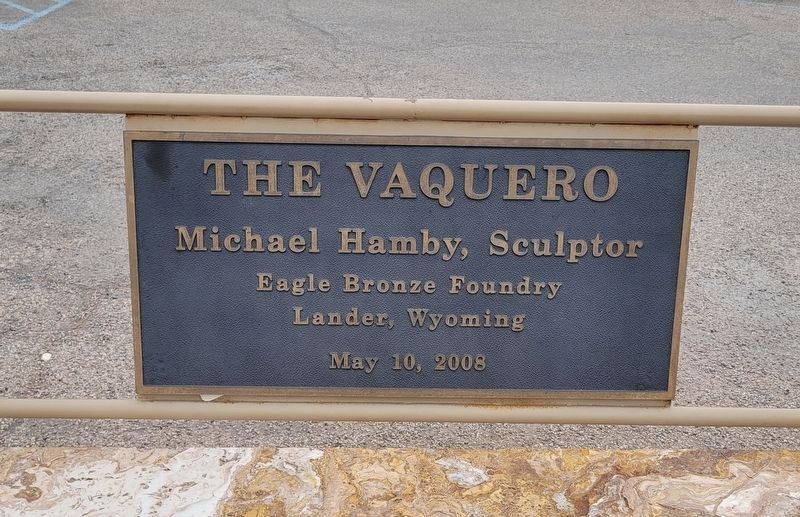
2nd Plaque
The Vaquero, Michael Hamby, Sculptor, Eagle Bronze Foundry Lander, Wyoming
Spanish Plaque
Mucho antes de que el término "cowboy" fuese tan popular, a los hombres que trabajaban el ganado se les llamaba "cowhands" o "vaqueros." Hoy en dia vaquero se traduce a cowboy en Inglés, pero el término en Español realmente captura la cultura y estilo de vida. del vaquero en el siglo XIX.
Muchas de las palabras
Photographed by James Hulse, June 25, 2024
2. 2nd Plaque
Erected 2008 by Artesia Mainstreet.
Topics. This historical marker is listed in these topic lists: Animals • Hispanic Americans • Indigenous Peoples and Communities • Industry & Commerce.
Location. 32° 50.544′ N, 104° 23.938′ W. Marker is in Artesia, New Mexico, in Eddy County. It is at the intersection of West Main Street and North 2nd Street, on the right when traveling west on West Main Street. The markers and artwork are located along the corner of the intersection. Touch for map. Marker is at or near this postal address: 210 W Main St, Artesia NM 88210, United States of America. Touch for directions.

Regionally, this marker is in the Pecos Valley. It is also in the American Southwest, on the Great Plains, on the Southern Plains, and
Photographed by James Hulse, June 25, 2024
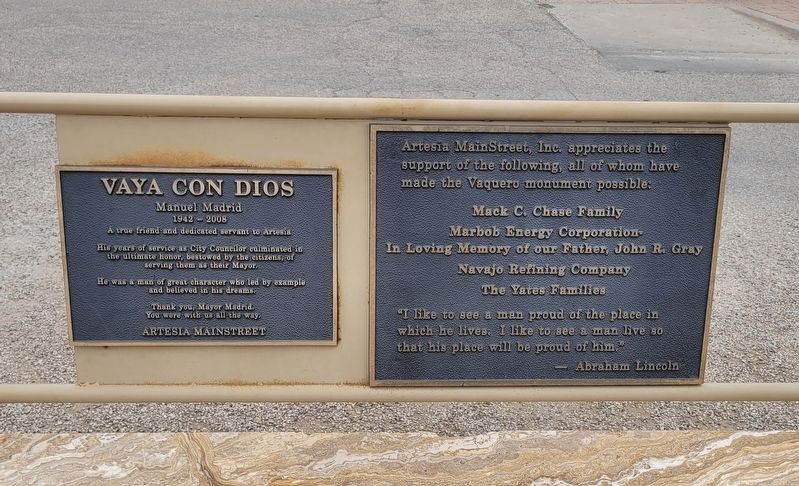
3. Dedication Plaques
Other nearby markers. At least 8 other markers are within walking distance of this marker: First Lady of Artesia (within shouting distance of this marker); Welcome to Artesia (within shouting distance of this marker); The Goodnight-Loving Trail (about 500 feet away, measured in a direct line); The Cattle Drive (about 500 feet away); The Cowboy's Gear (about 500 feet away); Independent Spirit (about 500 feet away); Ranchers' Brands (about 500 feet away); The Baskin Building (about 600 feet away). Touch for a list and map of all markers in Artesia.
Also see . . . Vaquero. Wikipedia
The vaquero is a horse-mounted livestock herder of a tradition that has its roots in the Iberian Peninsula and extensively developed in Mexico from a methodology brought to the Americas from Spain. The vaquero became the foundation for the North American cowboy, in Northern Mexico, Southwestern United States,(Submitted on July 14, 2024, by James Hulse of Medina, Texas.)and Western Canada.Photographed by James Hulse, June 25, 20244. The El Vaquero artwork
The cowboys of the Great Basin still use the term "buckaroo", which may be a corruption of vaquero, to describe themselves and their tradition. Many in Llano Estacado and along the southern Rio Grande prefer the term vaquero, while the indigenous and Hispanic communities in the age-old Nuevo México and New Mexico Territory regions use the term caballero. Vaquero heritage remains in the culture of the Californio (California), Neomexicano (New Mexico), and Tejano (Texas), along with Mexico, Central and South America, as well as other places where there are related traditions
Photographed by James Hulse, July 24, 2024
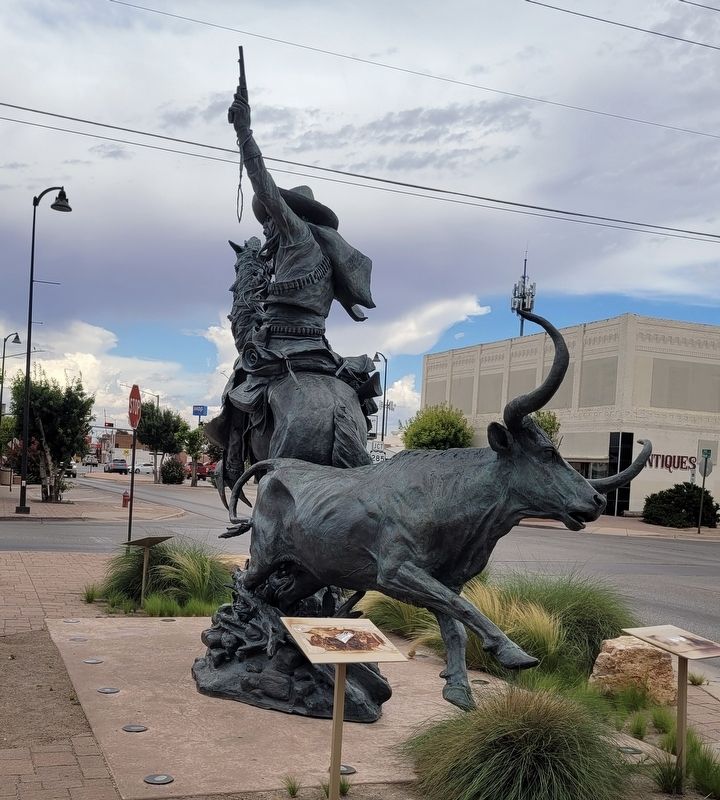
5. The view of the El Vaquero statue from across the street
Credits. This page was last revised on July 25, 2024. It was originally submitted on July 14, 2024, by James Hulse of Medina, Texas. This page has been viewed 244 times since then and 33 times this year. Photos: 1, 2, 3, 4. submitted on July 14, 2024, by James Hulse of Medina, Texas. 5. submitted on July 25, 2024, by James Hulse of Medina, Texas.
