Pawtucket in Providence County, Rhode Island — The American Northeast (New England)
Tolerance

Why Is The Sculpture Here?
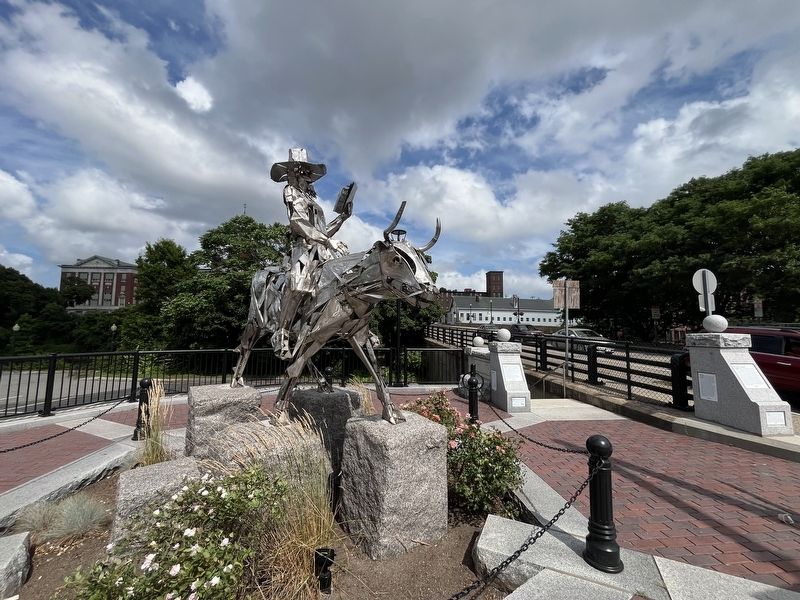
This sculpture, titled "Tolerance," is an artistic resemblance of the Reverend William Blackstone, an English minister who made a home several miles from here. His name is now attached to many places and organizations throughout the Blackstone River Valley. The idea for a sculpture on this site began in the mind of Morris Nathanson, an internationally-known designer and artist, and a fervent advocate for the arts in Pawtucket.
Morris was born in Pawtucket, and in his childhood experienced anti-semitism. He was inspired to enlist in the Navy during World War II when he learned about the Nazi policies of exterminating Jews in Europe. In the early 1960s Morris participated in the Freedom Rides in Atlanta, assisting the anti-violence and equal rights campaigns of Dr. Martin Luther King. Morris later was a social worker helping poor families in Providence. He pursued and excelled at his artistic career, and eventually came back to his hometown of Pawtucket and purchased the former Rhode Island Cardboard Company mill on Exchange Street, just across the now-named Morris Nathanson Bridge over
this page online
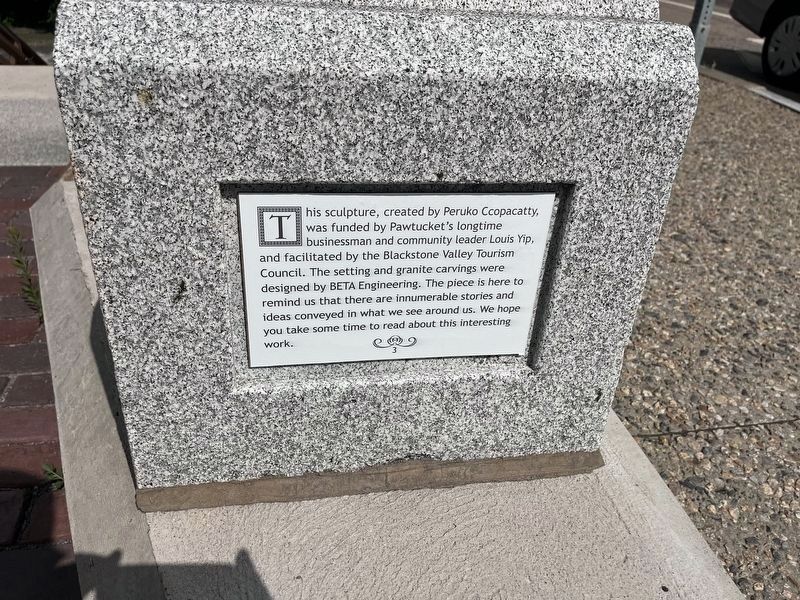
This sculpture, created by Peruko Ccopacatty, was funded by Pawtucket's longtime businessman and community leader Louis Yip, and facilitated by the Blackstone Valley Tourism Council. The setting and granite carvings were designed by Beta Engineering. The piece is here to remind us that there are innumerable stories and ideas conveyed in what we see around us. We hope you take some time to read about this interesting work.
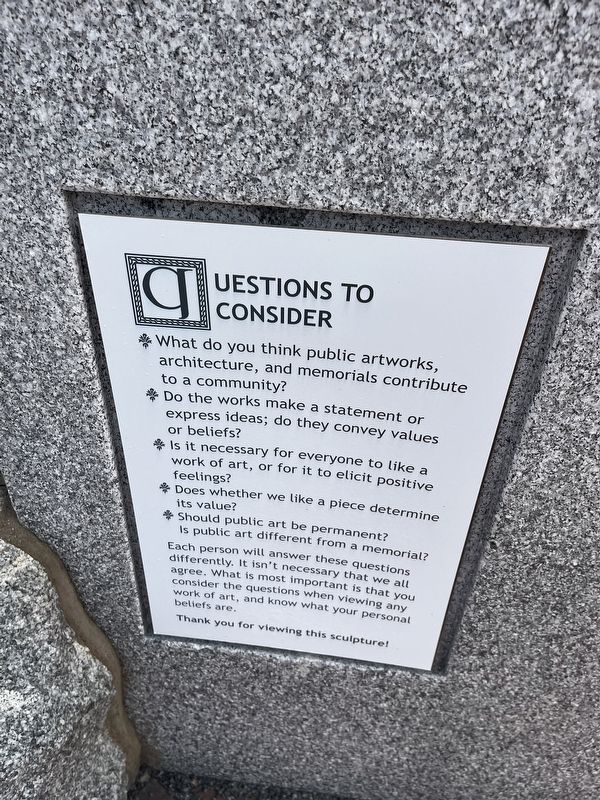
Questions to Consider
• What do you think public artworks, architecture, and memorials contribute to a community?
• Do the works make a statement or express ideas; do they convey values or beliefs?
• Is it necessary for everyone to like a work of art, or for it to elicit positive feelings?
• Does whether we like a piece determine its value?
• Should public art be permanent? Is public art different from a memorial?
Each person will answer these questions differently. It isn't necessary that we all agree. What is most important is that you consider the questions when viewing any work of art, and know what your personal beliefs are.
Thank you for viewing this sculpture!
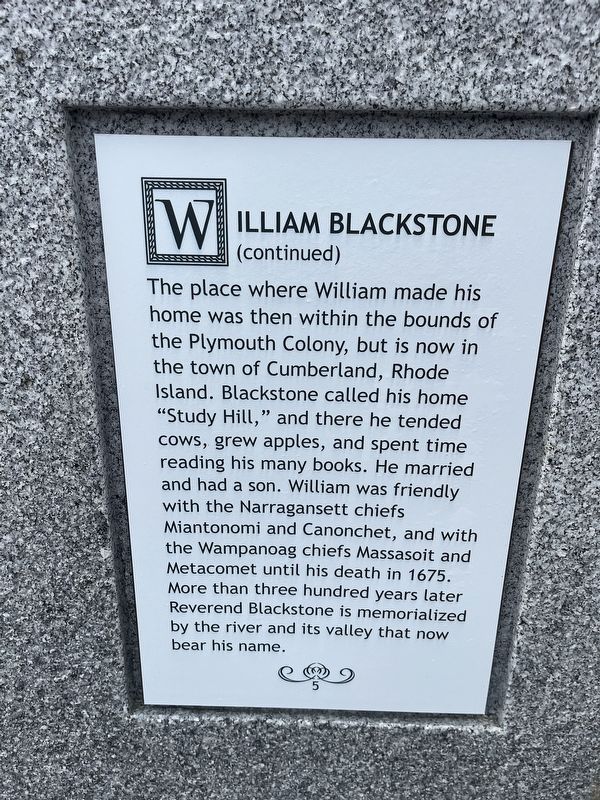
William Blackstone
(continued)
This

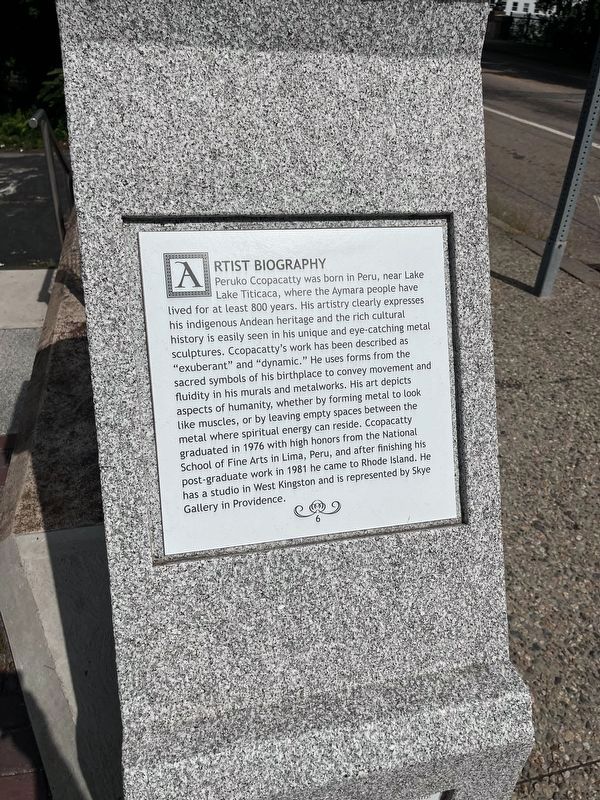
Artist Biography
Peruko Ccapocatty was born in Peru, near Lake Lake Titicaca, where the Aymara people have lived for at least 800 years. His artistry clearly expresses his indigenous Andean heritage and the rich cultural history is easily seen in his unique and eye-catching metal sculptures. Ccopacatty's work has been described as "exuberant" and "dynamic." He uses forms from the sacred symbols of his birthplace to convey movement and fluidity in his murals and metalworks. His art depicts aspects of humanity, whether by forming metal to look like muscles, or by leaving empty spaces
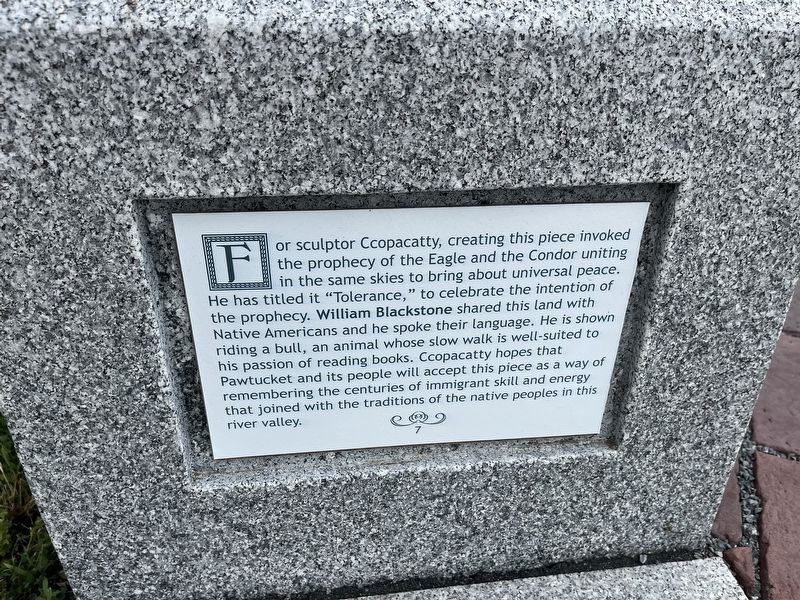
For sculptor Ccopacatty, creating this piece invoked the prophecy of the Eagle and the Condor uniting in the same skies to bring about universal peace. He has titled it "Tolerance," to celebrate the intention of the prophecy. William Blackstone shared this land with Native Americans and he spoke their language. He is shown riding a bull, an animal whose slow walk is well-suited to his passion of reading books. Ccopacatty hopes that Pawtucket and its people will accept this piece as a way of remembering the centuries of immigrant skill and energy that joined with the tradition of the native peoples in this river valley.
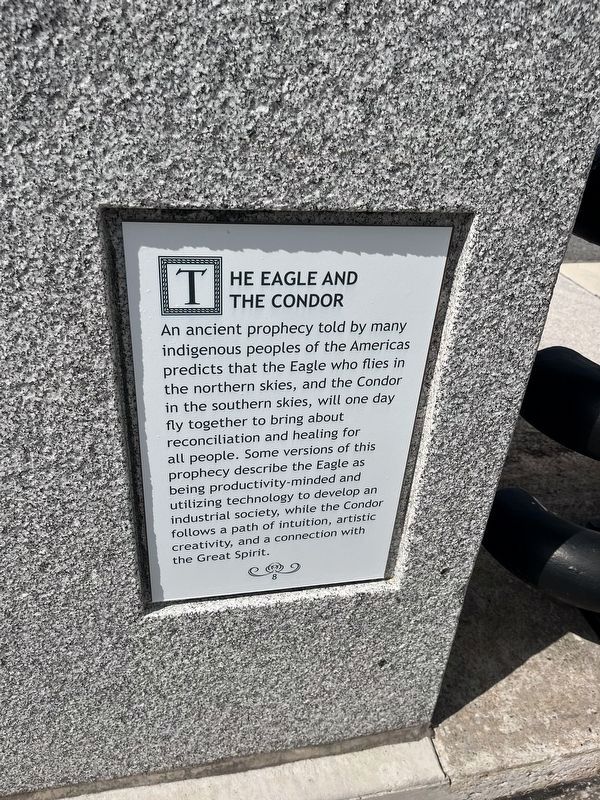
The Eagle and the Condor
An ancient prophecy told by many indigenous peoples of the Americas predicts that the Eagle who flies in the northern skies, and the Condor in the southern skies, will one
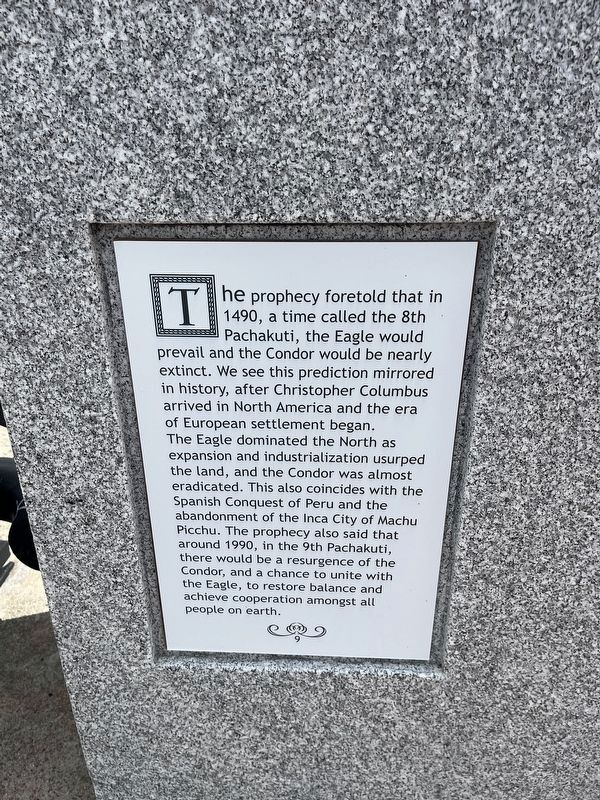
The prophecy foretold that in 1490, a time called the 8th Pachakuti, the Eagle would prevail and the Condor would be nearly extinct. We see this prediction mirrored in history, after Christopher Columbus arrived in North America and the era of European settlement began. The Eagle dominated the north as expansion and industrialization usurped the land, and the Condor was almost eradicated. This also coincides with the Spanish Conquest of Peru and the abandonment of the Inca City of Machu Picchu. The prophecy also said that around 1990, in the 9th Pachakuti, there would be a resurgence of the Condor, and a chance to unite with the Eagle, to restore blaance and achieve cooperation amongst all people on earth.
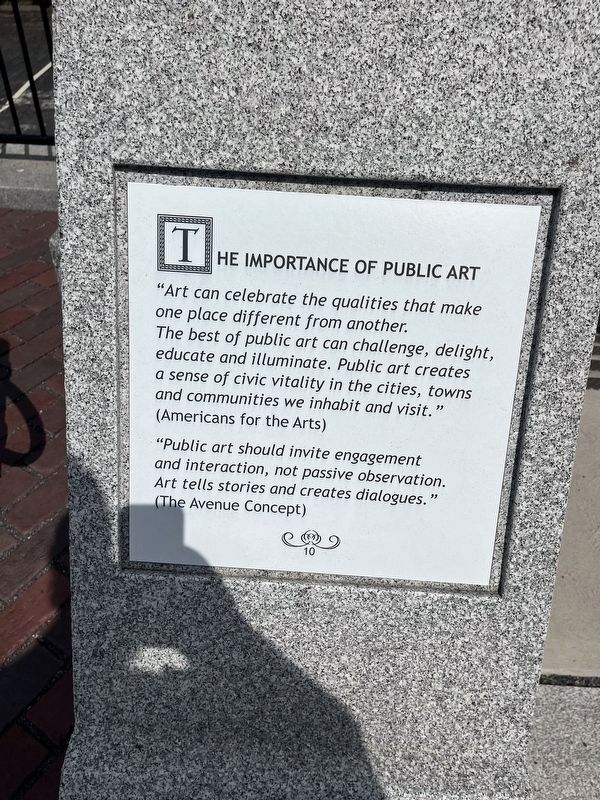
The Importance of Public Art
"Art can celebrate the qualities that make one place different from another. The best of public art can challenge, delight, educate and illuminate. Public art creates a sense of civic vitality in the cities, towns and communities we inhabit and visit."
(Americansfor the Arts)
"Public art should invite engagement and interaction, not passive observation. Art tells stories and creates dialogues."
(The Avenue Concept)
Erected by Peruko Ccopacatty, sculptor.
Topics. This historical marker is listed in these topic lists: Colonial Era • Indigenous Peoples and Communities • Religion & Religious Structures • Settlements & Settlers. A significant historical year for this entry is 1675.
Location. 41° 52.803′ N, 71° 22.938′ W. Marker is in Pawtucket, Rhode Island, in Providence County. It is at the intersection of Roosevelt Avenue and Exchange Street, on the right when traveling north on Roosevelt Avenue. Touch for map. Marker is at or near this postal address: 175 Roosevelt Ave, Pawtucket RI 02860, United States of America. Touch for directions.

Regionally, this marker is in Rhode Island’s Blackstone Valley, in Greater Providence, and on Narragansett Bay. It is also in the American Northeast, in New England, and on the Eastern Seaboard. Globally, it is in the North Atlantic Region, North America, the Western Hemisphere, the Western World, and the Anglosphere.
Other nearby markers. At least 8 other markers are within walking distance of this marker: Pawtucket Veterans Memorial (within shouting distance of this marker); River and Fields at Pawtucket (within shouting distance of this marker); Pvt Lawrence E. Redmond (within shouting distance of this marker); Pawtucket City Hall (about 400 feet away, measured in a direct line); Slater Mill (about 800 feet away); Pawtucket Public Library / Old Pawtucket Post Office (about 800 feet away); Old Slater Mill (approx. 0.2 miles away); A Mechanic's Life (approx. 0.2 miles away). Touch for a list and map of all markers in Pawtucket.
Other markers no longer nearby. Slater Mill Historic Site (was about 800 feet away but has been replaced with another marker now near it); Sylvanus Brown House (was approx. 0.2 miles away but has been replaced with another marker now near it).
Credits. This page was last revised on July 16, 2024. It was originally submitted on July 16, 2024, by Devry Becker Jones of Washington, District of Columbia. This page has been viewed 163 times since then and 17 times this year. Photos: 1, 2, 3, 4, 5, 6, 7, 8, 9, 10, 11. submitted on July 16, 2024, by Devry Becker Jones of Washington, District of Columbia.
