North Lawndale in Chicago in Cook County, Illinois — The American Midwest (Great Lakes)
Route 66 Landmark
⎯⎯⎯
Punto de Referencia de la Ruta 66
Douglass Park
| — | Local Neighborhood Impact / Impacto en el Vecindario Local | — |
Photographed by Sean Flynn, July 18, 2024
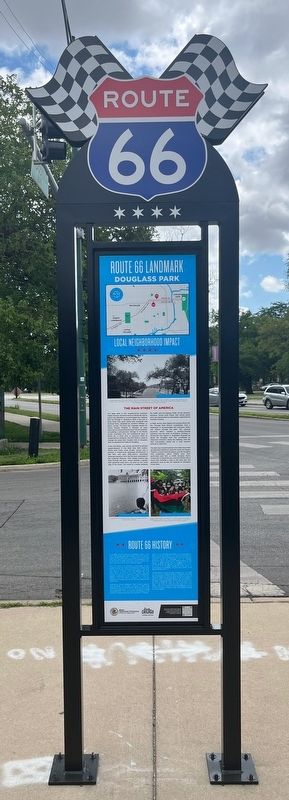
1. Route 66 Landmark side of marker
[English-language text on the west-facing side of marker:]
In the mid-1900s, Jens Jensen was hired as general superintendent of the West Side Park system. Along with Frank Lloyd Wright, Jensen was a pioneer in Prairie-style landscape architecture, a late 19th- and early 20th-century movement drawing inspiration from the flat, bare landscape of the American Midwest. After Ogden Avenue
this page online
In 1928, shortly after Ogden Ave became Route 66, the Chicago Park District Commission built a fieldhouse to accommodate the increased traffic and visitors through the park. This classical structure, which contains a terrazzo-floored ballroom, was the work of architects Christian S. Michaelsen and Sigurd A. Rognstad. Bisected by Route 66, Douglass Park was considered an important attraction along the highway, with the Park Commission laying out a road network tailored to motorists.
The park was located between two other important recreational institutions along the route, the Ogden Theatre, a motion picture palace, and the Douglass Park Auditorium, where Yiddish plays were performed until 1951. In 2000, Douglass Park's connection to Route 66 was commemorated with a mural that included a map of the park and city landmarks
Photographed by Sean Flynn
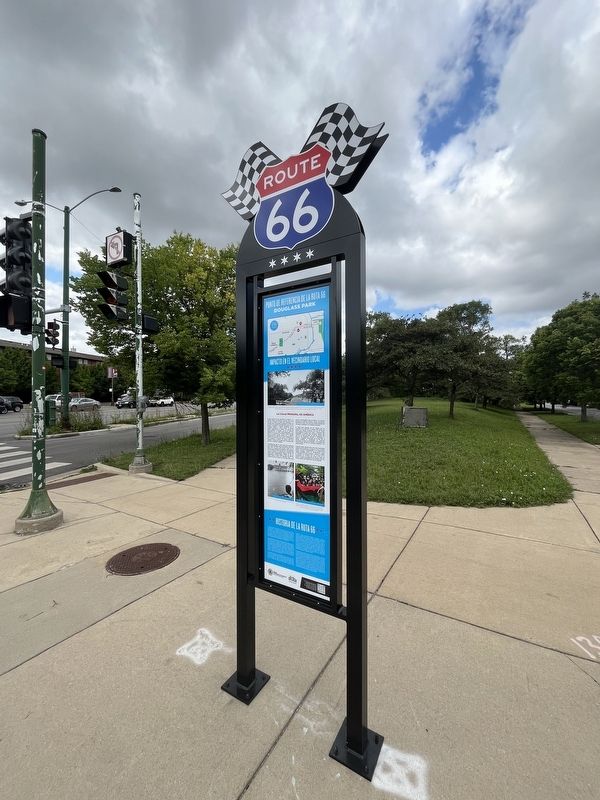
2. Punto de Referencia de la Ruta 66 side of marker
Route 66 was officially established in 1926. The Illinois stretch of Route 66 began as a two-lane road known as SB14, which followed the route of the old Pontiac Trail from Chicago
Photographed by Sean Flynn, July 18, 2024
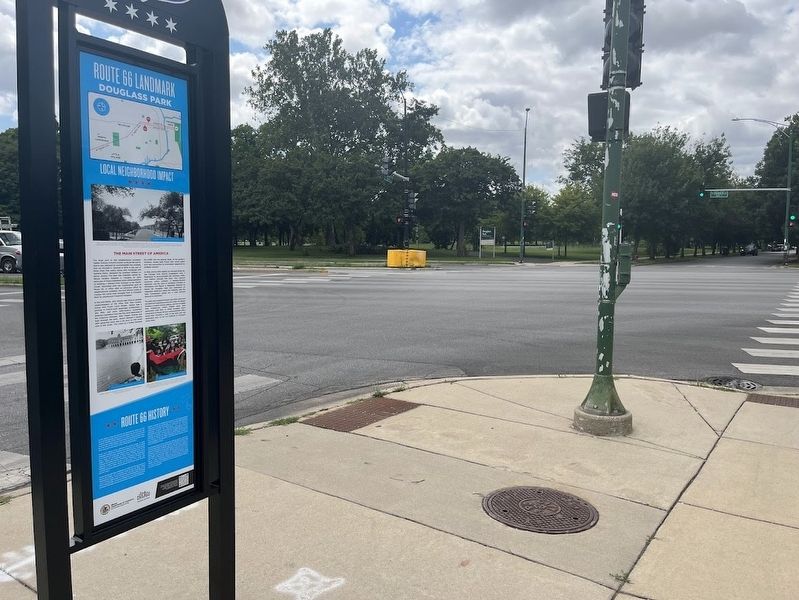
3. Route 66 Landmark Marker at Douglass Park
Ogden Avenue has traditionally been a major transportation route into and out of Chicago. This street parallels both the south branch of the Chicago River, which was once the main waterway toward the Mississippi, and the Chicago, Burlington & Quincy railroad tracks. The Route 66 era was the heyday of Ogden Avenue and the neighborhoods it runs through. Route 66 was and still is an emblem of the nation's car culture. From the 1920s through the 1950s, dozens of repair garages, tire suppliers, and automobile dealers set up shop along the street.
The development of the interstate highway system, the result of a bill signed by President Dwight D. Eisenhower, led to the decommissioning of Route 66 and the demise of many of Chicago's Ogden Avenue businesses. Drivers were offered a faster course to the southwest suburbs and central Illinois. In the 1960s, construction began on Interstate 55, and in 1977 the "End of Route 66" signs on Jackson
Photographed by Sean Flynn, July 18, 2024
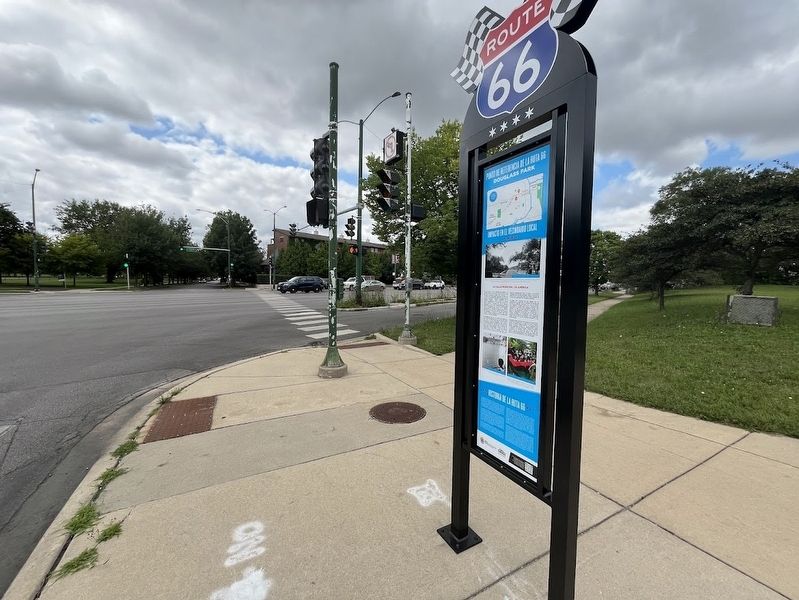
4. Punto de Referencia de la Ruta 66 marker, facing southwest
Ogden Avenue continues southwest in this photo.
[Spanish-language text on the east-facing side of the marker:]
A mediados del siglo
Photographed by Sean Flynn, July 18, 2024
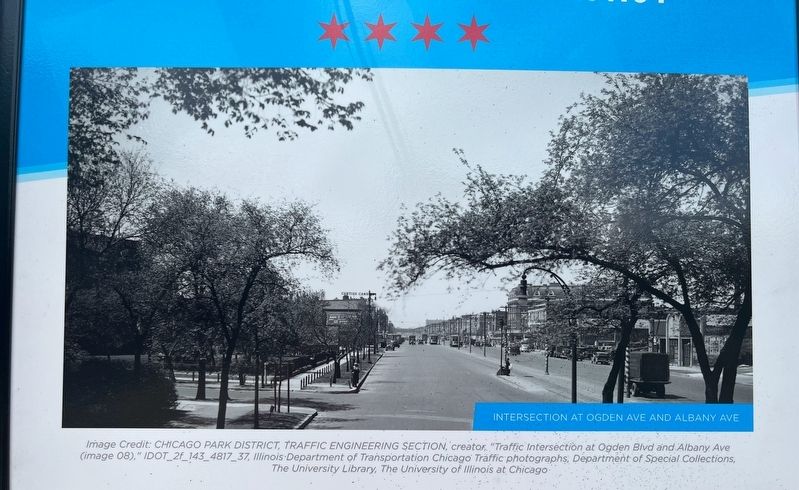
5. Albany and Ogden intersection
A close-up of the historical photo of this intersection that is included on this sign.
En 1928, poco después de que Ogden Ave se convirtiera en la Ruta 66, la Comisión del Distrito de Parques de Chicago construyó una casa de campo para organizar el tráfico que crecía y visitantes que atravesaban el parque. Esta estructura clásica, que contiene un salón de baile con piso de granito, fue obra de los arquitectos Christian S. Michaelsen y Sigurd A. Rognstad. Atravesado por la Ruta 66, el Parque Douglass se consideraba una atracción importante a lo largo de la carretera, y la Comisión del Parque diseñó una red de carreteras adaptada a los automovilistas.
El parque estaba ubicado entre otras dos importantes instituciones recreativas a lo largo de la ruta, el Teatro Ogden, un palacio cinematográfico, y el Auditorio del Parque Douglass, donde se representaron obras Yiddish hasta 1951 para visitantes y viajeros. En 2000, la conexión de Douglass Park con la Ruta 66 se conmemoró con un mural que incluía un mapa del parque y lugares emblemáticos de la ciudad, como los leones icónicos del Instituto de Arte de Chicago.
Más automóviles significaron más demanda de carreteras pavimentadas. En 1921, el Congreso aprobó la Ley de Ayuda Federal para Carreteras, que exigía una red de carreteras que cubriera todo el país. Unos años más tarde, se aprobaron planes de rutas interestatales para los 48 estados. La Ruta 66 se extendía más de 3,800 km desde Chicago hasta Santa Mónica, California. Cy Avery, el comisionado de carreteras de Oklahoma conocido como el "Padre de la Ruta 66", la apodó "La calle principal de América". Esta ruta se consideraba el camino principal entre los Grandes Lagos y la costa del Pacífico.
La Ruta 66 se estableció oficialmente en 1926. El tramo de Illinois de la Ruta 66 comenzó como una carretera de dos carriles conocida como SB14, que seguía la ruta del antiguo Pontiac Trail desde Chicago a St. Louis. Al principio, SB14 inició en Cicero, pero su designación como Ruta 66 aumentó el tráfico. Para adaptarse a esto, el punto de partida se trasladó a Michigan Avenue y Jackson Boulevard en Chicago. Ogden Avenue ha sido tradicionalmente una importante ruta de transporte hacia y desde Chicago. Esta calle es paralela tanto al brazo sur del río Chicago, que alguna vez fue la vía fluvial principal hacia el Mississippi, como a las vías del ferrocarril de Chicago, Burlington y Quincy. La era de la Ruta 66 fue el apogeo de Ogden Avenue y los vecindarios que atraviesa. La Ruta 66 fue y sigue siendo un emblema de la cultura automovilística del país. Desde la década de 1920 hasta la de 1950, docenas de talleres de reparación, proveedores de neumáticos y concesionarios de automóviles instalaron tiendas a lo largo de la calle.
El desarrollo del sistema de carreteras interestatales, resultado de un proyecto de ley firmado por el presidente Dwight D. Eisenhower, provocó el desmantelamiento de la Ruta 66 y la desaparición de muchos de los negocios de Ogden Avenue en Chicago. A los conductores se les ofreció un rumbo más rápido hacia los suburbios del suroeste y el centro de Illinois. En la década de 1960, comenzó la construcción de la Interestatal 55, y en 1977 se quitaron las señales de "Fin de la Ruta 66” en Jackson Boulevard. Algunos restaurantes y talleres de reparación que quedan a lo largo de Ogden Avenue todavía exhiben recuerdos de la Ruta 66, lo que garantiza que sus años como parte de la carretera más idealizada de Estados Unidos nunca se olviden.
Erected 2024 by Illinois Department of Commerce & Economic Opportunity; Choose Chicago.
Topics and series. This historical marker is listed in these topic lists: Architecture • Horticulture & Forestry • Parks & Recreational Areas • Roads & Vehicles. In addition, it is included in the Former U.S. Presidents: #34 Dwight D. Eisenhower, the Frank Lloyd Wright, the Jens Jensen, and the U.S. Route 66 series lists. A significant historical year for this entry is 1879.
Location. 41° 51.542′ N, 87° 42.181′ W. Marker is in Chicago, Illinois, in Cook County. It is in North Lawndale. It is at the intersection of West Ogden Avenue (U.S. 66) and South Albany Avenue, on the right when traveling west on West Ogden Avenue. The marker is across the street from the western edge of Douglass Park. Touch for map. Marker is at or near this postal address: 3100 West Ogden Avenue, Chicago IL 60623, United States of America. Touch for directions.

Regionally, this marker is on Chicago’s West Side. It is also in the American Midwest. Globally, it is in North America, on the Great Lakes, in the Western Hemisphere, in the Western World, and in the Anglosphere. Historically, it finds itself in what was once the Viceroyalty of New France, the territory of the Mississippian Culture, and the Northwest Territory.
Other nearby markers. At least 8 other markers are within walking distance of this marker: Douglas Park (approx. ¼ mile away); The Boulevard System (approx. ¼ mile away); A Nation's Image (approx. 0.3 miles away); Benny Goodman (approx. 0.6 miles away); Storytelling Sukkah (approx. 0.7 miles away); North Lawndale Wayfinding Map (approx. ¾ mile away); Stone Temple Baptist Church (approx. ¾ mile away); Vorwaerts Turner Hall (approx. one mile away). Touch for a list and map of all markers in Chicago.
More about this marker. The marker is one of four unveiled in 2024 in coordination with NASCAR's second Grant Park 165 race, a street circuit through Grant Park in downtown Chicago on July 7, 2024. One marker is downtown at the intersection of Adams and Michigan, where Route 66 ends in front of the Art Institute of Chicago; one is on Ogden east of here in the Illinois Medical District, and the other is about a mile southwest of here. The bottom of all three Ogden Avenue markers includes a "History of Route 66" with text that is identical to that on the marker in front of the Art Institute. Although Route 66 is a U.S. highway, the marker's styling at the top actually is based on that used by the Interstate Highway System.
Credits. This page was last revised on July 19, 2024. It was originally submitted on July 18, 2024, by Sean P. Flynn of Oak Park, Illinois. This page has been viewed 251 times since then and 41 times this year. Photos: 1, 2, 3, 4, 5. submitted on July 18, 2024, by Sean P. Flynn of Oak Park, Illinois.
