Near Camp Verde in Yavapai County, Arizona — The American Mountains (Southwest)
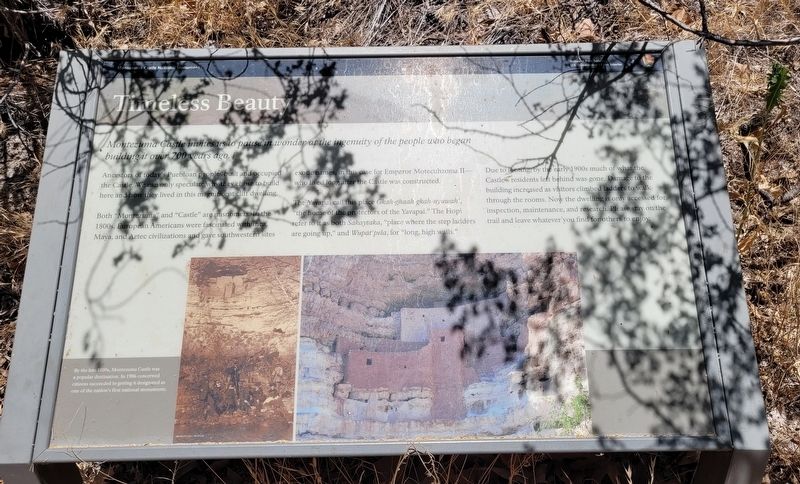
Timeless Beauty
Photographed by James Hulse, June 19, 2024
1. Timeless Beauty Marker
Ancestors of today's Puebloan peoples built and occupied the Castle. We can only speculate why they chose to build here and how they lived in this magnificent cliff dwelling.
Both "Montezuma" and "Castle" are misnomers. In the 1800s, European Americans were fascinated with Inca, Maya, and Aztec civilizations and gave southwestern sites exotic names, in this case for Emperor Motecuhzoma II - who lived long after the Castle was constructed.
The Yavapai call this place Gkah-ghaah-gkah-nyuwah', "the home of the protectors of the Yavapai." The Hopi refer to it as both Sakaytaka, "place where the step ladders are going up," and Wupat pela, for "long, high walls."
Due to looting, by the early 1900s much of what the Castle residents left behind was gone. Damage to the building increased as visitors climbed ladders to walk through the rooms. Now the dwelling is only accessed for inspection, maintenance, and research. Please stay on the trail and leave whatever you find for others to enjoy.
Captions
By the late 1800s, Montezuma Castle was a popular destination. In 1906 concerned citizens succeeded in getting it designated as one of the nation's first national monuments.
Sharlot Hall Museum
Erected by Montezuma
this page online
Topics. This historical marker is listed in these topic lists: Anthropology & Archaeology • Indigenous Peoples and Communities • Settlements & Settlers. A significant historical year for this entry is 1906.
Location. 34° 36.709′ N, 111° 50.42′ W. Marker is near Camp Verde, Arizona, in Yavapai County. It is on Montezuma Castle Road one mile east of Beaver Creek Estates Road. The marker is located along the loop hiking trail at the Montezuma Castle National Monument. Touch for map. Marker is at or near this postal address: 2800 Montezuma Castle Rd, Camp Verde AZ 86322, United States of America. Touch for directions.

Regionally, this marker is in Verde Valley and in the Yavapai-Apache Nation. It is also in the American Southwest and in the Mountain West. Globally, it is in North America, the Western Hemisphere, the Western World, and the Anglosphere. Historically, it finds itself in what was once New Spain and also Mexico’s Alta California.
Other nearby markers. At least 8 other markers are within walking distance of this marker: Kinship Ties (about 300 feet away, measured in a direct line);
Photographed by James Hulse, June 19, 2024
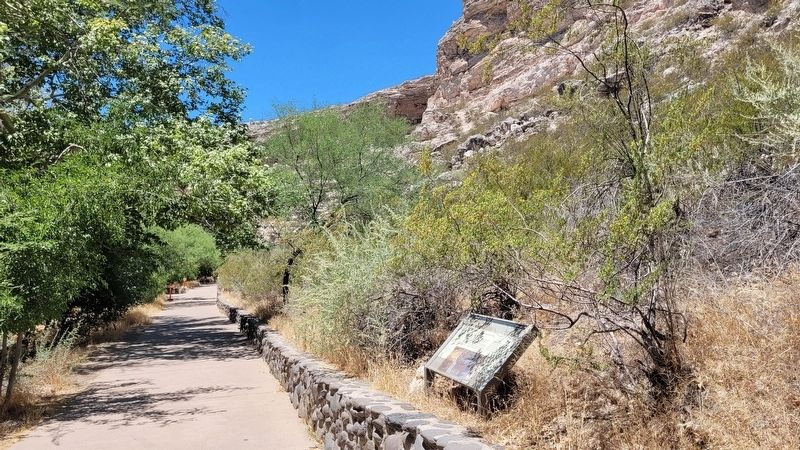
2. The view of the Timeless Beauty Marker along the trail
Other markers no longer nearby. Macaw Pen Stone? (was within shouting distance of this marker but has been confirmed missing); Welcome to The Castle (was within shouting distance of this marker but has been permanently removed); The Community (was about 300 feet away but has been permanently removed); The Way Up / Construction Sequence (was about 500 feet away but has been permanently removed); The Neighborhood / Mysterious Departures (was about 600 feet away but has been permanently removed).
Also see . . . Montezuma Castle - History & Culture. National Park Service
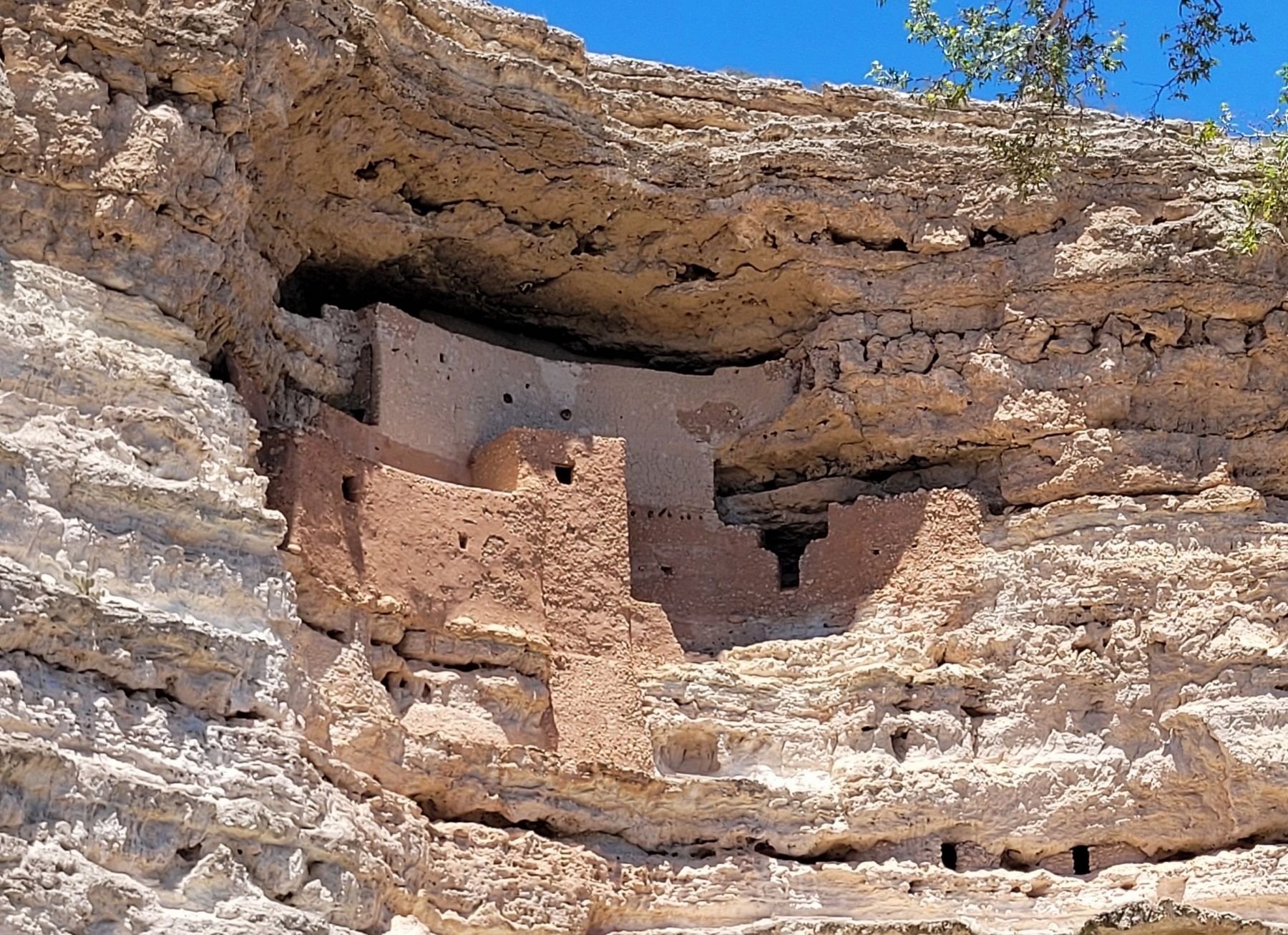
On December 8, 1906, President Theodore Roosevelt celebrated the passage of the Antiquities Act by declaring four sites of historic and cultural significance as our nation's first National Monuments.(Submitted on July 18, 2024, by James Hulse of Medina, Texas.)Among these was Montezuma Castle, which the President identified as a place "of the greatest ethnological value and scientific interest." Although very few original artifacts remained in the structure due to intensive looting of the site, Roosevelt's decision assured the continued protection of one of the best preserved prehistoric cliff dwellings in North America.Photographed by James Hulse, June 19, 20243. Montezuma Castle
Credits. This page was last revised on July 19, 2024. It was originally submitted on July 18, 2024, by James Hulse of Medina, Texas. This page has been viewed 223 times since then and 27 times this year. Photos: 1, 2, 3. submitted on July 19, 2024, by James Hulse of Medina, Texas.
