South Kansas City in Jackson County, Missouri — The American Midwest (Upper Plains)
The Power of Watts
Photographed by Duane and Tracy Marsteller, June 30, 2024
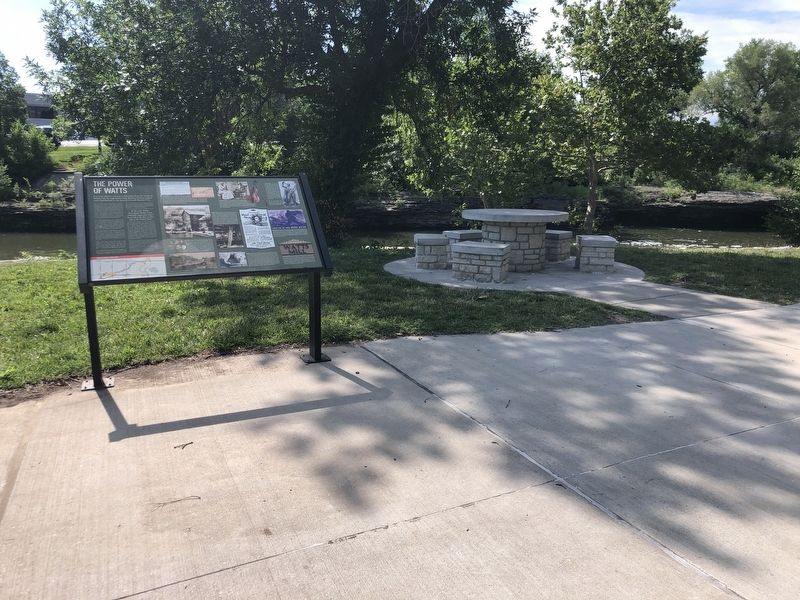
1. The Power of Watts Marker
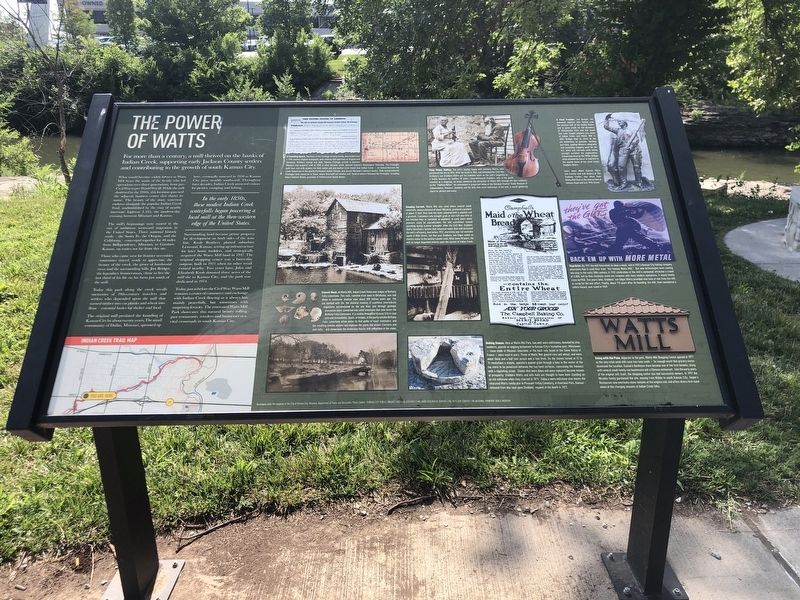
What would become widely known as Watts Mill bears the name of the family who led operations over three generations, from pre-Civil War to pre-World War II. While the mill shuttered in the 1940s, this location spawned the adjacent business center that shares its name. The beauty of the stony waterway endures alongside the popular Indian Creek Trail, undiminished by the roar of nearby interstate highway I-435, the modern-day crossing between Missouri and Kansas.
The mill's beginnings were rooted in the era of ambitious westward migration in the United States. The national historic trails – the Santa Fe, the Oregon and the California – converged together for 46 miles from Independence, Missouri, to Gardner, Kansas, on routes not far from this site.
Those who came west for frontier necessities sometimes stayed, ready to appreciate the beauty of the creek, the grove of hardwood trees and the surrounding hills. Jim Bridger, the legendary frontiersman, chose
this page online
Today this park along the creek recalls memories of 19th-century travelers and settlers who depended upon the mill that turned timber into cut planks and wheat into flour – essential basics for shelter and food.
The original mill predated the founding of Kansas City by about twenty years. The small community of Dallas, Missouri, sprouted up eventually annexed in 1958 as Kansas City grew steadily southward. Throughout later decades, Indian Creek attracted visitors for picnics, camping and fishing.
Surrounding land became prime property for development on both sides of the state line. Kroh Brothers platted suburban Leawood, Kansas, setting up infrastructure for later home builders, and strategically acquired the Watts Mill land in 1947. The original shopping center was a latter-day outpost, built in 1971 when no other retail existed nearby. Two years later, John and Elizabeth Kroh donated three acres of the mill site to Kansas City, and the park was dedicated in 1974.
Today, just as before the Civil War, Watts Mill remains a center of commerce and exchange,
Photographed by Duane and Tracy Marsteller, June 30, 2024
2. The Power of Watts Marker
[Captions]
Top row, left to right:
• A Founding Spark. Members of the Fitzhugh farming family, descended from a 17th-century English immigrant, were veteran mill operators in Virginia and Kentucky. Brothers George and John Thomas Fitzhugh arrived in western Missouri and acquired land in 1838 in what became south Jackson County's Washington Township. The Fitzhughs built their mill with planks cut from native oak and walnut trees found near Indian Creek – so named because the creek flowed out of the nearby Permanent Indian Frontier, just across Missouri's western border. Both entrepreneurial Fitzhughs later moved on to Texas, where they built yet another mill. Several owners followed the Fitzhughs, including Albert Gallatin Boone, grandson of frontiersman Daniel Boone.
• Flour Power Medley. The mill's heyday began with Anthony Watts, who purchased the site in 1852. After his
Photographed by Duane and Tracy Marsteller, June 30, 2024
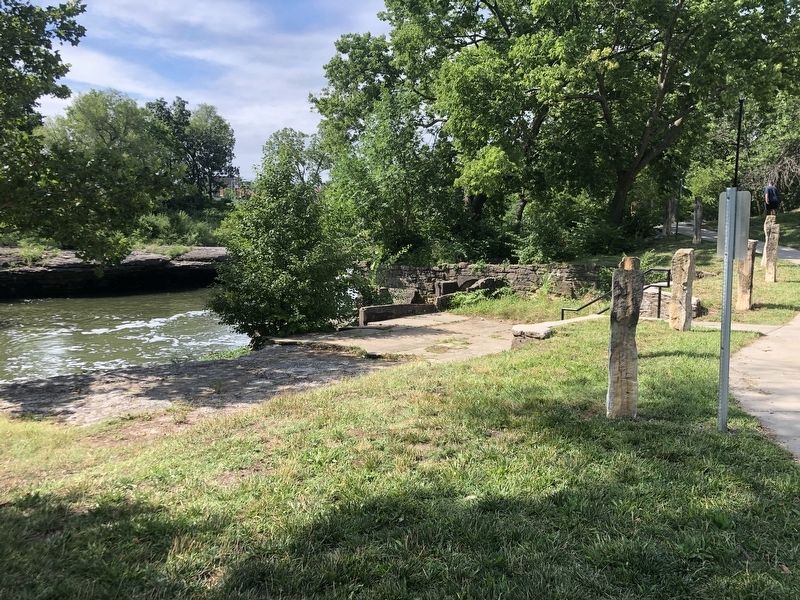
3. Watts Mill Remains
These foundation blocks are all that remains of the mill. Its iron components were scrapped for the World War II effort, and the mill was razed in 1949.
• A Final Frontier. Jim Bridger, the renowned explorer who helped map the western half of the United States and is given credit for the discovery of Yellowstone Park and the Great Salt Lake, bought property just south of Indian Creek and Watts Mill in 1855. Bridger kept as close to the old wilderness as possible, farming part-time, guiding Western emigrants and continuing mapping work for the U.S. Army and railroads until failing eyesight curtailed his explorations. Completely blind by the 1870s, Bridger often allowed his horse to lead him to the nearby home of his close friend Stubbins Watts.
Middle row, left to right:
•
Photographed by Duane and Tracy Marsteller, June 30, 2024
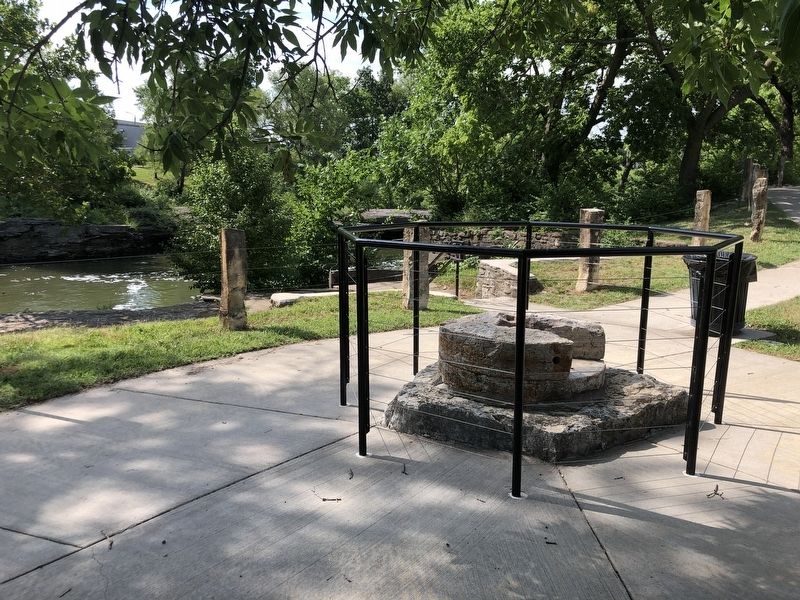
4. Millstones at Watts Mill Park
• Keeping Current. Watts Mill was sited where several small waterfalls, along a distance of about 100 yards, produced a gradient of about 12 feet. Over time the water powered both a sawmill and a gristmill. Customers who brought grain or corn left one-fifth of the finished flour or cornmeal as payment. In early years water pressure could be unpredictable; the mill sometimes ceased operating during summer droughts. After the Civil War, Stubbins Watts installed a turbine that enhanced water flow and increased the mill's efficiency. And before 1922, electricity was not available south of 85th Street, but that year Stubbins son Edgar added an electric motor to the facility's power train. After some 90 years, the mill no longer depended entirely upon the current of Indian Creek.
• True Grist. By 1911 the mill flourished six days a week, and in 1922 a Kansas City baking company advertised that it used flour from “the famous Watts Mill.” But new technologies were coming into play in the early 20th century. A 1932 celebration of the mill's centennial attracted a crowd of 6,000, but by then business could not compete with more modern operations; it would finally close by 1940. Two years later, Stubbins' son Edgar Watts provided nine tons of iron from the mill as scrap for the war effort. Finally, about 115 years after its founding, the mill, then considered a safety hazard, was razed in 1949.
Bottom row, left to right:
• Rolling Stones. Here at Watts Mill Park, two well-worn millstones, donated by area residents, provide an ongoing testament to Kansas City's formative past. Millstones – some made of Missouri limestone or the hard rock found in the Seine Valley of France – were used in pairs. Those at Watts Mill ground corn and wheat, and were about three and a half feet across and a foot thick. As the stones turned at 12 to 15 revolutions a minute, operators poured grain through a hold in the center of the top stone to be pulverized between the two hard surfaces, controlling the fineness with a regulating screw. Stones that wore down and were replaced became totems of prosperity: Stubbins Watts and wife Kate are thought to have been standing on an old millstone when they married in 1871. Today a worn millstone also marks the relocated Watts family plot in Pleasant Valley Cemetery, in Overland Park, Kansas – removed from this land upon Stubbins' request at his death in 1922.
• Going with the Flow. Adjacent to the park, Watts Mill shopping center opened in 1971 as the only retail amid still-rural two-lane roads – far enough south that grocery stores dismissed the location. Euston's Hardware store became one of the first tenants, along with several small family-run businesses and a Chinese restaurant. Like the early years of the original mill itself, the shopping center has had successive owners. In 1997 the Mirabile family purchased the site, moving from Waldo to south Kansas City. Jasper's Restaurant now overlooks stone remains of the original mill and offers diners first-hand views of the changing seasons at Indian Creek falls.
Topics. This historical marker is listed in these topic lists: Exploration • Industry & Commerce • Parks & Recreational Areas • Waterways & Vessels. A significant historical year for this entry is 1852.
Location. 38° 56.499′ N, 94° 36.311′ W. Marker is in Kansas City, Missouri, in Jackson County. It is in South Kansas City. It can be reached from West 103rd Street 0.1 miles east of State Line Road, on the right when traveling east. Touch for map. Marker is at or near this postal address: 1101 W 103rd St, Kansas City MO 64114, United States of America. Touch for directions.

Regionally, this marker is in the American Midwest, in the Lewis & Clark Corridor, in the Corn Belt, and on the Santa Fe Trail Corridor. Globally, it is in North America, the Western Hemisphere, the Western World, and the Anglosphere. Historically, it finds itself in what was once the territory of the Mississippian Culture, the Louisiana Purchase, and the Antebellum South.
Other nearby markers. At least 8 other markers are within 2 miles of this marker, measured as the crow flies: Thomas Farmhouse (approx. one mile away); "The Boy Scout" (approx. 1.2 miles away); Remembrance of Trails Past (approx. 1.3 miles away); Trail Hazards (approx. 2 miles away); James Beckwourth (approx. 2 miles away); Amache Prowers (approx. 2 miles away); Alexander Majors (approx. 2 miles away); Jim Bridger (approx. 2 miles away). Touch for a list and map of all markers in Kansas City.
Credits. This page was last revised on July 22, 2024. It was originally submitted on July 19, 2024, by Duane and Tracy Marsteller of Murfreesboro, Tennessee. This page has been viewed 347 times since then and 95 times this year. Photos: 1, 2. submitted on July 19, 2024, by Duane and Tracy Marsteller of Murfreesboro, Tennessee. 3, 4. submitted on July 22, 2024, by Duane and Tracy Marsteller of Murfreesboro, Tennessee.
