Greenville in Darke County, Ohio — The American Midwest (Great Lakes)
Little Turtle Island

Photographed by Craig Doda, July 7, 2024
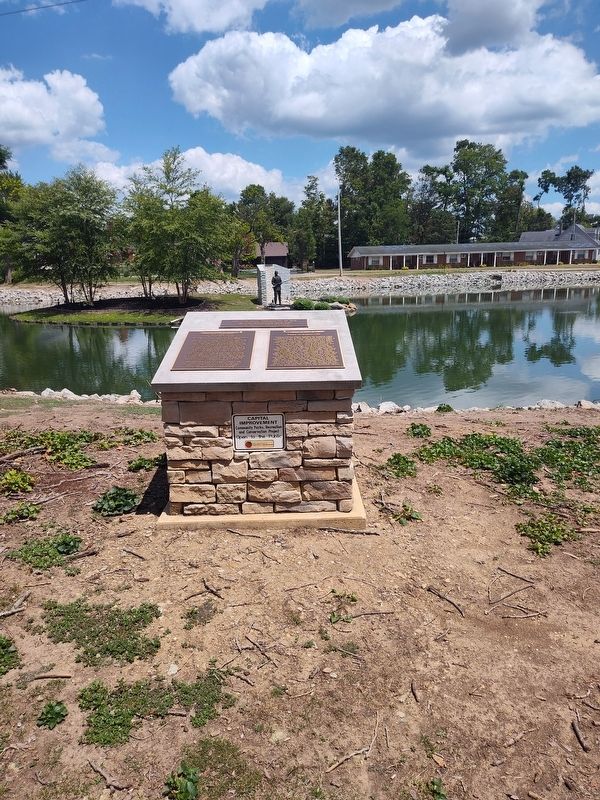
1. Little Turtle Island Marker
A project sponsored by the Friends of the Greenville City Parks and by an Ohio Department of Natural Resources Grant
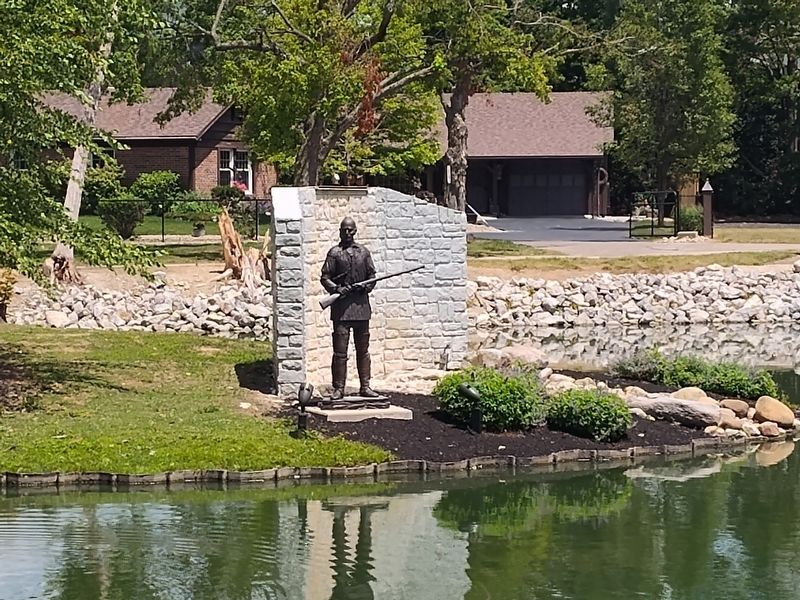
Chief Little Turtle sculpture created by Joshua Shepherd
Chief Little Turtle "Me-she-kin-no-quah"
One of the most famous Native American military leaders, Little Turtle was a chief of the Miami people.
Little Turtle and Tecumseh, a Shawnee war chief, led the Miami and Shawnee people to resist white settlers in the western part of Ohio. They successfully defeated United States soldiers led by General Josiah Harmar in October 1790 and soldiers led by General Arthur St. Clair in 1791. An attack on Fort Recovery failed in 1794. Little Turtle wanted to negotiate with the settlers, but other chiefs wanted to continue fighting. The defeat of the Indians at the Battle of Fallen Timbers on August 20, 1794, led to the signing of the Treaty of Greenville on August 3, 1795, ceding most of Ohio to the settlers. Little Turtle refused to take up arms against the United States ever again. He urged his fellow Native Americans to keep the peace and also encouraged them to give up consumption of
this page online
Little Turtle's legacy was one of initial resistance and then cooperation to preserve the lives and future of his people. He is held in the hearts of his people, allies, and foes with the greatest of honor and respect for his courageous valor and peacemaking.
Treaty of Greene Ville
General Anthony Wayne defeated the American Indian confederacy led by Blue Jacket at the Battle of Fallen Timbers on August 20, 1794. Abandoned by the British at Fort Miamis, the American Indians agreed to a peace settlement. A year later, representatives from twelve tribes met at Greene Ville, in present-day Darke County, to negotiate with Wayne. Among the leaders were Little Turtle of the Miamis, Tarhe of the Wyandots, and Blue Jacket and Black Hoof of the Shawnees. The Treaty of Greene Ville of 1795 opened the door to the settlement of the Midwest and resulted in Ohio statehood eight years later. The Treaty also ended forty years of conflict over the upper Ohio Valley. The
Photographed by Craig Doda, July 7, 2024
2. Little Turtle Island Marker
Erected 2019 by Greenville City Parks.
Topics. This historical marker is listed in these topic lists: Indigenous Peoples and Communities • Wars, US Indian. A significant historical date for this entry is July 14, 1812.
Location. 40° 6.656′ N, 84° 37.658′ W. Marker is in Greenville, Ohio, in Darke County. It is at the intersection of East Harmon Drive and East Park Drive, on the right when traveling north on East Harmon Drive. Touch for map. Marker is at or near this postal
Photographed by Craig Doda, July 7, 2024
3. Little Turtle Island Marker

Regionally, this marker is in the Till Plains. It is also in the American Midwest and in the Corn Belt. Globally, it is in North America, the Western Hemisphere, the Western World, and the Anglosphere. Historically, it finds itself in what was once the Haudenosaunee (Iroquois) Confederacy, the territory of the Mississippian Culture, and the Northwest Territory.
Other nearby markers. At least 8 other markers are within walking distance of this marker: In memory of Patsy And Anna Wilson (about 500 feet away, measured in a direct line); Harmon Field (about 700 feet away); Gold Star Veterans Memorial (approx. ¼ mile away); In Memory of the Grand Army of the Republic (approx. ¼ mile away); 1793 -1934 Greene Ville (approx. ¼ mile away); The Altar of Peace (approx. ¼ mile away); War of 1812 (approx. half a mile away); Water Street Cemetery (approx. half a mile away). Touch for a list and map of all markers in Greenville.
Credits. This page was last revised on July 27, 2024. It was originally submitted on July 19, 2024, by Craig Doda of Napoleon, Ohio. This page has been viewed 409 times since then and 141 times this year. Photos: 1, 2, 3. submitted on July 19, 2024, by Craig Doda of Napoleon, Ohio. • Devry Becker Jones was the editor who published this page.
