Fultonville in Montgomery County, New York — The American Northeast (Mid-Atlantic)
The Canalway Trail: Fultonville ⎯⎯⎯ Tapping the Keg ⎯⎯⎯ Ready for Business
Photographed by Steve Stoessel, July 21, 2024
1. The Canalway Trail: Fultonville
Inscription.
The Canalway Trail: Fultonville, also, Tapping the Keg, also, Ready for Business. .
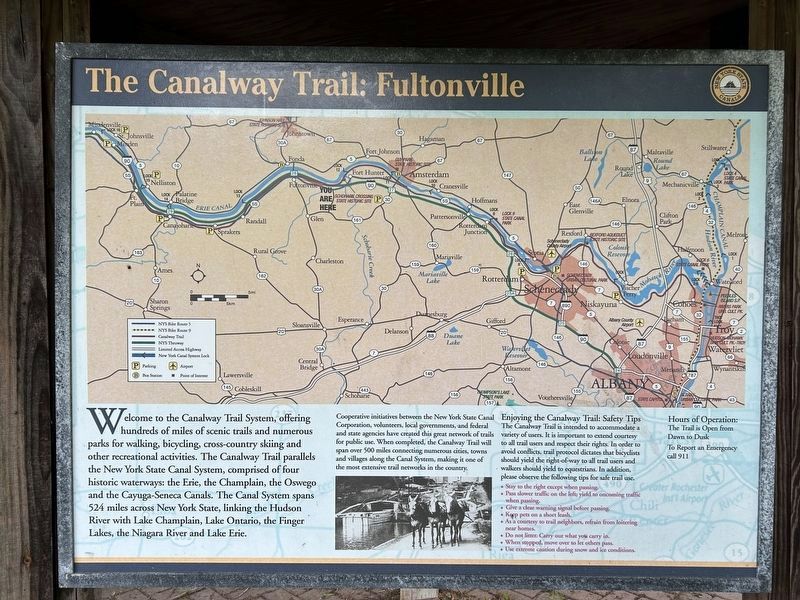
The Canalway Trail: Fultonville. Welcome to the Canalway Trail, offering hundreds of miles of scenic trails and numerous parks for walking, bicycling, cross-country skiing and other recreational activities. The Canalway Trail parallels the New York State Canal System, comprised of four historic waterways: the Erie, the Champlain, the Oswego and the Cayuga-Seneca Canals. The Canal System spans 524 miles across New York State, linking the Hudson River with Lake Champlain, Lake Ontario, the Finger Lakes, the Niagara River and Lake Erie., Cooperative initiatives between the New York State Canal Corporation, volunteers, local governments, and federal and state agencies have created this great network of trails for public use. When completed, the Canalway Trail will span over 500 miles connecting numerous cities, towns and villages along the Canal System, making it one of the most extensive trail networks in the country., Enjoying the Canalway Trail: Safety Tips The Canalway Trail is intended to accommodate avariety of users. It is important to extend courtesy to all trail users and respect their rights. In order to avoid conflicts, trail protocol dictates that bicyclists of should yield the right-of-way to all trail users and walkers should yiels to equestrians. In addition, please observe the following tips for safe trail use. [ Rules were not transcribed],
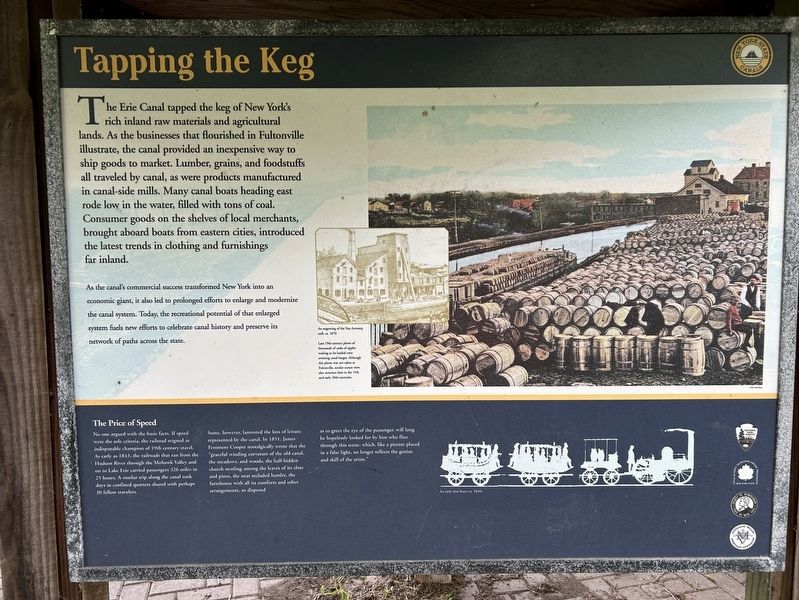
Tapping the Keg. The Erie Canal tapped the keg of New York's rich inland raw materials and agricultural lands. As the businesses that flourished in Fultonville illustrate, the canal provided an inexpensive way to ship goods to market. Lumber, grains, and foodstuffs all traveled by canal, as were products manufactured in canal-side mills. Many canal boats heading east rode low in the water, filled with tons of coal. Consumer goods on the shelves of local merchants, brought aboard boats from eastern cities, introduced the latest trends in clothing and furnishings far inland., As the canal's commercial success transformed New York into an economic giant, it also led to prolonged efforts to enlarge and modernize the canal system. Today, the recreational potential of that enlarged system fuels new efforts to celebrate canal history and preserve its network of paths across the state., [drawing:] An engraving of the Van Antwerp mill, ca. 1870 [photo:] late 19th-century photo of thousands of casks of apples waiting to be loaded onto awaiting canals barges. Although this photo was not taken at Fultonville, similar scenes were also common here in the 19th and early 20th-centuries., The Price of Speed No one argued with the basic facts. If speed were the sole criteria, the railroad reigned as indisputable champion of in 19th century travel. As early as 1843, the railroads that ran from the Hudson River through the Mohawk Valley and on to Lake Erie carried passengers 526 miles in 25 hours. A similar trip along the canal took days in confined quarters shared with perhaps 30 fellow travelers., Some, however, lamented the loss of leisure represented by the canal. In 1851, James Fenimore Cooper nostalgically wrote that the "graceful winding curvature of the old canal, the meadows, and woods, the half-hidden church nestling among the leaves of its elms and pines, the neat secluded hamlet, the farmhouse with all its comforts and sober arrangements, so disposed as to greet the eye of the passenger, will long be hopelessly looked for by him who flies through this scene, which, like a picture placed in a false light, no longer reflects the genius and skill of the artist.",
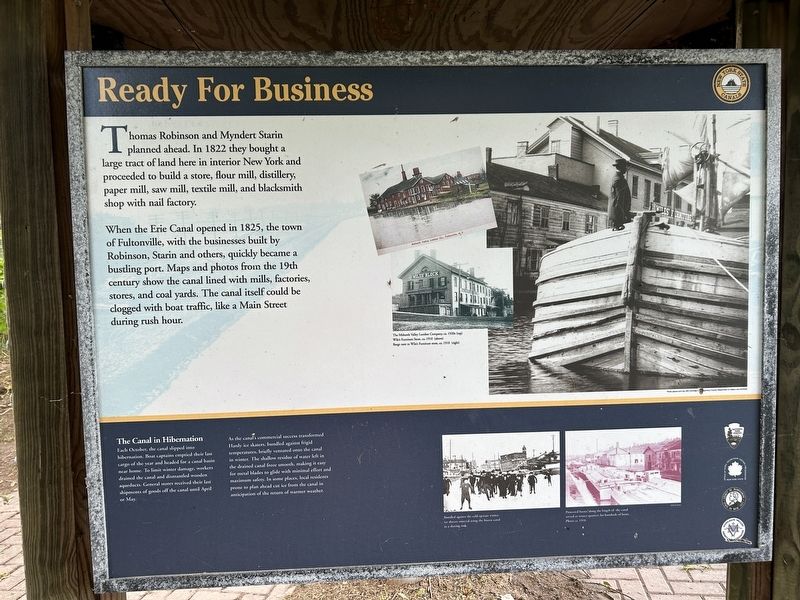
Ready for Business. Thomas Robinson and Myndert Starin planned ahead. In 1822 they bought a large tract of land here in interior New York and proceeded to build a store, flour mill, distillery, paper mill, saw mill, textile mill, and blacksmith shop with nail factory., When the Erie Canal opened in 1825, the town of Fultonville, with the businesses built by Robinson, Starin and others, quickly became a bustling port. Maps and photos from the 19th century show the canal lined with mills, factories, stores, and coal yards. The canal itself could be clogged with boat traffic, like a Main Street during rush hour., [postcard:] Mohawk Valley Lumber Company ca. 1920s [middle photo:] Wile's Furniture Store, ca. 1910 [main photo:] Barge next to Wile's Furniture store, ca. 1910, The Canal in Hibernation Each October, the canal slipped into hibernation. Boat captains emptied their last cargo of the year and headed for a canal basin near home. To limit winter damage, workers drained the canal and dismantled wooden aqueducts. General stores received their last shipments of goods off the canal until April or May., As the canal's commercial success transformed Hardy ice skaters, bundled against frigid temperatures, briefly ventured onto the canal in winter. The shallow residue of water left in the drained canal froze smooth, making it easy for metal blades to glide with minimal effort and maximum safety. In some places, local residents prone to plan ahead cut ice from the canal in anticipation of the return of warmer weather., [photos:] Bundled against the cold upstate winter, ice skaters enjoyed using the frozen canal as a skating rink., Protected basins along the length of the canal served as winter quarters for hundreds of boats. Photo ca. 1910.
The Canalway Trail: Fultonville
Welcome to the Canalway Trail, offering hundreds of miles of scenic trails and numerous parks for walking, bicycling, cross-country skiing and other recreational activities. The Canalway Trail parallels the New York State Canal System, comprised of four historic waterways: the Erie, the Champlain, the Oswego and the Cayuga-Seneca Canals. The Canal System spans 524 miles across New York State, linking the Hudson River with Lake Champlain, Lake Ontario, the Finger Lakes, the Niagara River and Lake Erie.
Cooperative initiatives between the New York State Canal Corporation, volunteers, local governments, and federal and state agencies have created this great network of trails for public use. When completed, the Canalway Trail will span over 500 miles connecting numerous cities, towns and villages along the Canal System, making it one of
the most extensive trail networks in the country.
Enjoying the Canalway Trail: Safety Tips
The Canalway Trail is intended to accommodate avariety of users. It is important to extend courtesy to all trail users and respect their rights. In order to avoid
Click or scan to see this page online
conflicts, trail protocol dictates that bicyclists of should yield the right-of-way to all trail users and walkers should yiels to equestrians. In addition, please observe the following tips for safe trail use. [ Rules were not transcribed]
Tapping the Keg
The Erie Canal tapped the keg of New York's rich inland raw materials and agricultural lands. As the businesses that flourished in Fultonville illustrate, the canal provided an inexpensive way to ship goods to market. Lumber, grains, and foodstuffs all traveled by canal, as were products manufactured in canal-side mills. Many canal boats heading east rode low in the water, filled with tons of coal. Consumer goods on the shelves of local merchants, brought aboard boats from eastern cities, introduced the latest trends in clothing and furnishings far inland.
As the canal's commercial success transformed New York into an economic giant, it also led to prolonged efforts to enlarge and modernize the canal system. Today, the recreational potential of that enlarged system fuels new efforts to celebrate canal history and preserve its network of paths across the state.
[drawing:] An
Photographed by Steve Stoessel, July 21, 2024
2. Tapping the Keg side of marker
engraving of the Van Antwerp mill, ca. 1870
[photo:] late 19th-century photo of thousands of casks of apples waiting to be loaded onto awaiting canals barges. Although this photo was not taken at Fultonville, similar scenes were also common here in the 19th and early 20th-centuries.
The Price of Speed
No one argued with the basic facts. If speed were the sole criteria, the railroad reigned as
indisputable champion of in 19th century travel. As early as 1843, the railroads that ran from the Hudson River through the Mohawk Valley and on to Lake Erie carried passengers 526 miles in 25 hours. A similar trip along the canal took days in confined quarters shared with perhaps 30 fellow travelers.
Some, however, lamented the loss of leisure represented by the canal. In 1851, James Fenimore Cooper nostalgically wrote that the "graceful winding curvature of the old canal, the meadows, and woods, the half-hidden church nestling among the leaves of its elms and pines, the neat secluded hamlet, the farmhouse with all its comforts and sober arrangements, so disposed
as to greet the eye of the passenger, will long be hopelessly looked
Photographed by Steve Stoessel, July 21, 2024
3. Ready for Business Marker
for by him who flies through this scene, which, like a picture placed in a false light, no longer reflects the genius and skill of the artist."
Ready for Business
Thomas Robinson and Myndert Starin planned ahead. In 1822 they bought a large tract of land here in interior New York and proceeded to build a store, flour mill, distillery, paper mill, saw mill, textile mill, and blacksmith shop with nail factory.
When the Erie Canal opened in 1825, the town of Fultonville, with the businesses built by Robinson, Starin and others, quickly became a bustling port. Maps and photos from the 19th century show the canal lined with mills, factories, stores, and coal yards. The canal itself could be clogged with boat traffic, like a Main Street during rush hour.
[postcard:] Mohawk Valley Lumber Company ca. 1920s
[middle photo:] Wile's Furniture Store, ca. 1910
[main photo:] Barge next to Wile's Furniture store, ca. 1910
The Canal in Hibernation
Each October, the canal slipped into hibernation. Boat captains emptied their last cargo of the year and headed for a canal basin near home. To limit winter damage, workers drained the canal
Photographed by Steve Stoessel, July 21, 2024
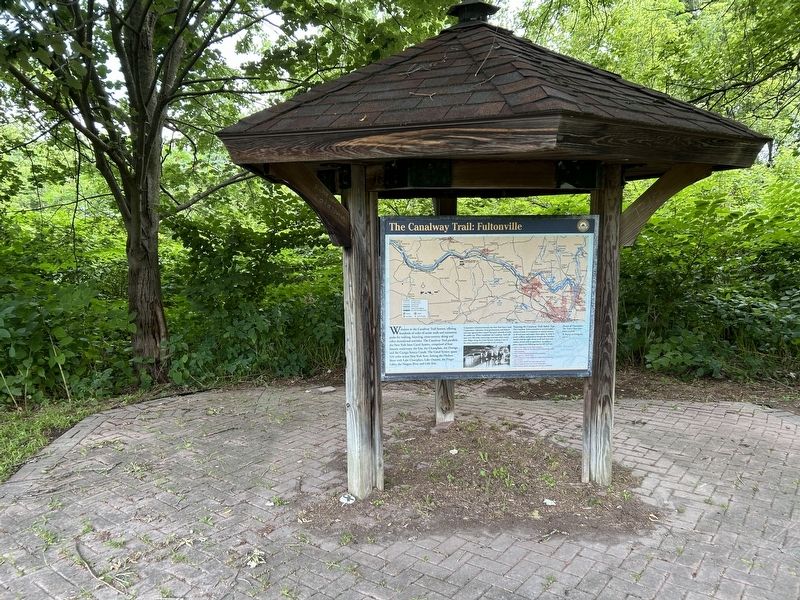
4. The Canalway Trail: Fultonville Marker
and dismantled wooden aqueducts. General stores received their last shipments of goods off the canal until April or May.
As the canal's commercial success transformed
Hardy ice skaters, bundled against frigid temperatures, briefly ventured onto the canal in winter. The shallow residue of water left in the drained canal froze smooth, making it easy for metal blades to glide with minimal effort and maximum safety. In some places, local residents prone to plan ahead cut ice from the canal in anticipation of the return of warmer weather.
[photos:]
Bundled against the cold upstate winter, ice skaters enjoyed using the frozen canal as a skating rink.
Protected basins along the length of the canal served as winter quarters for hundreds of boats. Photo ca. 1910.
Erected by National Park Service, NYS Parks, recreation and Historic Preservation, Montgomery County, Mohawk Valley Heritage Corridor.
Location. 42° 56.715′ N, 74° 21.997′ W. Marker is in Fultonville, New York, in Montgomery County. It is at the intersection of Empire State Trail and Erie Street, on the right when traveling west on Empire State Trail. Marker on the bike trail is about 5 yards east of the intersection. The Canalway is now oart of the Empire State Trail. Touch for map. Marker is in this post office area: Fultonville NY 12072, United States of America. Touch for directions.

Regionally, this marker is in Upstate New York and in the Mohawk Valley. It is also in the American Northeast and in the Mid-Atlantic. Globally, it is in North America, the Western Hemisphere, the Western World, and the Anglosphere. Historically, it finds itself in what was once the Haudenosaunee (Iroquois) Confederacy, New Netherland, and one of the original Thirteen Colonies.
More about this marker. This is a three-sided marker.
Also see . . . 1. Fultonville History. (Submitted on July 22, 2024, by Steve Stoessel of Niskayuna, New York.) 2. Fultonville (Wikipedia). (Submitted on July 22, 2024, by Steve Stoessel of Niskayuna, New York.) 3. The Erie Canal (Wikipedia). (Submitted on July 22, 2024, by Steve Stoessel of Niskayuna, New York.)
Credits. This page was last revised on July 22, 2024. It was originally submitted on July 21, 2024, by Steve Stoessel of Niskayuna, New York. This page has been viewed 173 times since then and 12 times this year. Photos:1, 2, 3, 4. submitted on July 21, 2024, by Steve Stoessel of Niskayuna, New York.
