Lower Macungie Township in Wescosville in Lehigh County, Pennsylvania — The American Northeast (Mid-Atlantic)
Barns, Decorative Art & Music
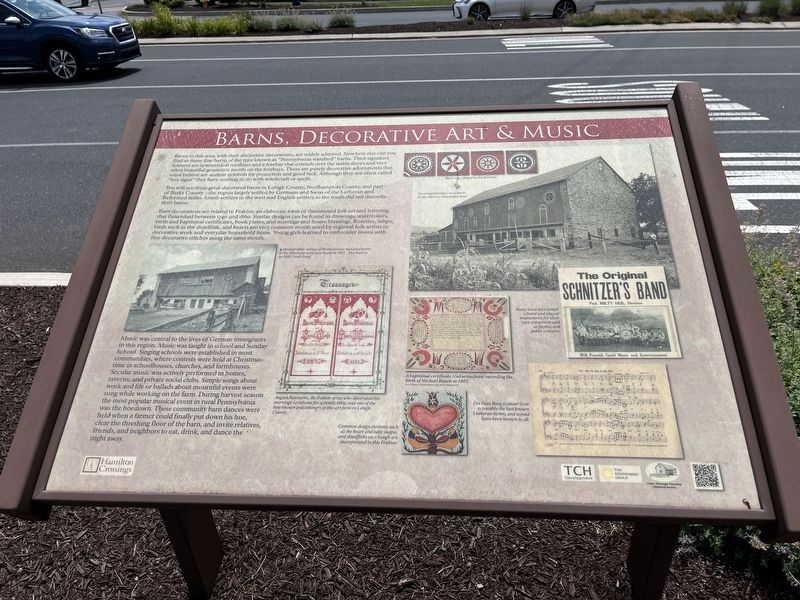
Barns in this area, with their distinctive decorations, are widely admired. Nowhere else can you find as many fine barns of the type known as "Pennsylvania standard" barns. Their signature features are symmetrical rooflines and a forebay that extends over the stable doors and very often beautiful geometric motifs on the forebays. These are purely decorative adornments that some believe are ancient symbols for protection and good luck. Although they are often called "hex signs" they have nothing to do with witchcraft or spells.
You will see these great decorated barns in Lehigh County, Northampton County, and part of Berks County—the region largely settled by Germans and Swiss of the Lutheran and Reformed faiths. Amish settles to the west and English settlers to the south did not decorate their barns.
Barn decorations are related to Fraktur, an elaborate form of illuminated folk art and lettering that flourished between 1740 and 1860. Similar designed can be found in drawings, watercolors, birth and baptismal certificates, book plates, and marriage and house blessings. Rosettes, tulips, birds such as the distelfink,
this page online
Music was central to the lives of German immigrants in this region. Music was taught in school and Sunday School. Singing schools were established in most communities, where contests were held at Christmastime in schoolhouses, churches, and farmhouses. Secular music was actively performed in homes, taverns, and private social clubs. Simple songs about work and life or ballads about mournful events were sung while working on the farm. During harvest season the most popular musical event in rural Pennsylvania was the hoedown. These community barn dances were held when a farmer could finally put down his hoe, clear the threshing floor of the barn, and invite relatives, friends, and neighbors to eat, drink, and dance the night way.
[Captions:]
A photographic survey of Pennsylvania standard barns in the Macungie area was made in 1941. This barn is on Mill Creek Road.
August Baumann, the fraktur artist who illustrated this marriage certificate for a family bible, was one of the best-known practitioners of this art form in Lehigh County.
Common design elements such as the heart and tulip shapes, and distelfinks on a bough are incorporated in this Fraktur.
Many local men joined a band and played instruments for their own enjoyment and at picnics and public concerts.
A baptismal certificate (Geburtsschein) recording the birth of Michael Rauch in 1803.
Ein Feste Burg is unser Gott is possibly the best known Lutheran hymn, and would have been known to all.
Erected by TCH
Topics and series. This historical marker is listed in these topic lists: Agriculture • Anthropology & Archaeology • Arts, Letters, Music • Settlements & Settlers. In addition, it is included in the Pennsylvania, Lower Macungie Township Historic Walking Trail series list. A significant historical year for this entry is 1740.
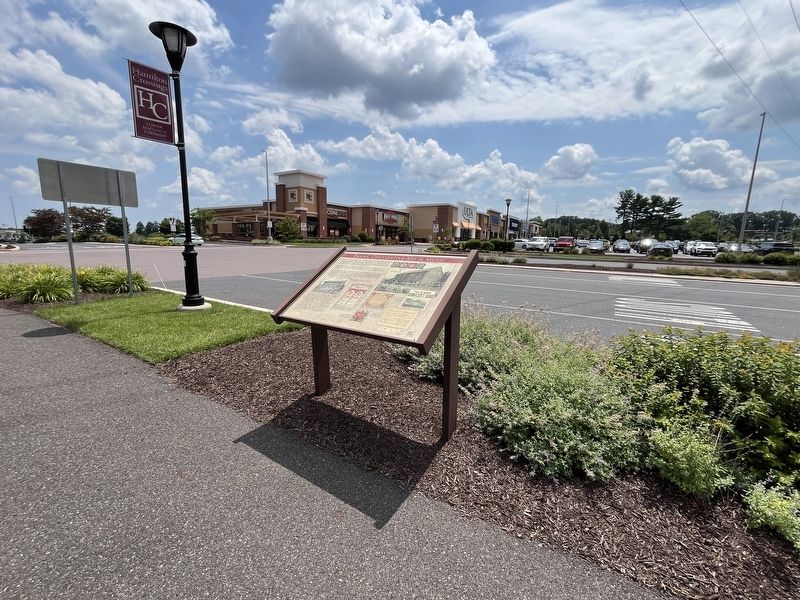
Location. 40° 33.904′ N, 75° 33.779′ W. Marker is in Wescosville, Pennsylvania, in Lehigh County. It is in Lower Macungie Township. It is on North Krocks Road 0.1 miles south of Fred Jaindl Memorial Highway (U.S. 222), on the right when traveling north. Touch for map. Marker is in this post office area: Allentown PA 18106, United States of America. Touch for directions.

Regionally, this marker is in Southeast Pennsylvania and in Lehigh Valley. It is also in the American Northeast and in the Mid-Atlantic. Globally, it is in North America, the Western Hemisphere, the Western World, and the Anglosphere. Historically, it finds itself in what was once the Haudenosaunee (Iroquois) Confederacy and also one of the original Thirteen Colonies.
Other nearby markers. At least 8 other markers are within walking distance of this marker: A Farming Community (within shouting distance of this marker); Business & Industry (about 300 feet away, measured in a direct line); The Mining Industry (about 400 feet away); Trains and Trolleys (about 400 feet away); Churches and Schools (about 500 feet away); Early Roads & Highways (about 600 feet away); Villages (approx. 0.2 miles away); Early Settlers (approx. 0.2 miles away). Touch for a list and map of all markers in Wescosville.
Credits. This page was last revised on July 24, 2024. It was originally submitted on July 24, 2024, by Devry Becker Jones of Washington, District of Columbia. This page has been viewed 160 times since then and 11 times this year. Photos: 1, 2. submitted on July 24, 2024, by Devry Becker Jones of Washington, District of Columbia.
