Boonville in Cooper County, Missouri — The American Midwest (Upper Plains)
Affair at Rawlings Lane
| — | Missouri's Civil War | — |
Photographed by Duane and Tracy Marsteller, July 1, 2024
1. Affair at Rawlings Lane Marker
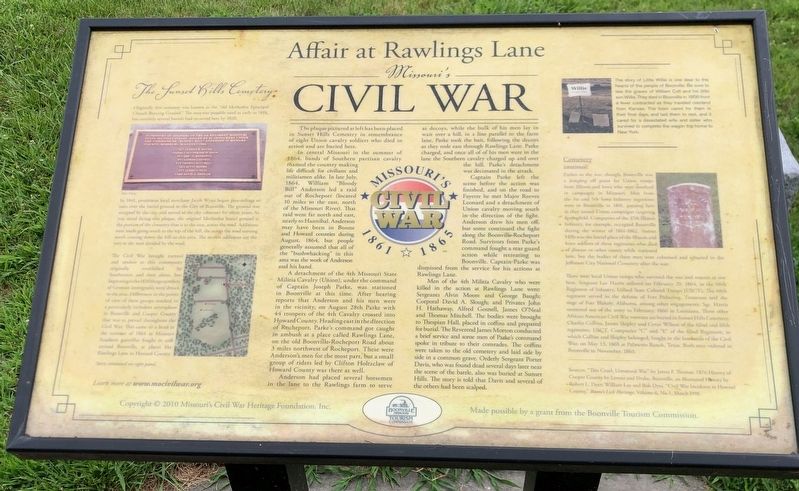
In central Missouri in the summer of 1864, bands of Southern partisan cavalry roamed the country making life diffcult for civilians and militiamen alike. In late July, 1864, William “Bloody Bill” Anderson led a raid out of Rocheport (located 10 miles to the east, north of the Missouri River). That raid went far north and east, nearly to Hannibal. Anderson may have been in Boone and Howard counties during August, 1864, but people generally assumed that all of the “bushwhacking” in this area was the work of Anderson and his band.
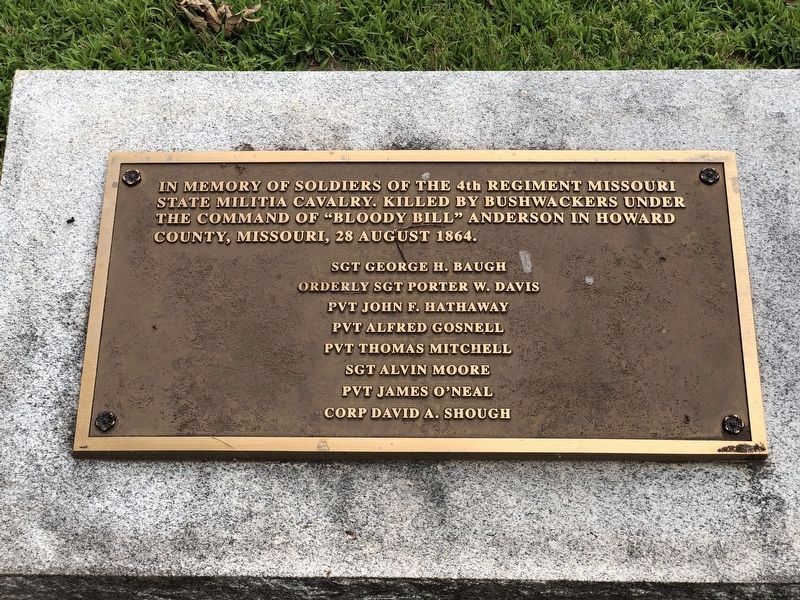
A detachment of the 4th Missouri State Militia Cavalry (Union), under the command of Captain Joseph Parke, was stationed in Boonville at this time. After hearing reports that Anderson and his men were in the vicinity, on August 28th Parke with 44 troopers of the 4th Cavalry crossed into Howard County. Heading east in the direction of Rocheport, Parke’s command got caught in ambush at a place called Rawlings Lane, on the old Boonville-Rocheport
this page online
Anderson had placed several horsemen in the lane to the Rawlings farm to serve as decoys, while the bulk of his men lay in wait over a hill, in a line parallel to the farm lane. Parke took the bait, following the decoys as they rode east through Rawlings Lane. Parke charged, and once all of of his men were in the lane the Southern cavalry charged up and over the hill. Parke’s detachment was decimated in the attack.
Captain Parke left the scene before the action was finished, and on the road to Fayette he met Major Reeves Leonard and a detachment of Union cavalry moving south in the direction of the fight. Anderson drew his men off, but some continued the fight along the Boonville-Rocheport Road. Survivors from Parke’s command fought a rear guard action while retreating to Boonville. Captain Parke was dismissed from the service for his actions at Rawlings Lane.
Men of the 4th Militia Cavalry who were killed in the action at Rawlings Lane were: Sergeants
Photographed by Duane and Tracy Marsteller, July 1, 2024
2. Affair at Rawlings Lane Marker
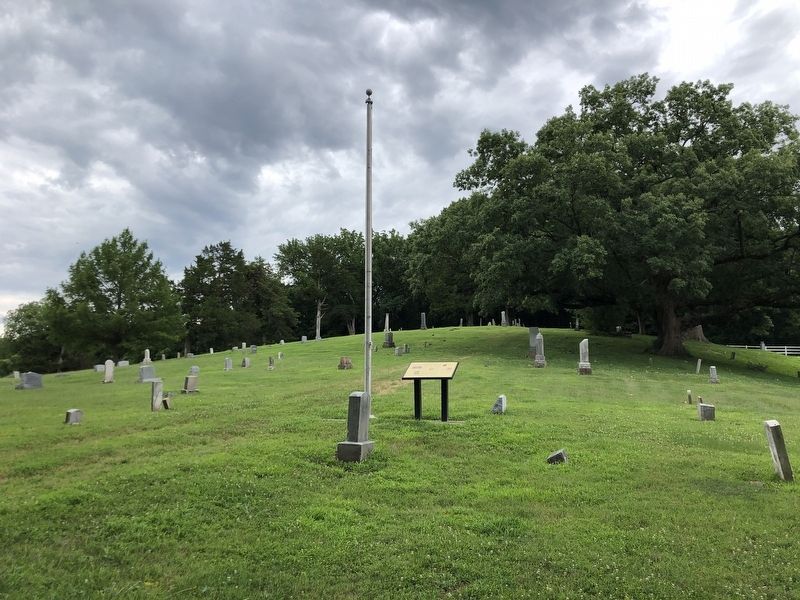
The Sunset Hills Cemetery
Originally this cemetery was known as the “old Methodist Episcopal Church Burying Ground.” The area was possibly used as early as 1818, but certainly several burials had occurred here by 1820.
In 1841, prominent local merchant Jacob Wyan began proceedings to turn over the burial ground to the City of Boonville. The ground was accepted by the city, and served as the city cemetery for many years. As you stand facing this plaque, the original Methodist burial ground is the portion of
Photographed by Duane and Tracy Marsteller, July 1, 2024
3. 4th Regiment Missouri State Militia Cavalry Memorial
The Civil War brought turmoil and tension to this community originally established by Southerners and their slaves, but beginning in the 1830's large numbers of German immigrants were drawn to the area. Differences in the points of view of these groups resulted in a particularly turbulent atmosphere in Boonville and Cooper County that was to prevail throughout the Civil War. This came to a head in the summer of 1864 as Missouri Southern guerillas fought in and around Boonville, at places like Rawlings Lane in Howard County.
Earlier in the war, though, Boonville was a jumping-off point for Union troops from Illinois and Iowa who were involved in campaigns in Missouri. Men from the 1st and 5th Iowa Infantry regiments were in Boonville in 1861, pausing here as they joined Union campaigns targeting Springfield. Companies of the 37th Illinois Infantry, for example, occupied Boonville during
Photographed by Duane and Tracy Marsteller, July 1, 2024
4. Graves of William Colt and son, Willie
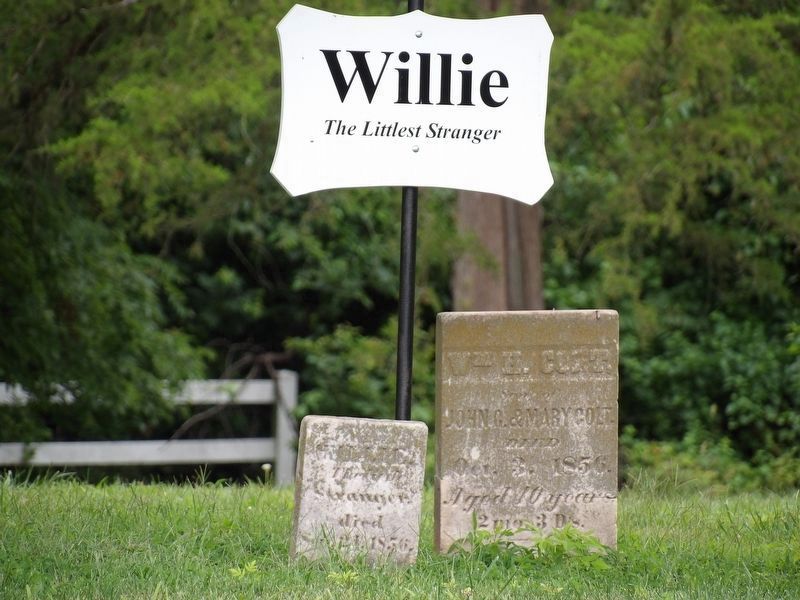
They died while passing through Boonville in 1856. Townsfolk cared for them in their final days and for Colt's wife and daughter, who survived.
There were local Union troops who survived the war and remain at rest here. Sergeant Lee Harris enlisted on February 29, 1864, in the 68th Regiment of Infantry, United States Colored Troops (USCT). The 68th Regiment served in the defense of Fort Pickering, Tennessee, and the siege pf Fort Blakely, Alabama, among other engagements. Sgt. Harris mustered out of the Army in February, 1866, in Louisiana. Three other African American Civil War veterans are buried in Sunset Hills Cemetery, Charles Collins, James Shipley and Cyrus Wilson of the 62nd and 65th regiments, USCT. Companies “C” and “E” of the 62nd Regiment, to which Collins and Shipley belonged, fought in the last battle of the Civil War, on May 13, 1865 at Palmetto Ranch, Texas. Both men enlisted in Boonville in November, 1863.
[Box, top right corner] The story of Little Willie is one dear to the hearts of the people of Boonville. Be sure to see the graves of William Colt and his little son Willie. They died in Boonville in 1856 from a fever contracted as they traveled overland from Kansas. The town cared for them in their final days, and laid them to rest, and it cared for a devastated wife and sister who survived to complete the wagon trip home to New York.
Erected 2010 by Missouri's Civil War Heritage Foundation, Inc.
Topics and series. This historical marker is listed in these topic lists: African Americans • Cemeteries & Burial Sites • War, US Civil. In addition, it is included in the Missouri’s Civil War series list. A significant historical month for this entry is July 1864.
Location. 38° 57.826′ N, 92° 44.766′ W. Marker is in Boonville, Missouri, in Cooper County. It is on South Street east of Nelson Street, on the left when traveling east. Touch for map. Marker is in this post office area: Boonville MO 65233, United States of America. Touch for directions.

Regionally, this marker is in the Missouri River Corridor. It is also in the American Midwest, in the Lewis & Clark Corridor, in the Corn Belt, and on the Santa Fe Trail Corridor. Globally, it is in North America, the Western Hemisphere, the Western World, and the Anglosphere. Historically, it finds itself in what was once the territory of the Mississippian Culture, the Louisiana Purchase, and the Antebellum South.
Other nearby markers. At least 8 other markers are within walking distance of this marker: 4th Regiment Missouri State Militia Cavalry Memorial (about 400 feet away, measured in a direct line); Roslyn Heights (approx. half a mile away); Kemper Military School & College 1844-2002 (approx. half a mile away); In Memory of Hannah Cole (approx. 0.6 miles away); 25th Anniversary (approx. 0.7 miles away); Capture of Union Troops (approx. 0.7 miles away); Boonville to Pilot Grove (approx. 0.7 miles away); Thespian Hall (approx. 0.7 miles away). Touch for a list and map of all markers in Boonville.
Credits. This page was last revised on August 4, 2024. It was originally submitted on July 26, 2024, by Duane and Tracy Marsteller of Murfreesboro, Tennessee. This page has been viewed 603 times since then and 91 times this year. Photos: 1, 2, 3, 4. submitted on July 26, 2024, by Duane and Tracy Marsteller of Murfreesboro, Tennessee.
