Chihuahuita in El Paso in El Paso County, Texas — The American South (West South Central)
Chihuahuita
Photographed by James Hulse, July 22, 2024
1. Chihuahuita Marker

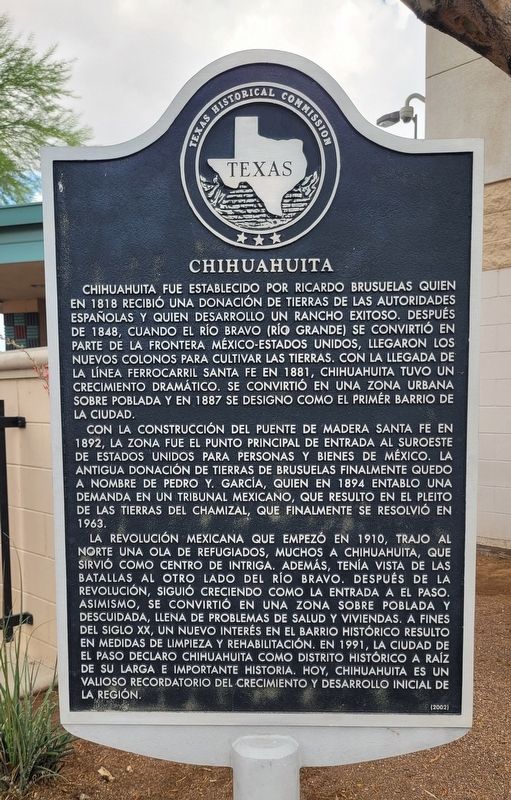
Con la construcción del puente de madera Santa Fe en 1892, la zona fue el punto principal de entrada al suroeste de Estados Unidos para personas y bienes de México. La antigua donación de tierras de Brusuelas finalmente quedo a nombre de Pedro Y. García, quien en 1894 entablo una demanda en un tribunal mexicano, que resulto en el pleito de las tierras del Chamizal, que finalmente se resolvió en 1963.
La revolución mexicana que empezó en 1910, trajo al norte una ola de refugiados, muchos a Chihuahuita, que sirvió como centro de intriga. Además, tenía vista de las batallas al otro lado del Río Bravo. Después de la revolución, siguió creciendo como la entrada a El Paso. Asimismo, se convirtió en una zona sobre poblada y descuidada, llena de problemas de salud y viviendas. A fines del siglo xx, un nuevo interés en el barrio histórico resulto en medidas de limpieza y rehabilitación. En 1991, la ciudad de El Paso declaro Chihuahuita como distrito histórico a raíz de su larga e importante historia. Hoy, Chihuahuita es un valioso recordatorio del crecimiento y desarrollo inicial de la región.
Chihuahuita was established by Ricardo Brusuelas who in 1818 received a donation of land from the Spanish authorities and who developed a successful ranch. After 1848,
this page online
With the construction of the Santa Fe wooden bridge in 1892, the area was the main entry point to the southwestern United States for people and goods from Mexico. The old Brusuelas land donation was finally left in the name of Pedro Y. García, who in 1894 filed a lawsuit in a Mexican court, which resulted in the Chamizal land lawsuit, which was finally resolved in 1963.
The Mexican revolution that began in 1910 brought a wave of refugees north, many to Chihuahuita, which served as a center of intrigue. In addition, he had a view of the battles on the other side of the Rio Grande. After the revolution, it continued to grow as the gateway to El Paso. Likewise, it became an overpopulated and neglected area, full of health and housing problems. At the end of the 20th century, new interest in the historic neighborhood
Photographed by James Hulse, July 22, 2024
2. Chihuahuita Marker (Spanish on left side)
Erected 2002 by Texas Historical Commission. (Marker Number 14827.)
Topics. This historical marker is listed in these topic lists: Hispanic Americans • Immigration • Industry & Commerce • Settlements & Settlers. A significant historical year for this entry is 1818.
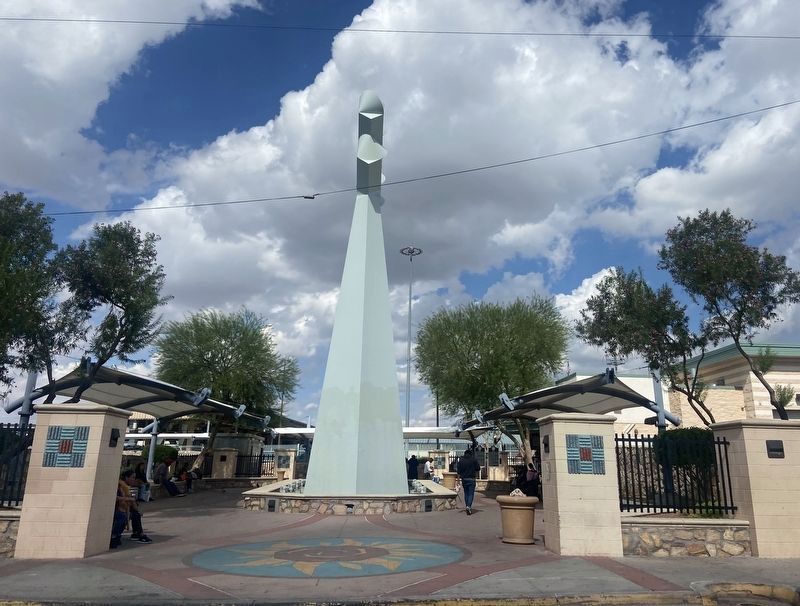
Location. 31° 44.981′ N, 106° 29.234′ W. Marker is in El Paso, Texas, in El Paso County. It is in Chihuahuita. It is at the intersection of South Santa Fe Street and Callaros Court on South Santa Fe Street. The marker is located in the Lions Plazita. Touch for map. Marker is at or near this postal address: 910 South Santa Fe St, El Paso TX 79901, United States of America. Touch for directions.

Regionally, this marker is in the Trans-Pecos & Big Bend Region. It is also in the American Borderlands and in the Southwest. Globally, it is in North America, a Gulf of Mexico state, the Western Hemisphere,
Photographed by James Hulse, July 22, 2024
3. The Chihuahuita Markers are located in the Lions Plazita.
Other nearby markers. At least 8 other markers are within walking distance of this marker: A different marker also named Chihuahuita (here, next to this marker); El Paso Laundry and Cleaners Company (within shouting distance of this marker); La Patria Newspaper (approx. 0.4 miles away); The Villa Stash House / Casa Clandestina Villa (approx. 0.4 miles away); Stage Station (approx. half a mile away); Montgomery Building (approx. half a mile away); El Paso & Southwestern Railroad (approx. 0.6 miles away); A City Is Born (approx. 0.6 miles away). Touch for a list and map of all markers in El Paso.
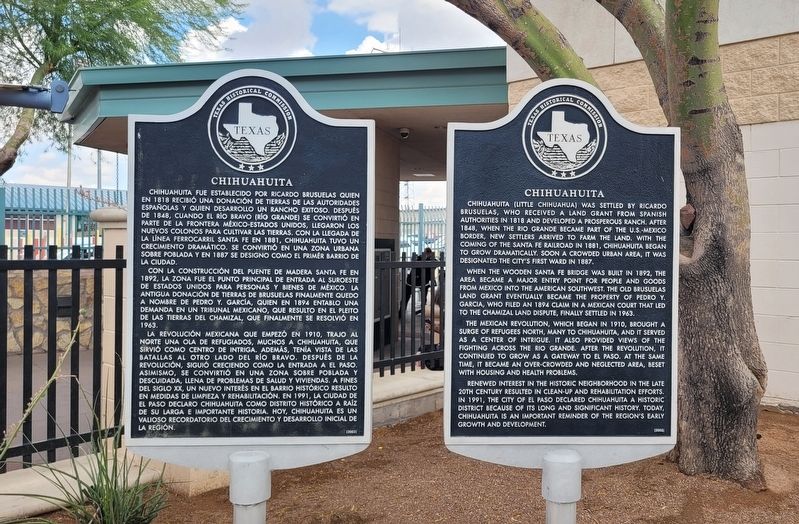
More about this marker. There is a English version of the marker located next to this marker with a different Texas Historical Commission number and year.
Also see . . . Chihuahuita, Texas. Wikipedia
Chihuahuita (or Little Chihuahua) is a neighborhood in El Paso, Texas. It has also been known as the "First Ward." It is considered the oldest neighborhood in the city. It has also suffered through extreme poverty in its history. It is currently on the Most Endangered Historic Places list as compiled by the National Trust for Historic Preservation. It is located on the border of the Rio Grande at the Mexico–United States border. For most of the twentieth century, the name Chihuahuita was used to refer to all of southern El Paso, often including El Segundo Barrio. In 1991, Chihuahuita was designated as a historic district by the city of El Paso.(Submitted on July 28, 2024, by James Hulse of Medina, Texas.)
Credits. This page was last revised on July 28, 2024. It was originally submitted on July 26, 2024, by James Hulse of Medina, Texas. This page has been viewed 196 times since then and 25 times this year. Photos: 1, 2, 3. submitted on July 28, 2024, by James Hulse of Medina, Texas.
