
Delta Township in Eaton County, Michigan — The American Midwest (Great Lakes)
Gossiping Grand
Photographed by Joel Seewald, March 2, 2024
1. Gossiping Grand Marker
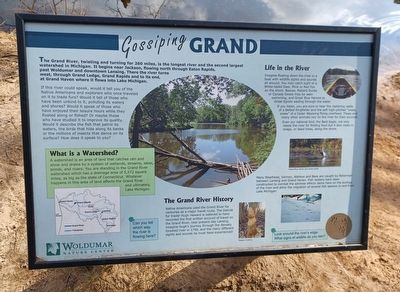
The Grand River, twisting and turning for 260 miles, is the longest river and the second largest watershed in Michigan. It begins near Jackson, flowing north through Eaton Rapids, past Woldumar and downtown Lansing. There the river turns west, through Grand Ledge, Grand Rapids and to its end, at Grand Haven where it flows into Lake Michigan.
If this river could speak, would it tell you of the Native Americans and explorers who once traveled on it to trade furs? Would it tell of those who have been unkind to it, polluting its waters and shores? Would it speak of those who have enjoyed their leisure hours while they floated along or fished? Or maybe those who have studied it to improve its quality. Would it describe the fish that patrol its waters, the birds that hide along its banks or the millions of insects that dance on its surface? How does it speak to you?
What is a Watershed?
A watershed is an area of land that catches rain and snow and drains by a system of wetlands, streams, lakes, ponds, and rivers. You are standing in the Grand River watershed which has a drainage area of 5,572 square miles, as big as
this page online
Life in the River
Imagine floating down the river in a boat with wildlife sights and sounds all around. You may catch sight of a White-tailed Deer, Mink or Red Fox on the shore. Beaver, Mallard Ducks or Canada Geese may be seen swimming, and Great Blue Herons or Great Egrets wading through the water.
If you listen, you are sure to hear the chattering rattle of a Belted Kingfisher and the soft high-pitched "sreee, screee" of a Cedar Waxwing flying overhead. These and many other animals rely on the river for their survival.
Even our national bird, the Bald Eagle, not only needs the river for finding food but it also nests in snags, or dead trees, along the shore.
Many Steelhead, Salmon, Walleye and Bass are caught by fisherman between Lansing and Grand Haven. Fish ladders have been constructed to combat the adverse effects dams have on the ecology of the river and allow the migration of several fish species to and from Lake Michigan.
The Grand River History
Native Americans used the Grand River for centuries
Photographed by Joel Seewald, March 2, 2024
2. Gossiping Grand Marker
Erected by Woldumar Nature Center.
Topics. This historical marker is listed in these topic lists: Environment • Exploration • Indigenous Peoples and Communities. A significant historical year for this entry is 1790.
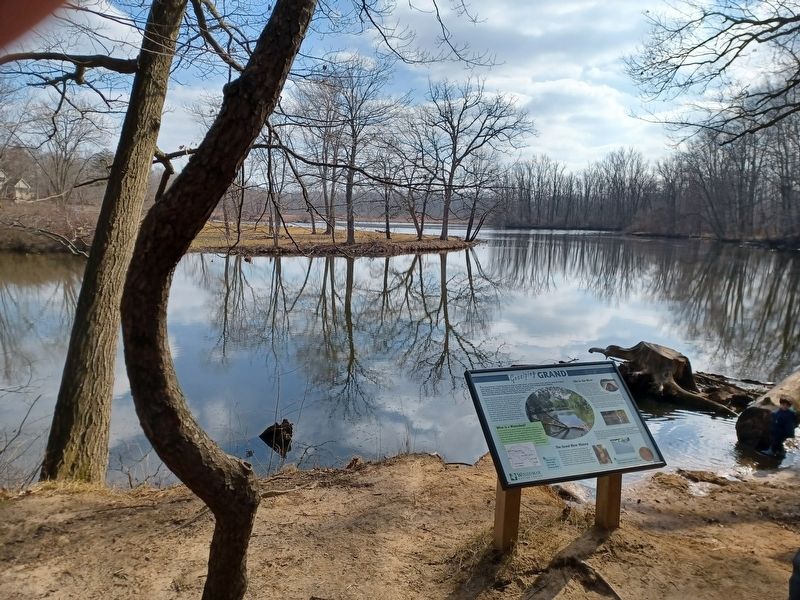
Location. 42° 41.09′ N, 84° 37.89′ W. Marker is in Delta Township, Michigan, in Eaton County. It can be reached from Old Lansing Rd east of Murel Drive. The marker is on the grounds of the Woldumar Nature Center. Touch for map. Marker is at or near this postal address: 5739 Old Lansing Road, Lansing MI 48917, United States of America. Touch for directions.

Regionally, this marker is in Mid-Michigan and in Greater Lansing. It is also in the American Midwest and on the Great Lakes. Globally, it is in North America, the Western Hemisphere, the Western World, and the Anglosphere. Historically, it finds itself in what was once the Northwest Territory.
Other nearby markers. At least 8 other markers are within 3 miles of this marker, measured as the crow flies: The Thought of a Summer Day (approx. 0.4 miles away); The Moon and Olds Family Legacies (approx. 0.4 miles away); The Door of the Past (approx. half a mile away); Trinity A.M.E. Church (approx. 1.9 miles away); First Presbyterian Church (approx. 2.8 miles away); First Presbyterian Church Bell (approx. 2.8 miles away); Rick's Barber Shop (approx. 2.8 miles away); Dimondale Cemetery Vietnam/Korea Memorial (approx. 2.9 miles away). Touch for a list and map of all markers in Delta Township.
Also see . . . Hugh Heward's Journal from Detroit to the Illinios, 1790. Hugh Heward's journal, mentioned on the marker, is Section VI of The John Askin Papers, Volume I: 1747-1795. The book is available through HathiTrust Digital Library. (Submitted on July 29, 2024, by Joel Seewald of Madison Heights, Michigan.)
Credits. This page was last revised on July 29, 2024. It was originally submitted on July 29, 2024, by Joel Seewald of Madison Heights, Michigan. This page has been viewed 118 times since then and 9 times this year. Photos: 1, 2. submitted on July 29, 2024, by Joel Seewald of Madison Heights, Michigan.
